This article was part of FORUM+ vol. 33 no. 2, pp. 64-71
Loud and bright, distorted, unstable. Alternative audiovisual perspectives on Shenzhen’s informal “low-fi” mediascape
Yaohan Zhang, Yujing Ma, Marcel Zaes Sagesser
Shenzhen, in stark contrast with its high-tech narratives, is characterized by a portable infrastructure of distorting megaphones and bright LED screens that form a “street mediascape” both informal and in flux. The artistic researchers and authors of this article investigate how an audiovisual method can produce alternative perspectives to archive – and learn from – Shenzhen’s streets. The project contributes to the methods of creative research between documentary, media arts, and socio-technical urban systems.
In schril contrast met zijn geavanceerde verhalen, wordt Shenzhen gekenmerkt door een draagbare infrastructuur van vervormende megafoons en felle led-schermen die een informeel en dynamisch “medialandschap in de straten” vormen. De artistieke onderzoekers verkennen hoe een audiovisuele methode alternatieve perspectieven kan opleveren om de straten van Shenzhen te archiveren en ervan te leren. Het project draagt bij aan de methoden van creatief onderzoek tussen documentaires, mediakunst en sociaal-technische stedelijke systemen.
Shenzhen’s Minzhi neighbourhood in flux
We sometimes default to thinking of built infrastructure1 and large cities as static complexes – as a sort of scaffolding that carries the dynamic individual and social lives within them.2 In the early summer of 2024, it was the bustling flow of elements, currents, and presences that struck us. In the early evening of a weekday, when the three of us visited the Minzhi neighbourhood of the city of Shenzhen – which feels at once central and peripheral, urban, new and old – we were captivated by what we experienced. The only static entity seemed to be the subway station from which we emerged onto the streets. Everything else felt evasive and fleeting. The sheer number of people – some presumably heading home after work, others pausing to get dinner from a street vendor – dynamically covered up the asphalt and constituted a fabric in flux. Cars, mopeds, scooters, delivery vans and shared bicycles sought their way through the fabric.

Fig. 1: Zhang/Ma/Sagesser, archive composition of circulating devices sourced and cropped from street recordings, 2025, digital composition. All figures in this article are a crucial part of the artistic research conducted: they help readers to understand the involved equipment, the methods used, and how the fieldwork data was produced and creatively interpreted. Together, Figures 1-5 reveal Minzhi’s diverse mediascape that is brought about as a result of the local informal economy. Fig. 1 details the collection of selected sonic-visual ephemera resulting from the audiovisual research in Minzhi’s mediascape. It is composed of cropped video stills and photographs from technical devices that are moving, or “flowing around” and are used by street vendors, in Shenzhen’s Minzhi neighbourhood. As objects detached from their environmental background, they become visual signifiers that emphasize their symbolic and fragmental nature when they are viewed out of context and out of scale.
Vending stalls formed obstacles, targets, and traffic participants themselves, with the result that the streets turned fluid and flexible: the paths that vehicles took changed from minute to minute, as if the street was literally moving from one side to the other. The surrounding buildings endorsed the fluidity: their entranceways, stairwells, and street patios alternatingly served to accommodate vendors, to house a few foldable camping chairs for people to sit and eat, or as temporary refuges. Streets, buildings, and traffic were continuously shifting to ever new grounds.
We started filming and recording. In the lab, we would then review and listen back to the footage; and we started to experiment with the ways in which we looked at the growing archive. We wondered: when we listen to, and view, the street mediascape of a neighbourhood through audiovisual collages made primarily from camera and microphone footage, what does the material tell us? Our creative research project “Flowing Sound” builds on, analyses, and interprets an audiovisual collection of Minzhi’s streets.
“Flowing Sound” is an ongoing creative inquiry, mainly targeting an artistic and academic audience, as well as the local public. Artistic results have been shown in one community-based street performance, two arts workshops and one group exhibition at, or organized by, the Pingshan Art Museum of Shenzhen (2024-25). A short documentary film showing our street performance was screened at an arts gallery in Macao (2025). An academic paper with sound and video snippets was presented at the Besides the Screen conference in Ningbo (2025). Future expected artistic outcomes are a digital archive of the street mediascape, as well as scenes with 3D models of collected street devices made digitally accessible, and potential exhibitions.
In this article we present a completed methodological reflection on an ongoing project, which we hope sheds light on the role of audiovisual, technologically mediated perspectives, and inspires others. As three artistic researchers who, for a year, all lived in Shenzhen (though none of us are from there), and guided by our approach through audiovisual documentary technology, we set out to create a set of “alternative” perspectives on Minzhi’s street mediascape. We chose Minzhi as the site for our fieldwork since it is very central and not far from the university where we all used to work.
As intruders, the sole approach we can take is to find creative methodological solutions to how we can render the observed street mediascape accessible.
Moreover, Minzhi is the neighbourhood in which we observed the most “flowing” circulation of the sound and light devices that we were interested in. Here we mean that the perspectives we developed challenge conventions of documentary work, that they encompass collage-based methodological experimenting, or that they (even if they do not dismantle hierarchies during fieldwork) at least reconsider roles and ensure that cameras and microphones are carried not only by us as researchers but also by others.
The following sections each present a perspective through a different audiovisual, theoretical, or description-based lens. They are far from forming a complete whole, and they exist in no particular order – yet together, they give novel insights into the streets of Minzhi and their mediascape. None of these perspectives are neutral; they were continually shaped by us as researchers while they kept shaping our senses concurrently, helping us understand the relationship between practice-based methods and the street mediascape.
As intruders, the sole approach we can take is to find creative methodological solutions to how we can render the observed street mediascape accessible. While our perspectives are inspired by auteur work and collective modes of production3 , we methodologically understand it as blending multisensory audiovisual ethnography, with the cinematic methods described, and with artistic practices rooted in digital media that conduct situated and relational work with a site or a community.
As our constructed perspectives prove insufficient to reveal socio-political knowledge of what we observed – given the complexity of the system and our method’s inadequacy – what remains is a work on a material-sensorial level, centring around the mediated nature of both Minzhi’s mediascape and our audiovisual tools.
Sound loops, mediation, urban migration: The informal economy of Minzhi
What we witnessed in Shenzhen’s Minzhi neighbourhood was the dynamism of an “informal economy”, an “economic reality” defined by the American scholar and social worker Martha Alter Chen as the “large share of the global workforce that contributes significantly to the global economy, while remaining outside the protection and regulation of the state”. It includes those who work in the streets and open air: pedlars, delivery people, or vendors.4 The circulation of physical, visual, olfactory, and aural materials included immediate sonic and visual signals to attract customers, alongside recorded voice announcements, loudspeaker music, and screen-based visual messages. A woman held a hammer and a piece of curved metal in her hands, and by hitting them against each other, produced a loud, rhythmic sound. Over her shoulder she was carrying a tray, upon which she had a plastic bucket displaying candy to the customers, with a cardboard sign saying in red paint “barley sugar” in Chinese. Other vendors carried megaphones with repeating four-second loops announcing the market price of coconuts, noodle soups, iPhone covers; or they carried small, bright LED panels attached to trays and stalls, showing the “on sale” items in rainbow-coloured low-resolution pixel matrices that repeated every few seconds. The lively chatter in the streets and the urban evening soundscape of car and metro noise was contrasted with a layer of asynchronous, repeating loudspeaker voices and loudspeaker music that was loud and on the brink of technical distortion.
What are these mediated “low-tech” sounds and visuals and how do they participate in the urban ecology of Minzhi? How can we stretch and sharpen our tools to document the sonic-visual low-tech noise of Minzhi?
Mediated content blended naturally with unmediated materials and became a part of Minzhi’s “urban ecology” of the early summer evening. Ash Amin and Nigel Thrift, known for their progressive and holistic way of urban thinking, remind us that cities are far from static and need to be read as “living ecologies” made of a range of entities being circulated, including signs, objects, and technologies.5 The megaphones, speakers, and LED signs, including their aural and visual messages, co-constituted the dynamic flux in this urban ecology that we characterize as an informal economy.
We characterize these technologies as “low-tech”, meaning that they are mostly cheap, simple, made of plastics, weather-proof, portable, battery-driven sturdy devices that resist the shocks and bumps they are subjected to. They also both reflect and stand in stark contrast to what Shenzhen, as a pilot city, has become known for: the manufacturing site of phones and computers, car batteries and cars – in short, that which is normally subsumed as “high-tech”. The devices in Minzhi emit a layer of sound and visuals that we therefore refer to as visual and sonic “low-tech noise”, a mediated layer of signals emitted from “flowing” street media devices that are easily missed and yet dominate the scene. There is a risk of aestheticizing (and thus romanticizing) the audiovisual noise of the flowing street media with their saturated colours and shrill voices – instead we draw attention to how loud, bright, and far from comforting these devices really are. Participants in the informal economy are potentially subjected to this powerful audiovisual noise for many hours a day.
Minzhi is one of the so-called “urban villages” – a political structure and organizational unit enclosed by the formal city of Shenzhen. It is a large residential community, built on older infrastructure, buildings that are densely packed, with tiny alleyways in between.6 Minzhi historically takes in large numbers of migrant workers from other provinces throughout China. Hong Kong-based scholar Him Chung, working on rural transformation in China, theorizes urban villages as “fragmented landscape between the old and the new”.7 Urban villages in South China gained scholarly interest in the 2010s, following China’s mass urbanization. Chung argues that these areas of settlement are commonly recognized as migrant-absorbing enclaves that are gradually losing their farmlands. Anthropologist and global studies scholar Jonathan Bach discusses urban villages in Shenzhen specifically, and adds reflections on the connection between urban villages and the social progress framework. He describes Shenzhen’s urban villages as sheltering places that hold dreams of success for those marginalized from high-speed economic and technological growth.8 Minzhi falls into categories as defined by Chung and Bach – a neighbourhood left out of the prosperous appearance constructed with and under the vision of grand urbanization and globalization. When large numbers of rural residents migrate to urban centres attracted by higher-income opportunities, yet the formal employment sector cannot absorb them, the informal economy becomes a refuge, making them into low-income urban groups. They sustain their livelihoods through informal employment, using it as a buffer against unemployment, as discussed by Chinese urban economics researcher Pang Juan in her work on the complex governance of informal economies, including those of street vendors.9 Minzhi is a particular site as an urban village, as well as an area where street vendors densely gather in a central district of Shenzhen. China’s high-tech narratives, urban migration, and the informal economy are connected with the four-second loops of distorted voices and repeating text phrases on saturated LED screens that we witnessed.
Alternative audiovisual practices
We circulated Minzhi’s streets, as visitors with open ears and eyes, with audiovisual recording technologies – cameras and microphones, prepared to attend to a found phenomenon predominantly characterized by audiovisual playback technologies – megaphones and LED screens. This relation between the recorded and the recorder motivated us to think through methods rooted – as we ourselves are – in documentary, in media arts, and in audiovisual scholarly forms of inquiry relating to social and urban systems. What are these mediated “low-tech” sounds and visuals and how do they participate in the urban ecology of Minzhi? How can we stretch and sharpen our tools to document the sonic-visual low-tech noise of Minzhi? How must our tools and methods attend to what is loud and bright, distorted and unstable? Or, the other way around and following moving image artist and writer Morgan Quaintance’s writing about Jia Zhangke’s 1997 film Xiao Wu: “Noise […] is filled with information”:10 if we listen to and look carefully at the noise, what will we find?
We understand “alternative” as pointing in several directions; as breaking with established perspectives, such as the perfectly polished, downward-looking views of urban life circulated by government agencies; but also as challenging some of the conventions that accompany audiovisual content production in their respective contexts. As an aesthetic choice, it becomes our methodological commitment, and ultimately epistemologically produces something new. “Alternative” has a long standing within media production.
Media activist and scholar Kate Coyer, documentary producer Tony Dowmunt, and film and television producer Alan Fountain, for example, define “alternative media” as those outlets – zines, pirate radio, online blogs – that are independently run and community-focused.11 We aim to challenge official, top-down representations of Shenzhen through the city’s official outlets in media, advertising, and web presences with their grand narratives of a perfected urban life, where camera angles will often look down from a bird’s-eye view.12 We also aim to utilize technical tools that are low-cost and at times low-quality: cheap consumer gear that breaks with the cinematographic aesthetics of the expensive cameras used in many commercial productions.13
Observing the dynamic flow of small media devices in Minzhi through our simple consumer cameras, we realized that our recorders needed to move with that flow.
Our alternative perspectives are inspired by feminist scholar Donna Haraway, in Situated Knowledges, where she argues that “the knowing self is partial in all its guises, never finished, whole, simply there and original; it is always constructed and stitched together imperfectly, and therefore able to join with another, to see together without claiming to be another”.14 An alternative perspective we thus understand as a perspective that is partial, that does not insist upon representing any entirety, which ultimately resembles a feminist modality of knowing.
Haraway’s call for the partial contrasts with the idea of a filmic perspective that “centres everything on the eye of the beholder.”15 “Perspective” not only refers to the conventional ways of seeing shaped through a socially constructed context, but also refers to framing reality through a mechanical eye – the camera.16 Technical qualities, such as depth of field, camera angle, placement of the camera, events and objects on and off camera, can all be interpreted as the externalization of perspective.
In Chinese independent cinema of the 2000s, a period in which urban migration became a great concern, filmmakers increasingly adopted an egalitarian, participatory way of working, devoid of a single authoritative perspective, while they explored migrant workers in urban villages. This novel direction in art and cinema was related to the massive migration from rural to urban regions around the millennium.17 The national distribution of resources resulted in the decline of economic and cultural activities in small-to-medium-sized cities and the countryside, leaving people to migrate to the regions of major development – such as Shenzhen.
Beyond China, sound scholar Jaime O. Bofill Calero and documentary filmmaker Michael Brims’s Sounds of Street Vendors, Havana, Cuba18 develops a multimodal approach to marginal sonic economies. French-Moroccan multidisciplinary artist Bouchra Khalili’s The Mapping Journey Project19 employs mixed and audiovisual media to trace forced migration workers but protects their anonymity. Musician Xabier Erkizia and sound artist Luca Rullo’s Soinumapa20 renders the Basque country audible through user-generated recordings uploaded to a web map. Sound explorer Taina Riikonen’s binaural recordings from Helsinki’s subway tunnels during the pandemic evoke memory and emotions.21 All these positions contribute to experimental methods and offer alternative perspectives. Our project originated from this context.
A media archive of cropped street mediascapes
A mediascape has often come to signify the assemblage of different media through which users consume content and through which individuals, corporations, and states represent themselves; the umbrella term often reflects and “explores who ‘owns’ and manages representation”.22 Indian-American anthropologist Arjun Appadurai’s seminal critique of globalization as a “cultural homogenization”23 defines mediascape as “landscapes of images”, referring “both to the electronic capabilities to produce and disseminate information, […] and to the images of the world created by these media”.24 In Minzhi, the issue at stake is not primarily global, and media is not consumed asynchronously by a high number of global users. Instead, we are facing a “street mediascape”, in which street users receive information immediately from the LED screens and megaphones. Information is circulated locally from dispersed and independently organized point-sources that are constantly blinking or repeating content.
As Haraway reminds us, there is a “serious danger of romanticizing and/or appropriating the vision of the less powerful while claiming to see from their positions”.25 It is easy to idealize street media devices for their sheer volume, glossy colours, “blinky-ness” and animation effects. Here, the idealization implies, to some extent, the inevitable or unintentional selection and exclusion; the conflict between glorification and neglect in practice; the construction of an incomplete and partial archive. The vendors’ technologies represent imperfection26 and privatization, defined by flexibility, easy access, and mobility in conveying information to large amounts of potential customers. The vendors’ business is never fixed; relocation becomes the default.
One of the perspectives we produced was thus a media archive of “audiovisual street devices”: we filmed and photographed anything that contributes to disseminating mediated sounds or communicates visuals to the public: megaphones, LED screens, carts, mopeds, trays, cardboard price tags, and so on. Their original sizes in relation to one another were neglected and they entered the archive at the size they were captured by the camera, thus ultimately depending on camera positioning and zoom factor. We curate the archive and define what counts as an “audiovisual street device” ourselves. At the lab, hours of footage were then reviewed, and “devices” under our own non-standard definition were cut out and labelled. As seen in Figure 1, a low-fi (as in low-resolution, ill-lit, unordered) archive of the street mediascape emerged.
Views from the tray: Non-standard camera angles
Observing the dynamic flow of small media devices in Minzhi through our simple consumer cameras, we realized that our recorders needed to move with that flow. Given our interests in filmmaking, sound, and participatory arts practices, we proposed that participants in the informal economy – not us – might carry our devices with them, following others who have used “distributed-production” methods before.27 We discussed our idea with street vendors in an open dialogue.
On 24 July 2024, in Minzhi, a woman selling candy and a man selling coconuts agreed to participate.28 The candy vendor agreed after initial hesitations. We told her that we were from the Southern University of Science and Technology and that we would use the footage for research and exhibitions. We approached the coconut vendor on the street and he agreed right away. He got enthusiastic about participating especially when he saw our cameras, expecting to receive attention. He also asked us if he could pose with us and use these shots in his own business promotions on social media. The idea of being photographed and published, in China, might have a different cultural standing than elsewhere; people usually react positively, whether the outlet is governmental, commercial, or private. So we agreed to share the pictures of our research. For ethical reasons, however, we decided not to publish any recognizable vendors or people in general in our materials.
Both vendors consented in their local language. We had asked them whether they would carry a sports camera, a small audio recorder, and a GPS tracker for several hours on their vending stalls, while they moved through Minzhi, following their respective businesses. Several conversations with them helped to build trust; and luckily, one of us spoke the candy vendor’s language, which was not Mandarin but a local dialect of Chongqing, from where the woman had immigrated to Shenzhen (she did not tell us when). We exchanged WeChat contacts, a common app in China through which vendors and shop owners often stay in closer touch with customers and send out sales announcements. Having her WeChat contact enabled us to find her at various locations over the next few days and weeks.
We discussed with both vendors how to fit their vending carts with our devices, consisting of:
- (1) a sound recorder mounted on the vendor’s tray that circulated the neighbourhood, sampling the detailed sounds and sonic textures that happened in the process of moving, advertising, and selling, while the microphones also captured the environmental soundscape around the tray;
- (2) a sports camera also fixed to the tray and pointed slightly upwards to the sky, showing both the surroundings in the street and the tops of the high-rise buildings around the neighbourhood, or downwards, focusing on asphalt and nearby carts; and
- (3) a GPS tracker recording the precise position and route of the vendor, as well as the alternation between motion and standing. With this method, our recording equipment took on the peculiar perspective of a vending stall (Figure 2).
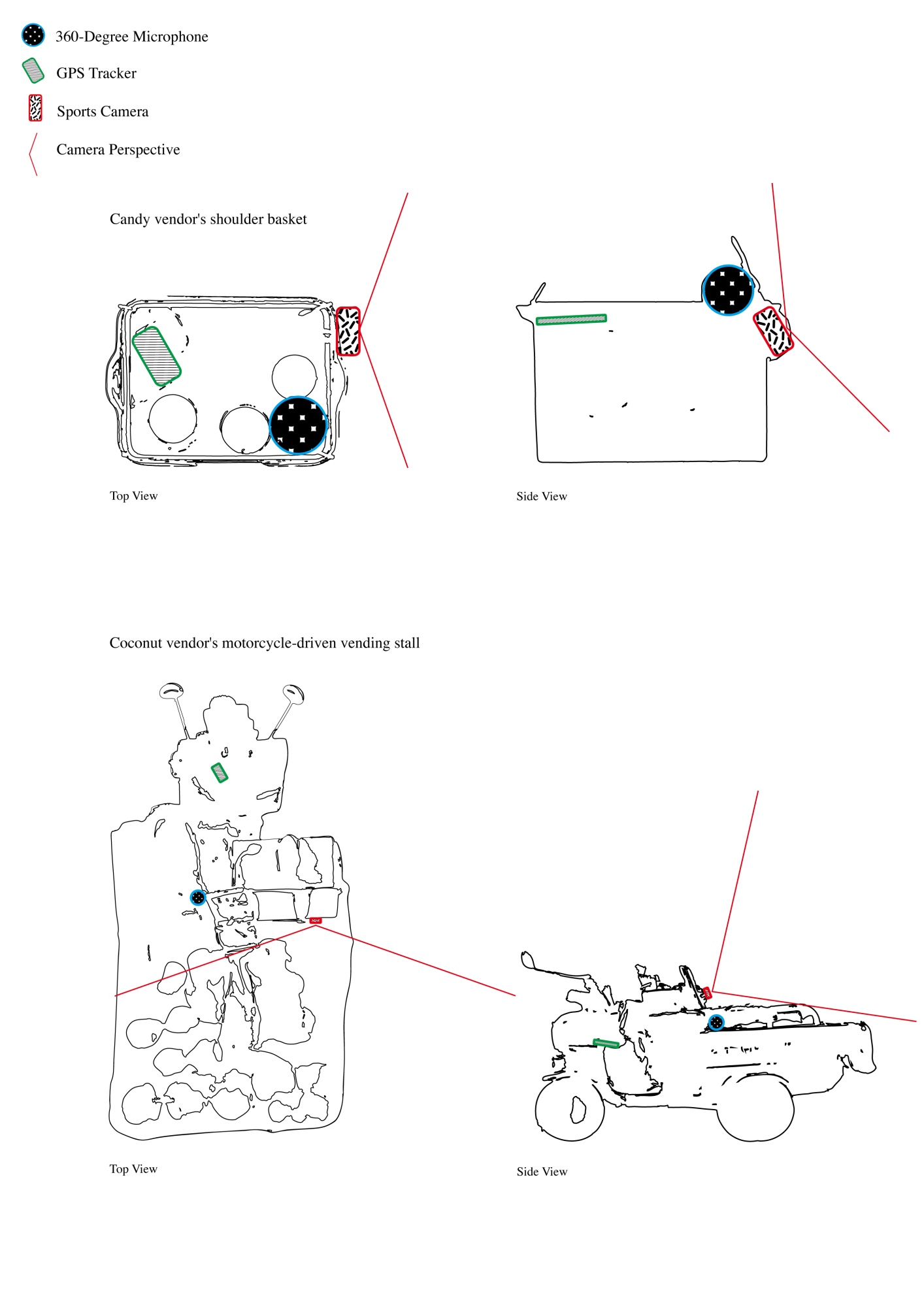
Fig. 2: Zhang/Ma/Sagesser, illustration of fieldwork equipment setup and camera angles, 2025, digital illustration. In the process of audiovisual fieldwork, the artists have come to document the exact positioning of their recording devices on the vendors’ mobile stalls. The abstracted line drawings, based on photographic documentation, help convey what types of recorders were used, where they were pointing, the ways they were used and moved, and their potential relationships and interactions with the vendors and customers in the street.
Working with informal workers and documenting the complex urban scene has brought many challenges in ethical considerations, especially with the setup mentioned above. Obtaining informed consent from every passer-by in a public space is impossible; we therefore focused on obtaining consent from the vendors. However, we acknowledge that the presence of cameras, in our hands or on the vendors’ carts, might have affected public life in Minzhi. As intruders from an academic institution “in the field”, we initiated this project based on our research interests. Mexican ethnographic filmmaker and researcher Klearjos Eduardo Papanicolaou asks: who is it that tells the story, and “whose truth” do we get to hear?29 It is ours.
Yet our methodological approach is to go beyond an ethnographic study towards a multisensorial mapping of a complex space, surpassing oral history or personal accounts through interviews. Offering experiential readings through audiovisual material rather than focusing on individuals, we follow Papanicolaou, when he writes that it is “not only [about] what people do and say” but “the whole set of relations in a time and place that produce those behaviors”, so as to “recalibrat[e] the ideological calculus behind [our] photographic and film images, if only slightly”.30
With our devices “that can be mounted almost anywhere”,31 we asked the vendors to document their space of the informal economy with our equipment, justified by compensating them with 200 Chinese Yuan for their potential business loss, and by an attempt at understanding the cultural practices that shape their everyday lives, rather than putting them on the spot. For the footage captured, we focused on the flowing sonic and visual perceptions (the media objects and devices) in the environment. Documenting the faces of different people in the space was not within the scope of our expected results. When selecting footage for publications, we were careful not to reveal any individuals’ identities. For the fieldwork, we received formal IRB approval from our then-institution, SUSTech Shenzhen. The ethical review stated that we would conduct, with participants, 1) interviews; 2) video recordings/photo documentation; and 3) sound recordings.
Our method requires situated interactions with participants in the informal economy, a modality that we call situational participation. This means we explore the fieldwork location without setting up exact plans or prompts in preproduction. Rather, we ask participants to take our equipment on the routes that they would follow anyway. This mode is influenced by the participatory and observational methods used in documentaries32 and audiovisual ethnographic projects, for example in visual anthropologist Sanderien Verstappen and digital culture scholar Sarah R. Davies’s work that considers filmic inquiry a “world-making project”.33 Linking back to Haraway’s “Situated Knowledges”, the method involves the construction of a production network with authors (ourselves) and participants (the participating vendors), so that the knowledge produced is “about communities, not about isolated individuals”.34
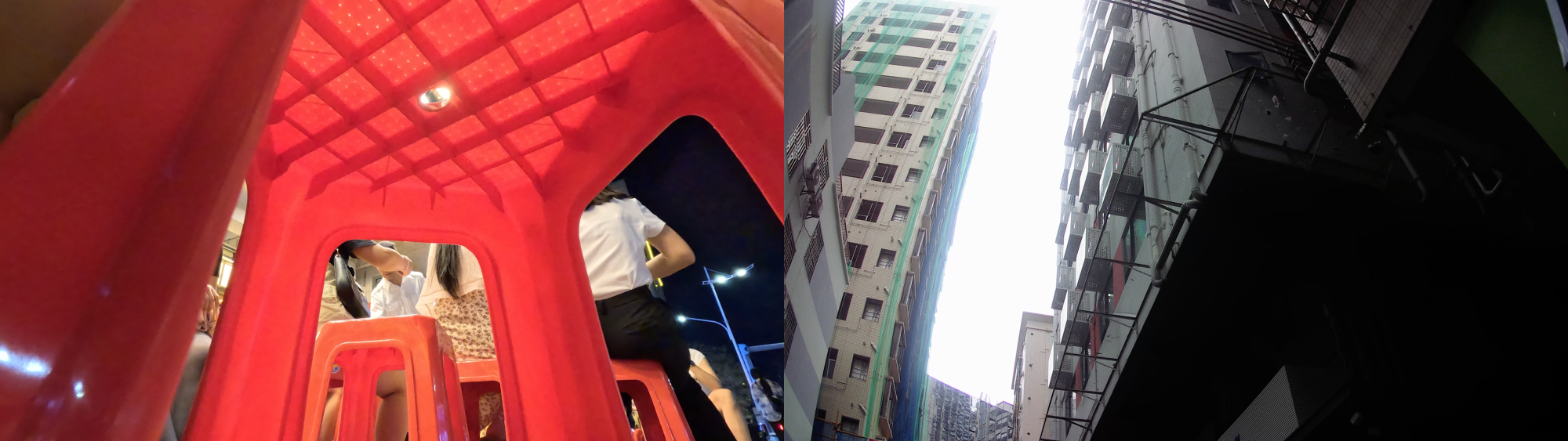
Fig. 3: Zhang/Ma/Sagesser, “From Underneath”, two video stills from GoPro street footage taken from a vendor’s shoulder basket, 2024, video frames. Photographed by participating street vendors and consented to Zhang/Ma/Sagesser for use. Viewed alongside Fig. 2, these frames show what the audiovisual fieldwork cameras mounted on vending stalls were seeing, and what potential relationships these cameras constituted with the passers-by in the street. The frames reveal how human bodies, mobile objects, the built infrastructure, and the larger environment formed an ephemeral situation.
Having vendors as camera carriers enabled us to create unusual and otherwise inaccessible perspectives. But, importantly, they are neither “our” nor “their” perspectives – the vendors agreed to carry our recording equipment, yet they did not operate the cameras, nor did they see what the cameras were filming. They pursued their business activities while our recorders captured what unfolded around them. The coconut vendor, driving a motorcycle-based cart, had a megaphone with a pre-recorded advertising sentence, a foam board with price tags on the side, and a portable LED light hung at the top of a metal bar fixed to the cart. The candy vendor carried a paper board inscribed with red paint. Ultimately, their advertising media equipment was informing our recording equipment.
The resulting views show fragmentary scenes from a continuous feed of street elements and the (quite low) perspective of the vending tray (Figure 3). Our goal was to capture as much of the street and its mediascape as possible. Our recorders became part of the infrastructure of Minzhi on that evening – and in line with Brian Larkin’s thinking, this infrastructure forms a dynamic, techno-political system.35
Timelines and collages: Looking through technologies
As we view the media collected, we switch on several streams, cameras, microphones, and look at GPS routes on a screen. In so doing, we produce – for ourselves, in the absence of an audience – a multi-dimensional view of Shenzhen’s Minzhi. Numerous details emerge from the street mediascape that would often go unseen or unheard; from those devices that participate in disseminating mediated sounds and visuals to the public. Loud and distorted, they are also soft and masked by the loud environmental sounds. The upturned camera on the coconut vendor’s cart shows a wiggly and at times blurred urban landscape behind the vendor; the camera on the candy vendor’s basket is particularly unstable and unusual – looking down onto the street, rotating and shaking as the woman walks, with the lens constantly scanning people’s legs and cars’ wheels.
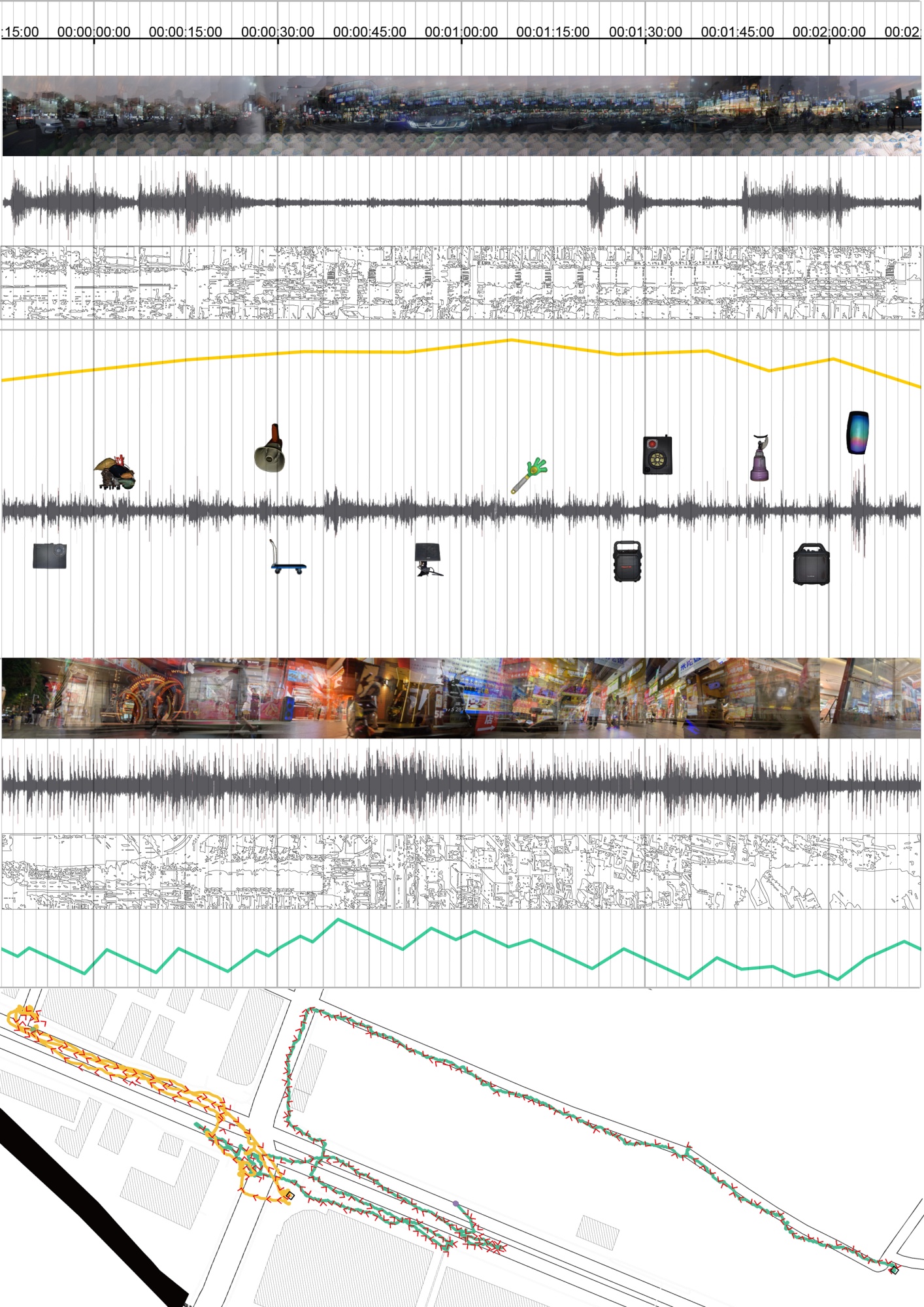
Fig. 4: Zhang/Ma/Sagesser, collage with timeline, representations of collected devices and footage, and map of Minzhi with GPS routes of participating street vendors showing camera angles, digital composition with elements from QGIS, 2025. The artists attempted, with this visual timeline, to represent a fieldwork period of two minutes in a collage. The collage is made of keyframes from camera recordings, waveforms from audio recorders, a folded GPS path, a GPS map, simplified line drawings of the buildings passed along the GPS route, and manually added icons to show what sounds can be identified from the overall soundscape. The collage’s goal is to juxtapose the various media, forms and data sources in the audiovisual fieldwork. The accuracy of an actual synchrony between the events presented remains low and suggestive, as much of the data is qualitative. The collage suggests how “flowing” objects together form a mediascape that is in flux and can never be captured in full.
These unconventional perspectives reveal a side of Shenzhen’s great contrasts, opposing the solid, stable, orderly, high-technological. The footage no longer only shows our own perspectives as intruders and observers; it now shows vendor tray-enabled perspectives. We accepted the captured footage as it was. We then sought ways to render it accessible and move beyond romanticization of the street and the hard everyday labour conducted by its participants. Departing from a scientific interpretation, we were interested in a critical 'un-interpretation'. We prioritized blurred content over clarity, collages over single pictures, timeline still series over static materials, dynamic environmental contexts over individual situations. Furthermore, we chose to consciously obscure and leave out materials when they depicted recognizable individuals.
With the methods developed, by continuously re-viewing and re-listening to the Minzhi streets of 24 July, we constructed timelines and map-based graphical representations, which provide us with the flexibility to recombine the elements recorded. Creating connections between that which otherwise remains unconnected became our task. Moving images were turned into series of stills, and motion was roughly mapped out. Creating such collages is one way of rendering collected information in an alternative perspective, in a frame held on a piece of paper.
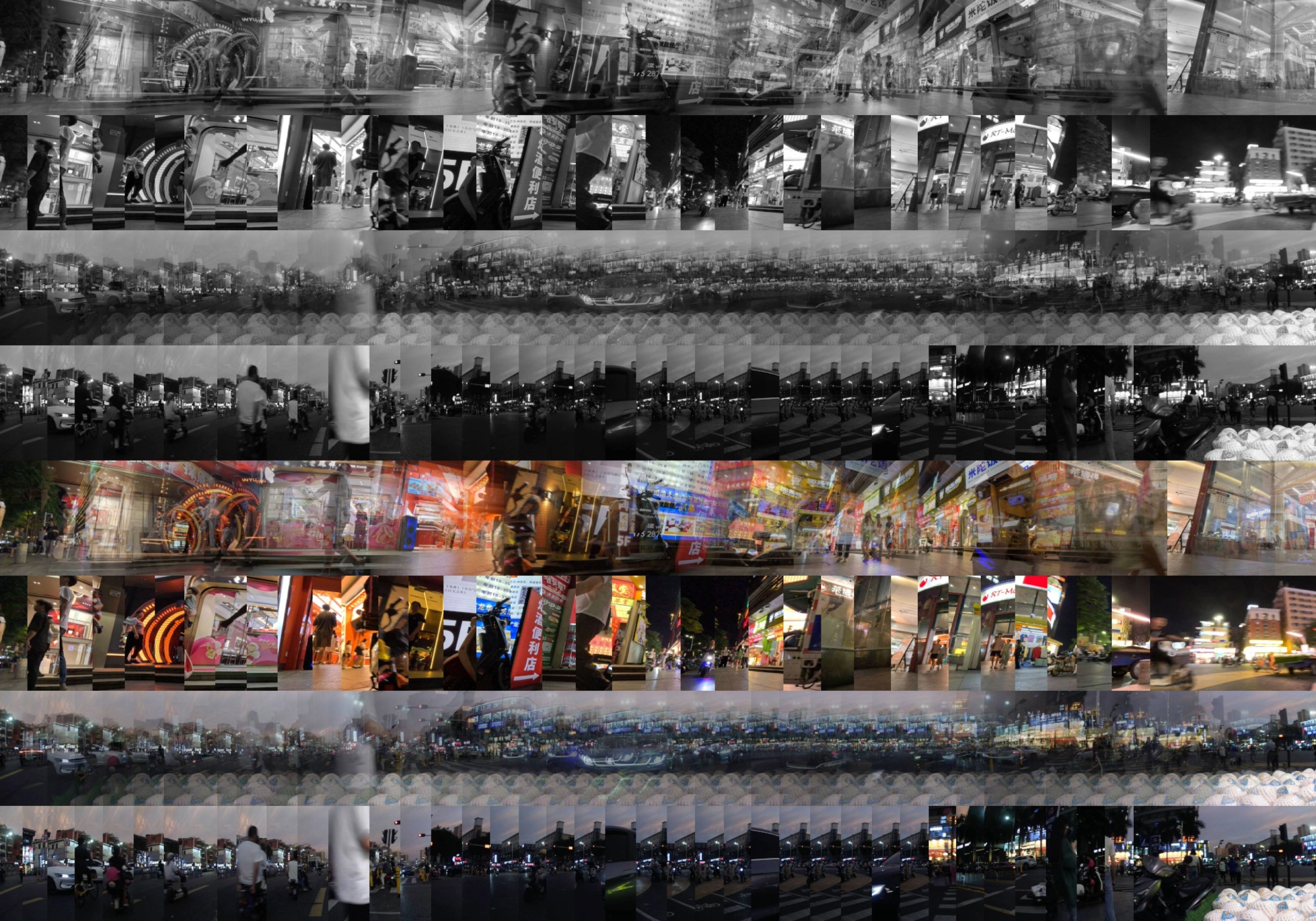
Fig. 5: Zhang/Ma/Sagesser, timeline composition of Minzhi’s informal street mediascape, 2025, digital composition based on GoPro stills taken on the coconut vendor’s cart and the candy vendor’s shoulder basket. The image shows a handmade collage. Stills from vendor-driven camera footage were selected by us to present roughly similar time intervals between the frames. They were arranged on a timeline over several rows. The criteria for assembly were few: primarily to use material that is anonymous and shows the dynamic infrastructure of Minzhi’s evening. Colour processing was introduced to observe how our technical methods would change the information in the collage (lines 1 and 5 are identical, once in greyscale, and once in colour). The colour version adds what is characteristic for the street mediascape: the bright and saturated colours of LED screens, light boxes, reflected lights, and so on. The revealed “knowledge” is partial and incomplete. The collage proves to be a sort of colour dictionary of Minzhi’s urban ecology specific to that one night. It also shows a contrast between movement (much change between the frames) and more static moments (less change between frames). We call this collage a timeline composition of Minzhi’s street views captured by vendor-enabled camera perspectives.
Wrapping up: Aligning tools
The loosely connected alternative perspectives presented in this piece show at once Shenzhen’s Minzhi, and a completed creative method to attend to Minzhi’s dynamic sound and screen devices that circulate as part of an informal economy. Our work “Flowing Sound” contributes to rethinking and recombining methods from documentary, from media arts, and from technology-informed multisensory work, deviating from much other work by generating dynamic, “blurred” collages and by aligning our recording technology towards the technologies used by participants on the site. We developed partially new creative methods to map complex informal urban mediascapes. This open-ended account shows a part of Shenzhen that exists in contrast to top-down grand narratives of high-tech development.
We walked through Shenzhen as guests, observing intruders. While all of us had experienced street vendors and informal economies in other places, we were all struck by the way in which Shenzhen’s street activities stand in stark contrast with the glossy, spacious office parks in the city’s several centres, with their large green areas and urban redevelopment aesthetic. In the centre, we see increasing efforts to create a so-called “smart city” that is networked, digitized, digital-looking, and online at all times.
Technology means something completely different at the edge: a mediascape made from low-tech gear that is overly loud and bright on the participants in the informal economy who are subjected to them for hours, if not days in a row, working under difficult labour conditions. Sociologists Li Qiang and Tang Zhuang have described the structural discrimination vendors and other informal workers faced in the early 2000s: the work they do is dismissed as inefficient, serving merely to relieve poverty.36 The technologies of saturation and distortion, that interest us because of our unfamiliarity with them, have consequences for those in the street. These are their means for visibility and attention, given the lack of availability of formalized advertising channels and official protection. For nearby residents and passers-by, the amplified sounds and bright screens are even more intrusive and inescapable.
As artistic researchers, we are interested in aligning our technical tools for fieldwork with the ones used by participants in the informal economy to advertise their produce and entertain their customers. This approach holds more potential for future work and has methodological significance. Refraining from romanticization and acknowledging our outsider viewpoints, we believe that this alignment enables us to focus on the technologies themselves; which are characteristic of Minzhi and dominate the senses of many – at least to our own ears and eyes, the low-tech street mediascape becomes part of the dynamic urban infrastructure.
The alignment also has consequences in our writing: we align the structural logic of our reflection with the production of a set of loosely connected collaged perspectives that each present the same Minzhi in a different way. Our audiovisual perspectives, then, do not just give us multiple fragmentary insights into Minzhi, they also let us experience how mediating technologies as street infrastructure are a constitutional part of this particular part of Shenzhen. Content and method relate to each other through their material and technological realities.
Acknowledgements
This project was shaped by our shared time in Shenzhen while working at the Southern University of Science and Technology, School of Design, and it was funded by the university. Our gratitude goes first and foremost to the street vendors we met during fieldwork around Shenzhen; we thank them for their time and commitment. In addition, the research team of the Sound Studies Group at the university was instrumental in supporting fieldwork, research, and the production of several workshops and a large-scale exhibition: Xiaoyao Ma, Sihui Li, Ziye Chen, and Zhaorui Liu, as well as the interns at our research group, Yeqi Shen and Yuning Zhang from the Shenzhen Technology University SZTU. Much would not have been possible without Fancy Jing Luo from the Pingshan Art Museum (PAM) in Shenzhen; thank you for supporting the project throughout fieldwork and its exhibition at PAM.
+++
Yaohan Zhang (she/her)
is an interdisciplinary artist and researcher. She focuses on body politics, materiality, informal economic labour, and marginalized cultural communities and remains at the urban peripheries.
Yujing Ma (she/her)
is a filmmaker, video artist, and artistic researcher, currently at Queen’s University, Canada. Her work explores the in-betweenness of perspectives between reality and fiction, with an interest in mass urbanization, ephemerality, and the unseen, as conveyed through fragmented media.
Marcel Zaes Sagesser (he/him)
is an artist and researcher investigating how humans are increasingly intertwined with their technologies, focusing on the material qualities of sonic media in social environments. He currently lives in Vienna and teaches at the University of Applied Sciences St Pölten.
Footnotes
- Larkin, Brian. “The Politics and Poetics of Infrastructure”. Annual Review of Anthropology, vol. 42, 2013, pp. 328, 332. Larkin explains infrastructure as a dynamic system, a network far from fixed that quintessentially enables the flow of goods, of people, of ideas – but in our case, that would also include the flow of street technologies and media artefacts. Larkin links in the concept of “technopolitics” to show how the infrastructure of the city needs to be understood as a dynamic system built on technological and political aspects. Ultimately, he shows how material has consequences for political and cultural “goods” that circulate, and we believe that it is exactly this intersection between a materiality and broadcast content that characterizes the mediascape of the street. ↩
- Lefebvre, Henri. The Production of Space. Translated by Donald Nicholson-Smith. Blackwell, 2017. Henri Lefebvre distinguishes between spatial practices and representational spaces so as to emphasize how social forms of life constantly reinterpret and at times challenge built forms of environments. ↩
- The term “auteur work” details how cinema directors express their personalities and apply their “personal styles” through control over techniques; see Thompson, Kristin and David Bordwell. Film History: An Introduction. McGraw-Hill, 2003, pp. 416, 559. “Auteur” was first coined by the French filmmaker and actor François Truffaut in the 1950s; see Truffaut, François. A Certain Tendency of the French Cinema. new wave film.com, 2008-25, newwavefilm.com/about/a-certain-tendency-of-french-cinema-truffaut.shtml. Accessed 29 June 2025. This work was originally published in Cahiers du cinéma, 1954. ↩
- Chen, Martha Alter. The Informal Economy: Definitions, Theories and Policies. WIEGO, 2012, p. 4. ↩
- Amin, Ash, and Nigel Thrift. Cities: Reimagining the Urban. Cambridge: Polity, 2002, p. 30. ↩
- Wang, Ruyuan. 深圳特区城中村研究 (Urban Villages Studies in the Shenzhen’s Special Economic Zone). 成都:西南交通大学出版社 (Chengdu: Southwest Jiaotong University Press), 2004. p. 57, translated from Chinese. ↩
- Chung, Him. “Building an Image of Villages-in-the-City: A Clarification of China’s Distinct Urban Spaces”. International Journal of Urban and Regional Research, vol. 34, no. 2, 2010, p. 421. ↩
- Bach, Jonathan. “Shenzhen: City of Suspended Possibility”. International Journal of Urban and Regional Research, vol. 35, no. 2, 2011, p. 414. ↩
- Pang, Juan. “城市非正规性治理反思、空间转向及策略选择” (“Reflections on Urban Informality Governance, Spatial Shifts, and Strategic Choices”). 学术界 (Academics), no. 3, 2019, p. 116, translated from Chinese. ↩
- Quaintance, Morgan. “汾阳的喧嚣: Ironic Resonance, Anti-sound Design and Radical Cacophony in Jia Zhangke’s 小 Xiao 武 Wu (2024)”. Morgan Quaintance, 2024, morganquaintance.com/2024/03/07/ironic-resonance-anti-sound-design-and-radical-cacophony-in-jia-zhangkes-xiao-wu. Accessed 2 Feb. 2026. ↩
- Coyer, Kate et al. The Alternative Media Handbook. Routledge, 2007, p. 3. ↩
- See, for example, sz.gov.cn/index.html, accessed in July 2025, which had a glossy blue-sky panorama photo of the glass towers in the city centre on its landing page – probably shot with a drone, and showing little or no pedestrians or traffic. ↩
- Papanicolaou, Klearjos Eduardo. “Mirror Image: Cinematic and Sensory Ethnography for Landscape and Urban Studies”. Research Otherwise: Pluriversal Methodologies for Landscape and Urban Studies, edited by Nitin Bathla. Zurich: gta Verlag, 2024, p. 177. ↩
- Haraway, Donna. “Situated Knowledges: The Science Question in Feminism and the Privilege of Partial Perspective”. Feminist Studies, vol. 14, no. 3, 1988, p. 586. ↩
- Berger, John. Ways of Seeing. Penguin Books, 1972, p. 16. ↩
- Vertov, Dziga. Kino-Eye: The Writings of Dziga Vertov, edited by Annette Michelson, translated by Kevin O’Brien. University of California Press, 1984, p. 17. ↩
- Jia, Zhangke. 贾想I: 贾樟柯的电影手记 (Jia Xiang I: Jia Zhangke Cinema Notes). Edited by Jiahuan Wan, 北京:台海出版社 (Beijing: Tai Hai Publishing House), 2017. See chapter 2004, “The World”. ↩
- Bofill Calero, Jaime O., and Michael Brims. “Sounds of Street Vendors, Havana, Cuba”. Vimeo, 2015, vimeo.com/187588487. Accessed 1 Sept. 2025. ↩
- Khalili, Bouchra. “The Mapping Journey Project, 2008-2011, Museum of Modern Art, New York”. MoMA, moma.org/calendar/exhibitions/1627. Accessed 24 Sept. 2025. ↩
- Erkizia, Xabier, and others. Soinumapa. Audio Laborategia Elkartea, 2005-25, soinumapa.net. Accessed 1 Sept. 2025. ↩
- Riikonen, Taina. “Digital Anthropology Meets Multisensory Listening”. Journal of New Music Research, vol. 50, no. 2, 2021, p. 191, doi.org/10.1080/09298215.2021.1898647. Accessed 1 Aug. 2026. ↩
- Kidd, Jenny. Representation. Routledge, 2016, p. 3. ↩
- Appadurai, Arjun. “Disjuncture and Difference in the Global Cultural Economy”. Theory, Culture & Society, vol. 7, nos 2–3, 1990, p. 295, doi.org/10.1177/026327690007002017. Accessed 1 Aug. 2026. ↩
- Appadurai, pp. 298-99. ↩
- Haraway, p. 584. ↩
- Steyerl, Hito. “In Defense of the Poor Image”. e-flux Journal, no. 10, 2009, pp. 6-7. According to the filmmaker and video artist Hito Steyerl, we can create new visual bonds in the circulation of poor images that create an “alternative economy”. With this idea of imperfect cinema, we approach here the media technologies used by street vendors. That is, even though vendors do not use media for creative purposes, they contribute to circulation within informal economies under high-tech consumerism. ↩
- Nash, Kate, and others. New Documentary Ecologies: Emerging Platforms, Practices and Discourses. Palgrave Macmillan, 2014, p. 136. ↩
- Both vendors preferred to remain anonymous. ↩
- Papanicolaou, p. 177. ↩
- Ibid. ↩
- Ibid. ↩
- Nichols, Bill. Introduction to Documentary. Indiana University Press, 2017, p. 156. ↩
- Verstappen, Sanderien, and Sarah R. Davies. “Ethnographic Film as World-Making: Connecting Visual Anthropology with Science and Technology Studies”. Visual Anthropology Review, vol. 40, no. 2, 2024, pp. 147-60. Wiley Online Library, doi.org/10.1111/var.12338. Accessed 1 Aug. 2026. ↩
- Haraway, p. 590. ↩
- Larkin, p. 328. ↩
- Li, Qiang and Zhuang Tang, “城市农民工与城市中的非正规就业” (“Urban Migrant Workers and Informal Employment in Cities”). 社会学研究 (Sociological Studies), no. 6, 2002, pp. 13-25, translated from Chinese. ↩
More from this theme
Artists think (with or without academisation)
Klaas Tindemans
More from this edition
Teaching decoloniality in the art school. Lessons in decolonial pedagogy through the arts in Belgium (2018-2025)
U. Laura Nsengiyumva
Embodied Theory
Anne-Lise Brevers