This article was part of FORUM+ vol. 33 no. 1, pp. 54-65
Drawing Across Borders. Collective mark-making in the networked studio
Janna Beck
This article examines Drawing Across Borders as a situated experiment in collective mark-making across studios in Antwerp, Kraków, Kentucky, and Durban. Using the open-source platform FRAMED, drawing becomes a shared, performative negotiation shaped by infrastructure, latency, and unequal access. Rather than a prototype, the project presents a fragile, continually reconfigured studio. It argues for process-based practices that foreground digital autonomy, open-source tools, and critical literacy within an increasingly complex post-digital landscape.
Dit artikel vertrekt vanuit Drawing Across Borders, een gesitueerd experiment in collectieve beeldvorming via het open-source platform FRAMED. In een netwerkstudio tussen Antwerpen, Kraków, Kentucky en Durban wordt tekenen een performatieve onderhandeling onder invloed van infrastructuur, latency en ongelijke toegang. Auteurschap vervaagt waar lijnen elkaar kruisen of verdwijnen. Vanuit telematische en participatieve kunstpraktijken onderzoekt deze bijdrage hoe agency verschuift in een postdigitaal ecosysteem en pleit zij voor procesgericht werken, digitale autonomie en kritische geletterdheid.
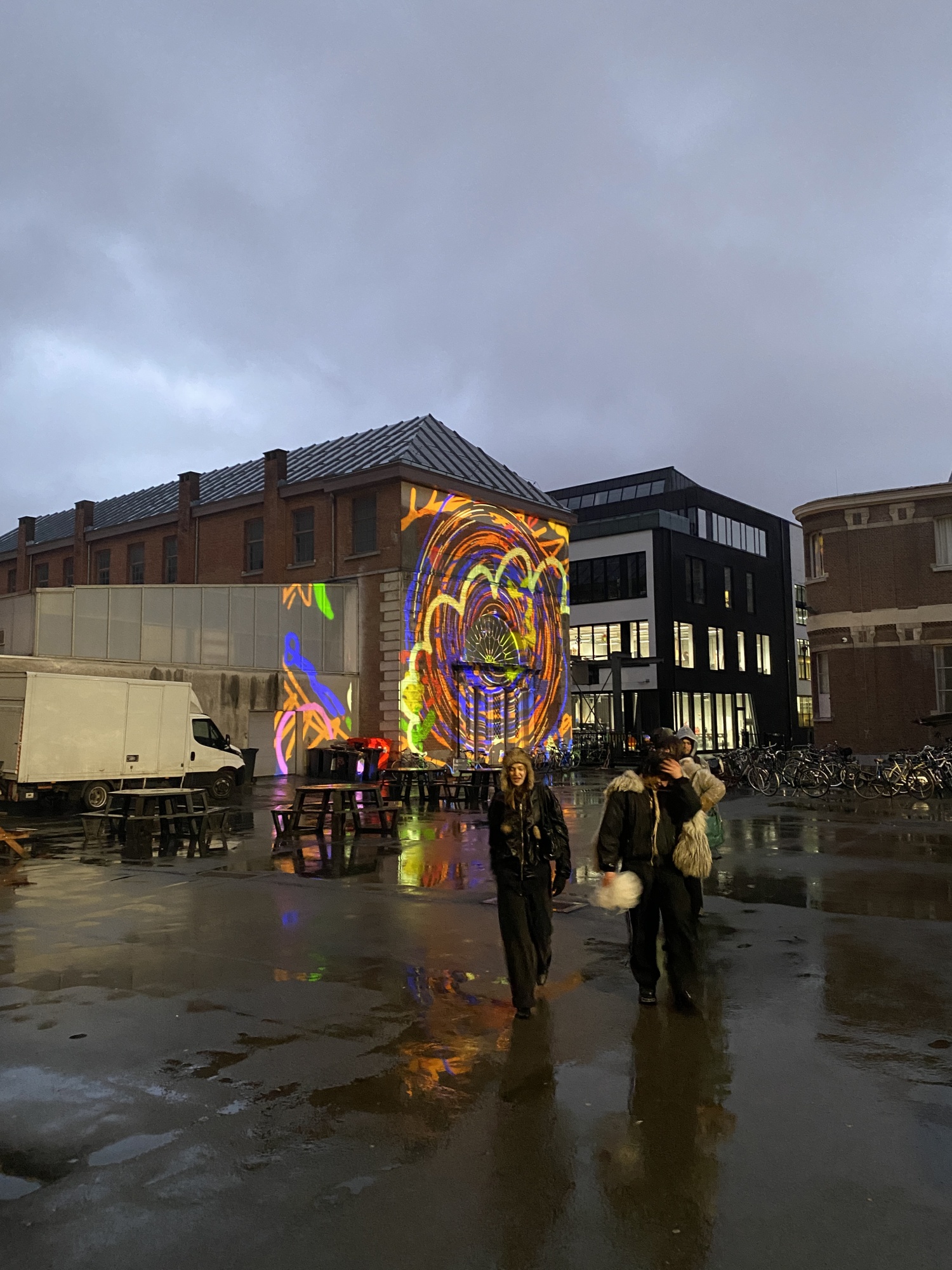
Large-scale projection of Drawing Across Borders on the façade of the Royal Academy of Fine Arts Antwerp during the Drawing Marathon, 2025. Photo by Janna Beck.
The studio as a network
What happens when the artist’s studio is no longer a physical space, but a dynamic, digital network? What if the traces left by an artist can be instantly altered by someone thousands of kilometres away, without the possibility of erasure or return?
In today’s digitally connected world, artistic collaboration is no longer bound to a single location but unfolds within a fluid, networked environment. This fundamentally challenges the classical image of the studio. Within such a shared digital space, mark-making, the act of leaving and transforming visual traces, shifts from an individual to a collective practice that evolves in real time. Artists create within structures in which authorship, agency, and process are continuously negotiated collectively and synchronously, where process outweighs final outcome and improvisation is essential.
Artistic agency is not claimed individually, but dynamically and precariously negotiated.
This article examines Drawing Across Borders as a case study in digital and transnational artistic collaboration. The project is conceived as a distributed studio performance, carried out via FRAMED, an open-source drawing platform developed at the Royal Academy of Fine Arts Antwerp. By simultaneously connecting artists and students in Antwerp, Kraków, Kentucky, and Durban, Drawing Across Borders reconstructs the studio as a networked studio: open, dynamic, and shaped by technological, institutional, and geopolitical forces.
The central question addresses how Drawing Across Borders redefines the concept of the studio and artistic authorship within a shared digital network ecosystem. At the same time, the research demonstrates how the network-based workspace manifests as a fragile, contingent space. Digital collaboration exposes latent tensions: unequal access to technology, differences in network stability, institutional censorship, and infrastructural inequalities. By analysing practical experiences with FRAMED and Drawing Across Borders, this article situates the networked studio as a mobile and contested terrain. It discusses how shared authorship, technological constraints, and latent power structures jointly shape the emerging contours of digital artistic collaboration.
Drawing Across Borders was not conceived as a classical case study with predefined parameters, but has grown organically since 2017 through a series of successive experiments. Its methodology is grounded in iterative, practice-based research: observation, dialogue with participating artists, and continuous adaptation of both platform and set-up. This reflexive approach positions the research as embedded, with the author actively involved as organizer, artist, researcher, and system designer.
Toward a networked studio: Theoretical foundations
The shift from isolated, physical studios to shared, digital studios is not merely a technological evolution; it touches on deeper questions of authorship, agency, and control. To understand the networked studio, it is necessary to trace its roots in earlier forms of collective art practices, such as the Mail Art and Fax Art movements of the twentieth century.1 In these early experiments, artists used networks for artistic exchange, but communication remained slow and sequential.
From the 1980s and 1990s onward, telematic art projects introduced a fundamental shift: digital networks were no longer used merely as carriers of messages, but as active spaces of interactive authorship. Artist and telematics pioneer Roy Ascott replaced the singularity of the author with a distributed network of storytellers in La Plissure du Texte, in which narrative emerged through live negotiation. Artist Paul Sermon disrupted physical proximity in Telematic Dreaming by replacing body and touch with video feedback loops. Artist Ken Goldberg explored agency in Telegarden through a remotely controlled robotic arm, decoupling presence from action.2 Together, these projects marked a break with the idea of the artist as an autonomous creator. They introduced a network logic in which artistic practice emerged from interaction, negotiation, and unpredictability. The studio was no longer a place, but became a process: an open system in which artworks were fluid, collective, and contingent.
At the same time, artists such as Goldberg and sociologists such as Manuel Castells emphasized that networks are not neutral. Digital platforms promise openness, yet they are structured by technical, economic, and political forces. Authorship and participation within a networked studio are therefore always co-determined by infrastructures: who has access, who can respond in real time, and who becomes visible, or remains unseen?3
In today’s digitally connected world, artistic collaboration is no longer bound to a single location but unfolds within a fluid, networked environment.
Drawing Across Borders extends this telematic legacy while introducing a new element: radical synchronicity. Whereas earlier network experiments were often delayed or filtered, every intervention here is immediate and irreversible, compelling participants toward a relational approach to drawing in which each line is instantly absorbed into a collective flow. Where much discourse on networked art and collaboration becomes lost in schemas, models, and wishful thinking, Drawing Across Borders focuses on actual frictions. It offers no ideal-typical model, but a process full of glitches, asymmetries, and unexpected alliances. It is precisely through this unpredictability that new modes of working emerge.
The fragile nature of digital infrastructure becomes visible through delays, dropouts, and unequal access to stable networks. This produces asymmetries in participation: fast connections render some artists immediately visible, while others appear later or less prominently in the collective process. Rather than smoothing over this instability, it is deliberately left visible as part of the work itself. Glitches, latency, and network errors become part of the canvas. This approach resonates with the principles articulated in Glitch Feminism, where breakdowns and interruptions are not treated as obstacles but as openings for new forms of creativity and identity.4 FRAMED functions like a faltering jazz improvisation: it rubs, it collides, and it is precisely there that energy emerges.
Interfaces, moreover, are not neutral conduits. As early as the 1960s, computer pioneer Douglas Engelbart demonstrated that technology does not merely extend creativity, but structurally shapes it. His experiments with alternative input devices, such as foot pedals, knee controls, and chorded keyboards, made clear that modes of interaction influence artistic choices.5 The computer interface thus became an active actor within the artistic process. Within FRAMED, this idea takes concrete form: the absence of an undo button is not only a deliberate design decision, but partly the result of how the system operates. Because actions are transmitted as continuous data streams, reversal is technically complex and far from trivial. Rather than compensating for this with additional control mechanisms, the limitation was embraced not as a flaw but as an invitation to adapt. The absence of undo becomes an artistic condition, encouraging attentiveness, care, and an acceptance of impermanence. Why would we need an undo? Because we are used to it? What if it could be otherwise?
This theoretical framework offers a lens through which to analyze Drawing Across Borders as a practice that builds on historical models of networked art, while simultaneously exposing their limits and rearticulating them within contemporary digital ecosystems.
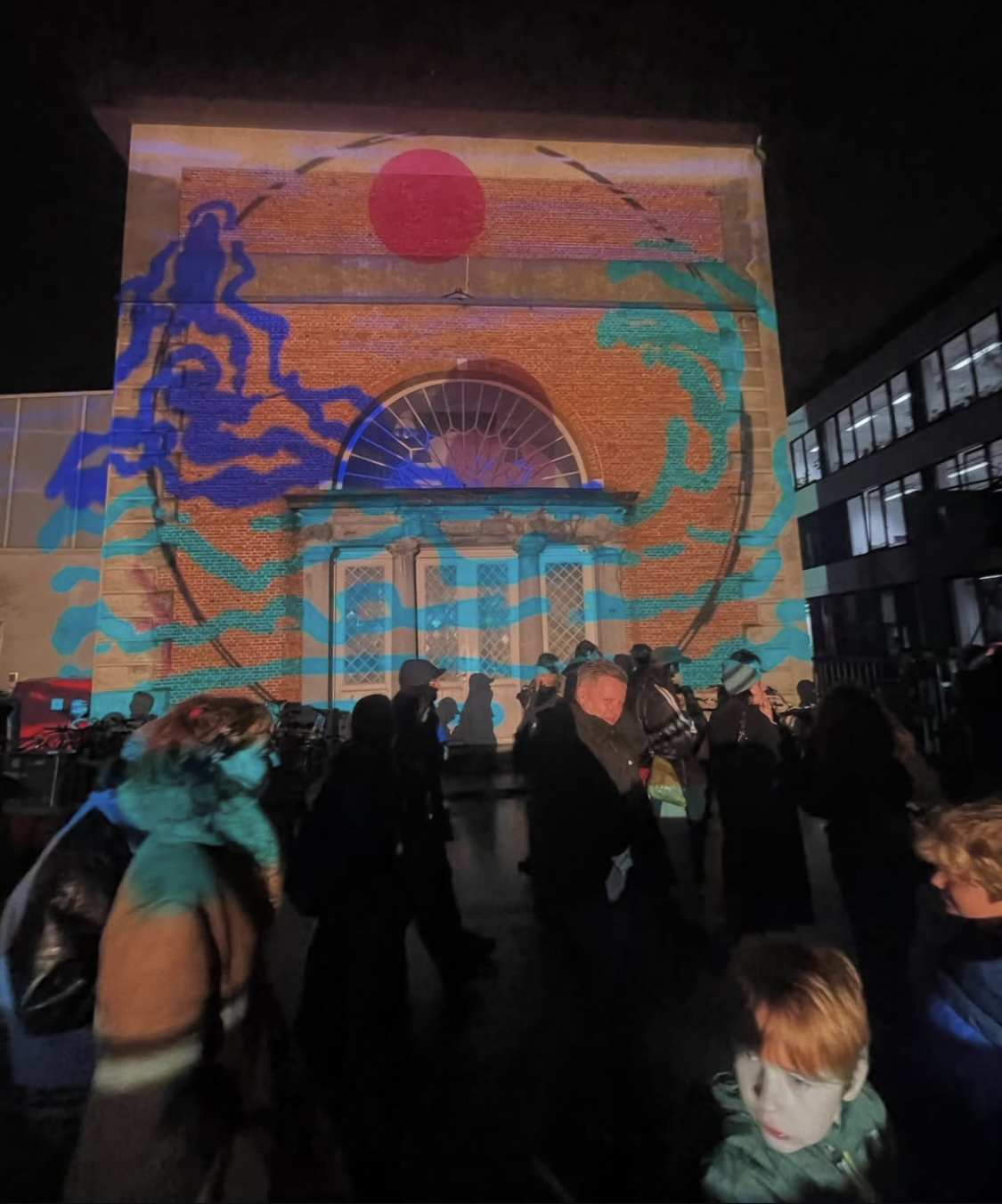
Large-scale projection of Drawing Across Borders on the façade of the Royal Academy of Fine Arts Antwerp during the Drawing Marathon, 2025. Source: Beam Inc, photo by Jan Vanbriel.
Drawing Across Borders: Practice and process
Drawing Across Borders constitutes the most recent and large-scale case study within the broader development trajectory of FRAMED, an open-source platform that has been built step by step since 2017 at the Royal Academy of Fine Arts Antwerp. What began as an experimental digital life-drawing project evolved, through iterative workshops and technical adaptations, into a distributed studio focused on simultaneous, collective drawing without hierarchical control mechanisms. FRAMED compels participants to assume shared responsibility, transforming drawing into a relational and irreversible process. Every intervention appears instantly and can be overwritten, extended, or transformed by others. The shared canvas is not a safe haven, but a battleground of lines where egos collide, dissolve, and reinvent themselves. Artistic agency is thus not claimed individually, but dynamically and precariously negotiated.6
During the biennial Drawing Marathon 2025, organized by the Royal Academy of Fine Arts Antwerp, the central live session of Drawing Across Borders took place. Over the course of four hours, studios in Antwerp, Kraków, Kentucky, and Durban were simultaneously connected via FRAMED within a shared digital space.
Over the years, numerous FRAMED sessions have been organized in diverse contexts, each with its own dynamics. At times these involved small, tightly knit groups of artists intuitively responding to one another’s lines. At other moments, the canvas was shared with larger groups of students, artists, or incidental audiences. In open sessions lacking a clear structure, this occasionally led to territorial tensions. During sessions with Cuban graffiti artists and in workshops with children, for instance, participants sometimes expressed a desire for “their own piece of wall.” In a few cases, this request was accommodated by literally drawing a frame within which no one else was allowed to draw.
In early versions of FRAMED, when the canvas still consisted of a single frame, guidance was provided primarily through spoken prompts. Facilitators offered live suggestions or proposed small interventions to the drawers, which worked smoothly in smaller groups. Prompts functioned more as gentle stimuli than as directives. At a later stage, the frame-by-frame mechanism was introduced, adding time as a third dimension to the drawing process. The canvas came to consist of multiple successive frames, between which drawers could freely choose and continuously switch when adding their lines or marks.
This expansion required a different mode of orientation: the timeline proved far from intuitive, particularly for larger groups. It often resulted in confusion or visual chaos. To keep the shared canvas workable, new strategies emerged to guide the drawing process, through instructions, visual examples, or a clearer structure. These experiments formed the basis for a sub-study within FRAMED, developed in collaboration with multidisciplinary designer Annelise Cerchedean, focusing on the use of instructions in collective drawing processes and on how such instructions might take graphic or performative form.
During an earlier edition of the Drawing Marathon, this guidance took a literal form through small strips of paper bearing playful assignments: “mark your presence and disappear again,” “follow the red line,” or “draw something that repeats.” In the AfrikaBurn edition, a paper cootie catcher, a folded fortune-teller revealing a hidden instruction, was used. In theory, it worked perfectly, until it became clear that the desert at night is truly dark, rendering the carefully designed instructions largely unusable.
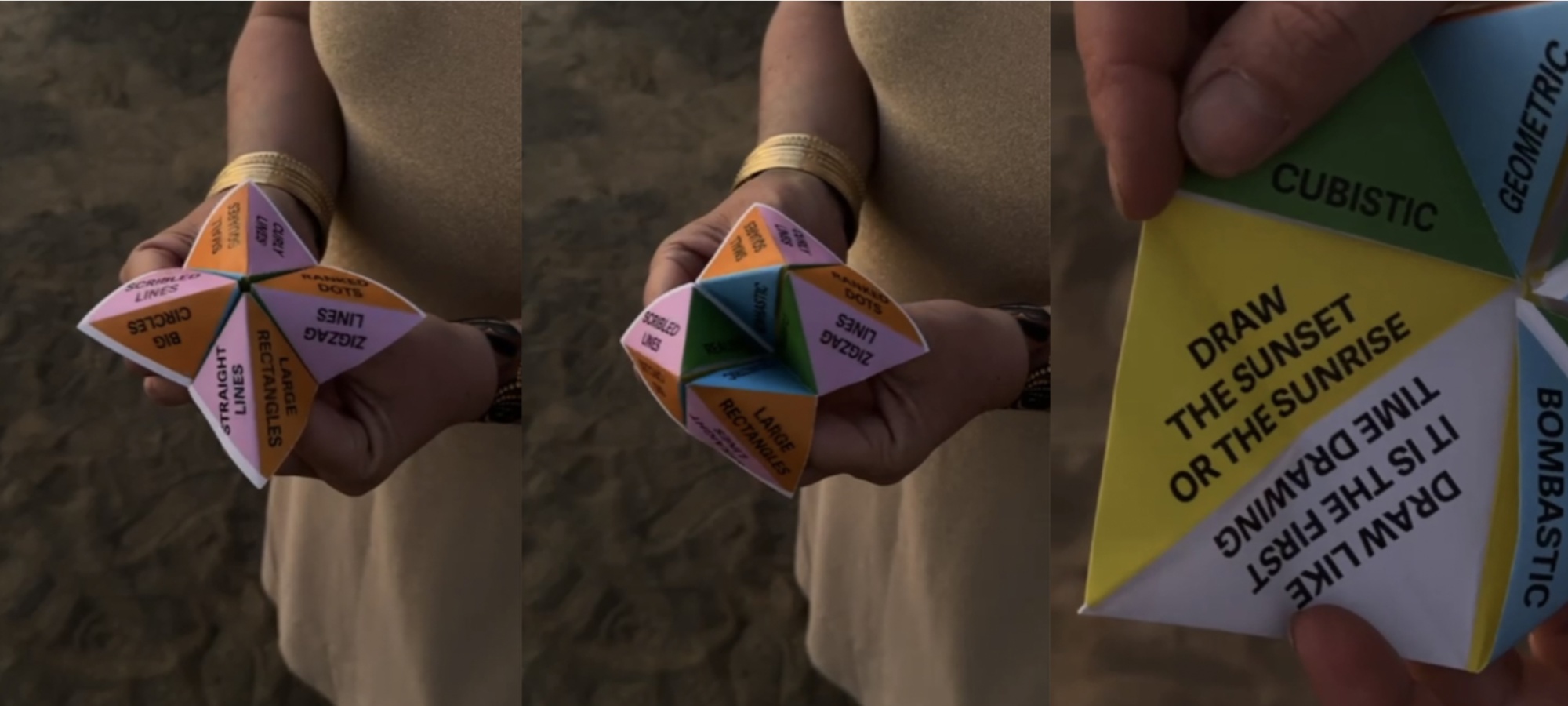
A paper cootie catcher used as an interactive prompt tool during AfrikaBurn, 2024, Tankwa Karoo Desert. Photo by Annelise Cerchedean.
For Drawing Across Borders, a digital prompt app accessible on participants’ smartphones was selected. During a joint brainstorming session with the international partners, a new set of instructions emerged, visual, abstract, poetic, humorous, or slightly tongue-in-cheek. The overarching theme was “borders,” intended to encourage participants from widely different contexts to reflect on what a boundary might signify: geographically, politically, digitally, bodily, or socially. The app allowed users to scroll easily through multiple prompts until one resonated, keeping interaction light and playful.
Some participants engaged actively with the prompts, while others were guided more by spontaneous visual interaction. In certain cases, the instructions developed into short visual narratives. The prompts were deliberately left open to interpretation, such as: “Animate a boundary that breathes, expanding and contracting across frames,” “Draw a line that dissolves into nothingness,” “Draw a border that invites crossing,” or “Animate something that bulges, explodes, and disappears.” Some instructions suggested actions unfolding across multiple frames: “Choose a frame and hide a secret within the border, then gradually reveal it,” or “Choose an odd frame and draw a box that encloses something, then let it escape in the next frames.” Other prompts were simpler in structure, such as “Choose a frame and crosshatch part of it,” while others, like “Drop a bomb, clear a frame!”, were more disruptive, inviting a visual reset or interruption. What began as a technical aid to facilitate coordination gradually evolved into a performative engine within the collective work.
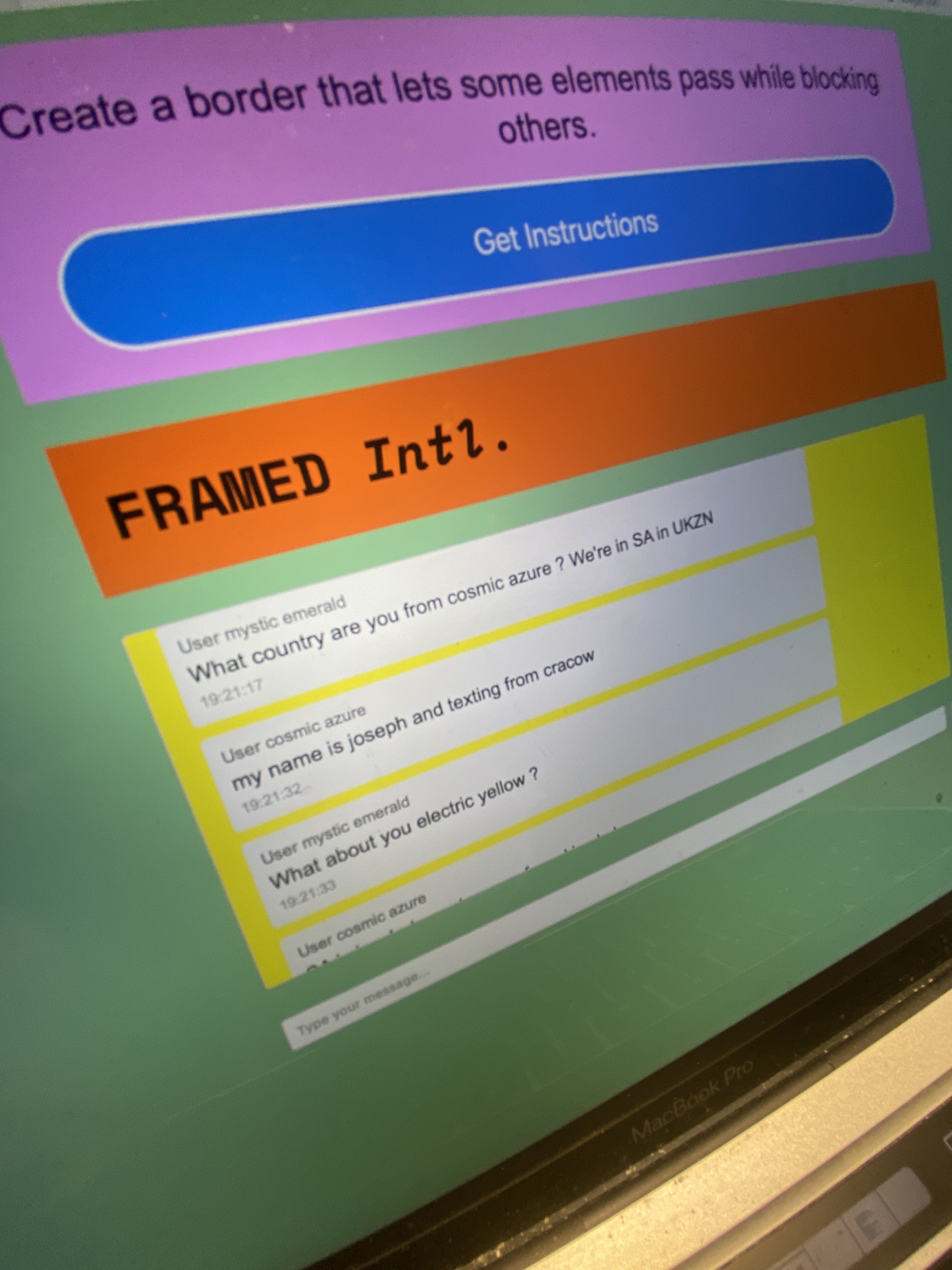
Interface of the custom-built prompt app: an instruction appears at the top alongside a “get instructions” button and a simple open chat function, 2025, Royal Academy of Fine Arts Antwerp. Photo by Janna Beck.
The technology behind FRAMED follows the KISS principle: Keep It Stupid Simple. With a nod to developer Kris Meeusen, we sometimes refer to this instead as the KRIS principle: Keep Rethinking Its Simplicity. The technology was deliberately kept simple and robust in order to maintain a focus on interaction and collaboration. At the same time, the system is the result of years of iterative development, in which every modification emerged from practical experience and evolving needs within live drawing environments.
At the outset, computers are synchronously started up and connected to Wacom tablets. Key parameters such as frame rate and resolution are defined in advance. The software includes the option to control these settings centrally, a feature developed because manual configuration on each individual computer becomes time-consuming and error-prone with larger groups. For Drawing Across Borders, this central control was deliberately disabled in order to avoid potential synchronization issues between the international locations. During start-up, experienced users populate each individual frame of the canvas, which consists of multiple successive images, with a quick line or color field, ensuring that the projection does not begin empty. A frequently used technique involves drawing while holding down the arrow key, allowing a single gesture to unfold fluidly across several frames.
Photographs of test images, such as a red circle in Antwerp and a blue one in Kentucky, were shared in advance via WhatsApp to verify connectivity. Locations that logged in later, such as Kraków, could only see the current state of the canvas, without access to its history. This asymmetry gradually dissolved through the collective process that followed.
FRAMED is therefore not a neutral interface, but an active agent within the artistic process. The system not only determines what is visible, but fundamentally shapes how collaboration emerges, develops, and is perceived.
Technology functions as an active co-player: those who draw, also reflect on the interface; those who observe, simultaneously propose technical alternatives. Collaboration emerges where disciplinary boundaries become porous.
Interaction unfolded according to different rhythms: some participants added short, impulsive marks, while others constructed layered structures around existing gestures. This fluid, relational dynamic resonates with art theorist Nicolas Bourriaud’s notion of Relational Aesthetics, in which art emerges from intersubjective encounters and temporary communities. Where Bourriaud primarily defines relationality as social and situational, Drawing Across Borders demonstrates that it is also deeply technologically mediated. Latency, visibility, and network speed structure encounters on the canvas. Relational aesthetics here are shaped not only by human interaction, but also by digital infrastructures that are unevenly distributed, rendering the relational space fundamentally asymmetrical.7
Because there was no possibility for correction or ownership, a form of collective alertness emerged: every intervention was simultaneously a response to what already existed and an invitation for further intervention. This ongoing process of reconfiguring the canvas reflects media scholar Henry Jenkins’s concept of participatory culture: not a linear or hierarchical trajectory, but a non-linear co-creation in which meaning and ownership remain fluid.8
In Antwerp and Kentucky, interaction proceeded relatively smoothly, while participants in Durban and Kraków encountered less visible power imbalances. Crucially, Drawing Across Borders did not attempt to conceal these vulnerabilities. On the contrary, they were acknowledged as integral to the project. The networked studio was thus not presented as a utopian space, but as an ecosystem in which digital collaboration remains dependent on circumstance.
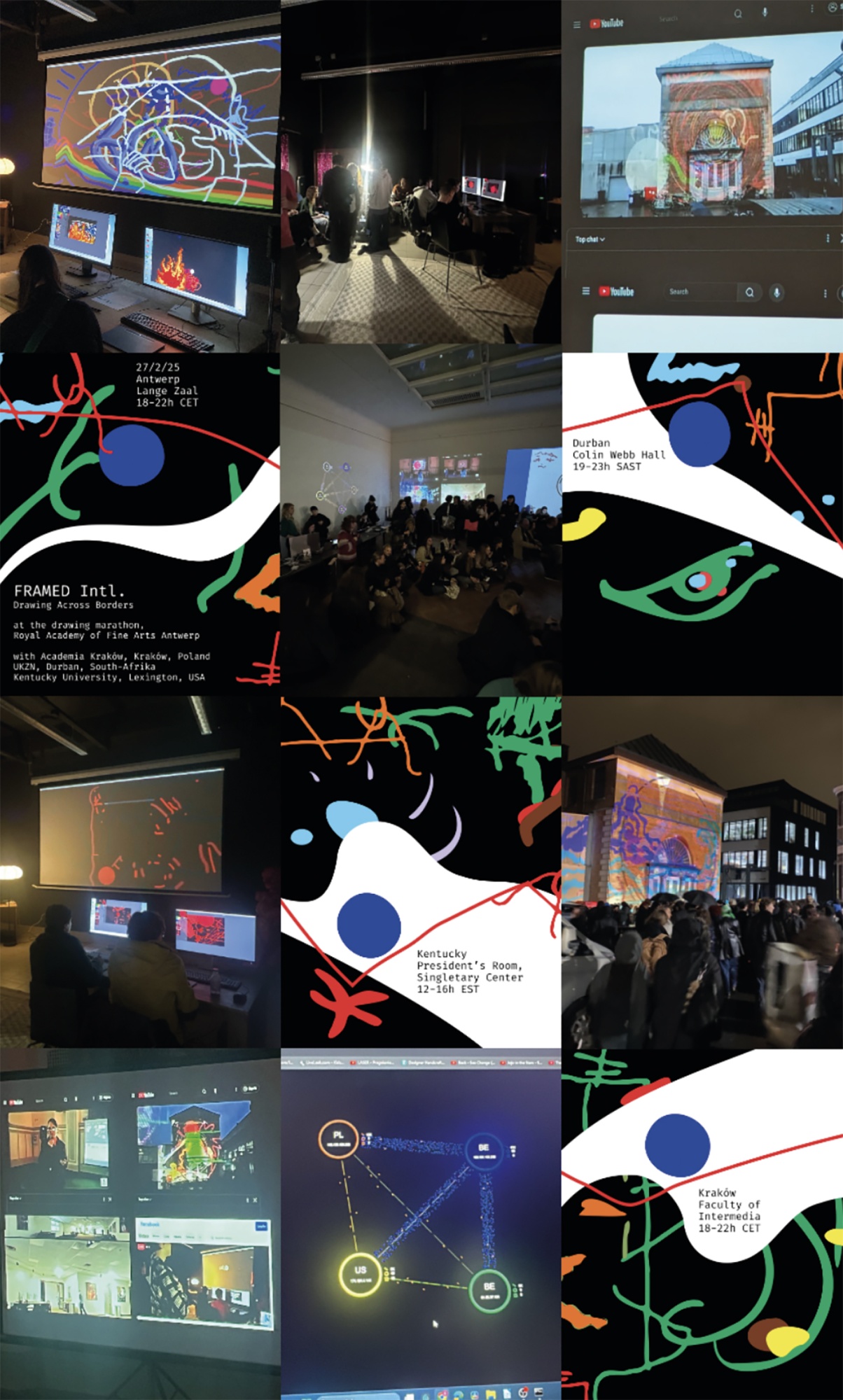
Composite image capturing the atmosphere of the Drawing Across Borders event across four international locations. Shown are projections of the shared canvas in Antwerp, Durban, Kentucky, and Kraków, each location connected in real time. Also visible are the four locally adapted posters announcing the event; each designed for its own hub, yet together forming a coherent image as a symbol of networked unity, 2025, Antwerp / Durban / Kentucky / Kraków. Photos by various participants.
Parallel to the digital interaction, the shared canvas was projected at large scale in real time at the different locations. In Antwerp, this took place on the facade of the Royal Academy of Fine Arts, giving the transnational collaboration a public dimension. Passers-by witnessed lines appearing, disappearing, and mutating, a visual play reminiscent of digital graffiti: fleeting, anonymous, and perpetually in flux. Unlike traditional murals or curated participatory art projects, Drawing Across Borders had no finality. There was no fixed composition, no completed product. Its value lay in temporary presence, akin to performance art, where meaning emerges in the moment and dissipates once the event ends.
Not everything within FRAMED is documented. Many sessions exist only as fleeting projections that vanish as soon as they appear. This conscious choice, a refusal to fix everything, emphasizes the value of the moment, of contact and co-presence. Where performance art has historically built a canon through photographs and recordings, Drawing Across Borders allows a large part of its history to remain unfixed. This strengthens the immediacy of the experience, but limits the possibilities for later analysis. In a culture that tends to evaluate digital art primarily through visibility and reproducibility, the project places process at the center. The canvas remains a living, incomplete entity: what is visible in one place is absent elsewhere. This incompleteness is not a shortcoming, but part of the system’s operation, raising questions about who is seen and what persists. In this way, a temporary space emerges that resists closure and the logic of a complete archive.
The shared responsibility embedded in FRAMED created room for collective expression, but also revealed the fragility of agency within an open system. Without clear distinctions between contributions, individual intentions blurred: not everyone engaged actively or assumed responsibility for sustaining the dialogue. At times, friction arose, participants could abruptly overwrite others’ work, intentions were missed, spontaneous alliances formed and dissolved again. This dynamic exposes the fact that shared authorship is not an inherently harmonious process. Artistic agency in a shared digital space requires constant attentiveness, adaptability, and a willingness to accept loss, miscommunication, and chance as intrinsic to artistic practice.
In this sense, Drawing Across Borders offers a provisional answer to the question with which this article opened: relocating the studio to a shared digital space enables immediate collective creation, but simultaneously reveals new tensions around ownership, visibility, and access. And nowhere did this become more apparent than during the “F*ck Trump” incident.
“F*ck Trump” and the paradox of radical openness
The fragility of digital openness became painfully tangible when, during a Drawing Across Borders session, someone wrote the words “F*ck Trump” on the canvas. What initially appeared to be a glitch, the sudden loss of connection with the studio in Durban, soon proved to be a human intervention. The local university had stepped in out of concern for potential political repercussions.
The incident cut straight through the project’s performative layer and revealed what often remains beneath the surface: digital collaboration is never detached from control, policy, or fear. FRAMED may be built on the principle of radical openness, but no network is ever entirely free of power. Even the most porous canvas can be censored by an invisible firewall, a policy document, or a phone call from higher up.
What emerged here was not merely a technical disruption, but a collision between intention and infrastructure. Drawing Across Borders sought to dismantle borders, yet inadvertently exposed new ones, those of institutional nervousness, geopolitical asymmetry, and digital vulnerability. The networked studio revealed itself not as a boundless space, but as a temporarily permitted terrain in which openness is always conditional. What is open can also be closed. And what is shared can suddenly disappear.
This tension touches on another fundamental question within FRAMED: how much direction is desirable or necessary during a collective drawing session? In small, familiar groups, such direction often emerges organically. Someone notes that a particular area lacks a colour field, or that a zone has become too dark and could use more lightness. Suggestions are made, “use brighter colours,” “redraw that part”, and sometimes a specific colour palette is agreed upon in advance. The group then functions almost like a single organism, with shared intentions and an attentiveness to the whole.
This critical stance is essential to prevent the digital future from becoming a globalized reissue of existing paradigms, merely presented as progress.
As the number of participants increases, verbal moderation becomes less straightforward. Different styles and speeds collide. Some participants are cautious, others impulsive. The question then arises whether intervention is needed, and if so, by whom. Often, one of the more experienced users intuitively assumes the role of a “director,” for instance by removing disruptive elements or establishing a visual line that others can follow. Wouter Steel, a draftsman and early co-researcher, never hesitated to intervene decisively when it benefited the image. Kris Meeusen, the software developer behind FRAMED, also occasionally moderated through technical interventions.
The idea of formalizing such interventions once led to a playful yet serious proposal: a “dictator button.” With a single press, certain frames would receive an immediate and synchronized visual reset. Although this button was never implemented, the concept remains emblematic of a persistent tension within FRAMED: between control and freedom, between chaos and composition. The question of who decides what is “better” in a shared artwork, and on what grounds, remains a recurring theme within the research project.
Yet moderation is not always self-evident. The role itself introduces doubt. When do you intervene? And how? Drawing over someone else’s work also risks conflict, or at least discomfort. In smaller groups, there is usually more implicit consent and trust, but in larger, more anonymous environments hesitation often arises. Is it appropriate to erase something? Or does that feel like censorship? Others, conversely, appropriated the visual direction more forcefully, perhaps because anonymity loosened their restraint.
This reflexivity is part of what makes FRAMED distinctive: it leaves room for doubt, for moments of temporary not-knowing. It is precisely these fragile moments, where control and surrender intersect, that render the collective practice palpable and alive. At the same time, it became clear that moderation does not always need to be explicit. Sometimes the system itself subtly guides behavior through speed, prompts, or interface constraints. Sometimes a user steers simply by continuing to draw, by taking space, or by deliberately leaving space. In this way, FRAMED allows hierarchy itself to remain fluid and context-dependent, shifting between curated installations and collective improvisation.
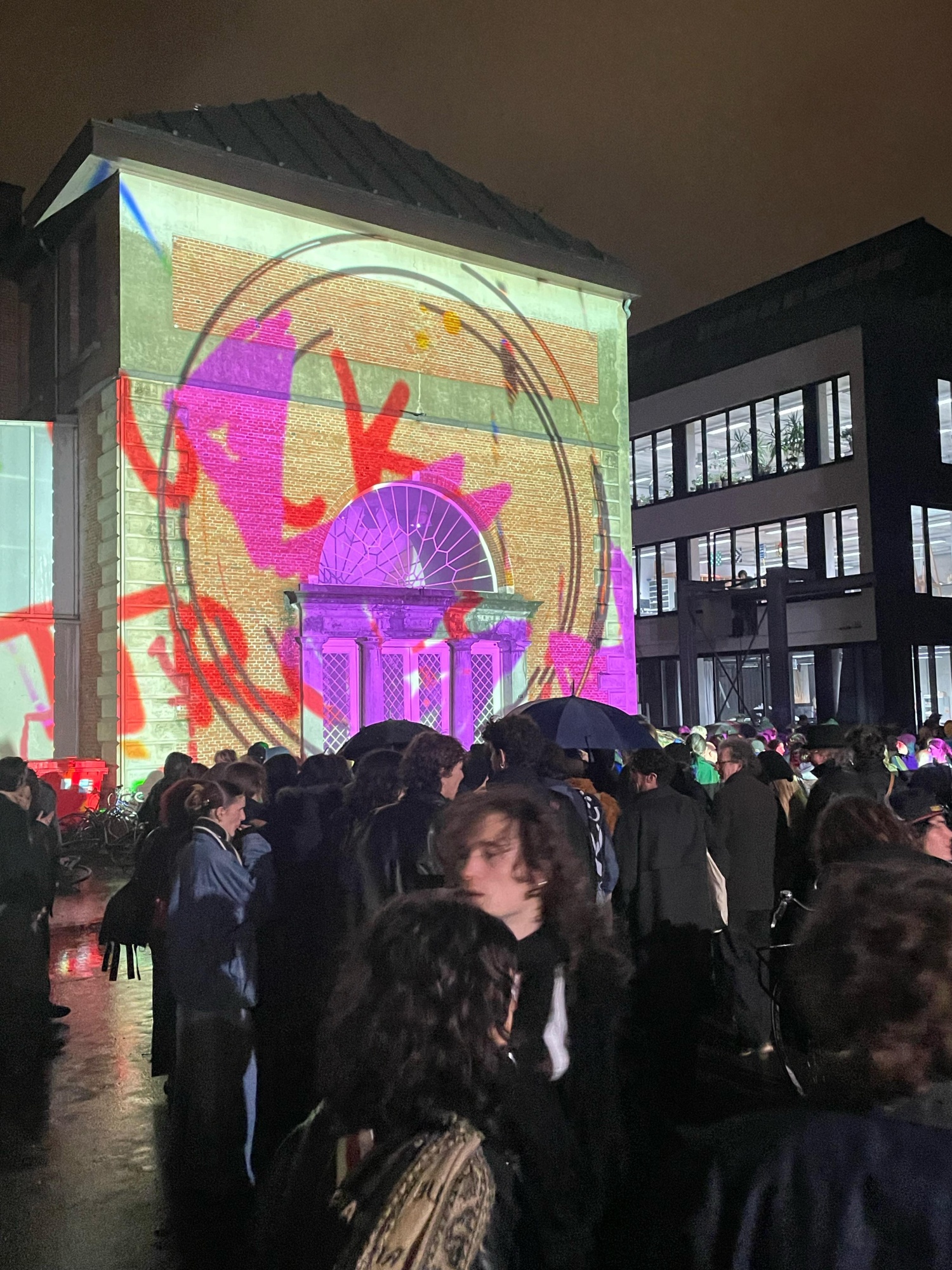
Large-scale projection of Drawing Across Borders on the façade of the Royal Academy of Fine Arts Antwerp during the Drawing Marathon, 2025. Source: Beam Inc, photo by Jan Vanbriel.
Infrastructures and collective effort
Although Drawing Across Borders appeared as a spontaneous and intuitive collaboration, the project rested on a complex web of technological and organizational infrastructures. Behind the shared canvas lay a network of servers, local installations, synchronization protocols, and real-time communication channels connecting Antwerp, Durban, Kraków, and Kentucky. Each local studio was equipped with computers running the FRAMED software, connected to drawing tablets.
In addition to FRAMED itself, supplementary tools were developed to strengthen the collective process. One of these was a real-time data visualization that made activity across the different locations visible. This visualization functioned as a graphical feedback layer: each line drawn on the canvas was individually registered and rendered as a pixel. In this way, it became visible who was active and how dynamically interactions unfolded across locations. Participants were thus able not only to follow one another’s lines and animations, but also to intuitively sense each other’s presence, energy, and rhythm.
Another supplementary tool was the instructions app, easily accessible via visible QR codes, featuring an open chat function that allowed participants to exchange messages with everyone in the system without login or identification. While typing, the system assigned random names and colours such as “wild purple” or “mystic navy”, a nod to the playful anonymity of shared Google Docs, where anonymous users appear as animals. These colours were deliberately chosen in the design as a form of subliminal messaging: a subtle layer intended to unconsciously encourage users to adopt those colours in their drawings. This was not an active steering mechanism, but an illustration of how design can attempt to influence users through layering.
The chat space thus functioned as a parallel communicative network that enabled thoughts, reactions, and spontaneous remarks to circulate independently of the visual channel of the canvas, contributing to a sense of openness and collectivity. Participants’ experiences illustrate how this parallel communication space shaped interaction and the collective process:
It was strange at first, seeing my drawing disappear under someone else’s. But then I realized that was the point, it’s not about ‘my’ work, it’s about how we respond to each other.
– Student, Royal Academy of Fine Arts, Antwerp
Being part of the Drawing Across Borders project was a unique and inspiring experience. The idea of collaborating with people from different countries through drawing felt both playful and meaningful.
– Taeena Pillay, student University of KwaZulu-Natal, Durban
The software pulled its weight and we saw some intriguing patterns and artworks being made. Seeing it in action was lovely.
– Kyle Maistry, student University of KwaZulu-Natal, Durban
Using this interactive art software has been incredibly refreshing. The interface was simple and intuitive, no steep learning curve, no technical hurdles, letting creativity take the lead. The collaborative element brought a sense of community and excitement that made every session feel like a shared adventure.
– Zahra Saib, student University of KwaZulu-Natal, Durban
One of the things I loved about the Drawing Across Borders event was how it allowed us to connect with artists from different parts of the world and collaborate on creative work, even from a distance.
– Evan Frank, student University of KwaZulu-Natal, Durban
Drawing Across Borders was a collective undertaking at every level. Not only the canvas was shared: preparation, technical set-up, and facilitation were also realized through cross-border collaboration. Under my direction, artistic, technical, and logistical teams worked together across four cities. In Antwerp, local studio coordination was handled by Tom Dietvorst, Frankie Anh Le, Bert Hellemans, Gina Poortman, Annelise Cerchedean, and Wouter Steel. In Durban, Michelle Stewart, Limo Velapi, and Bhavna Pather ensured local embedding. In Kraków, Mariusz Sołtysik and Estera Gałuszka established connections; in Kentucky, Jonathan McFadden, Chad Ebly, and Dmitry Strakovsky developed the technical infrastructure and educational support. Visual communication was overseen by Kristí Fekete. Kris Meeusen, developer of FRAMED, was responsible for technological coordination: he prepared the platform technically, monitored live data streams, and remained on standby for interventions, an essential link in the transnational connection.
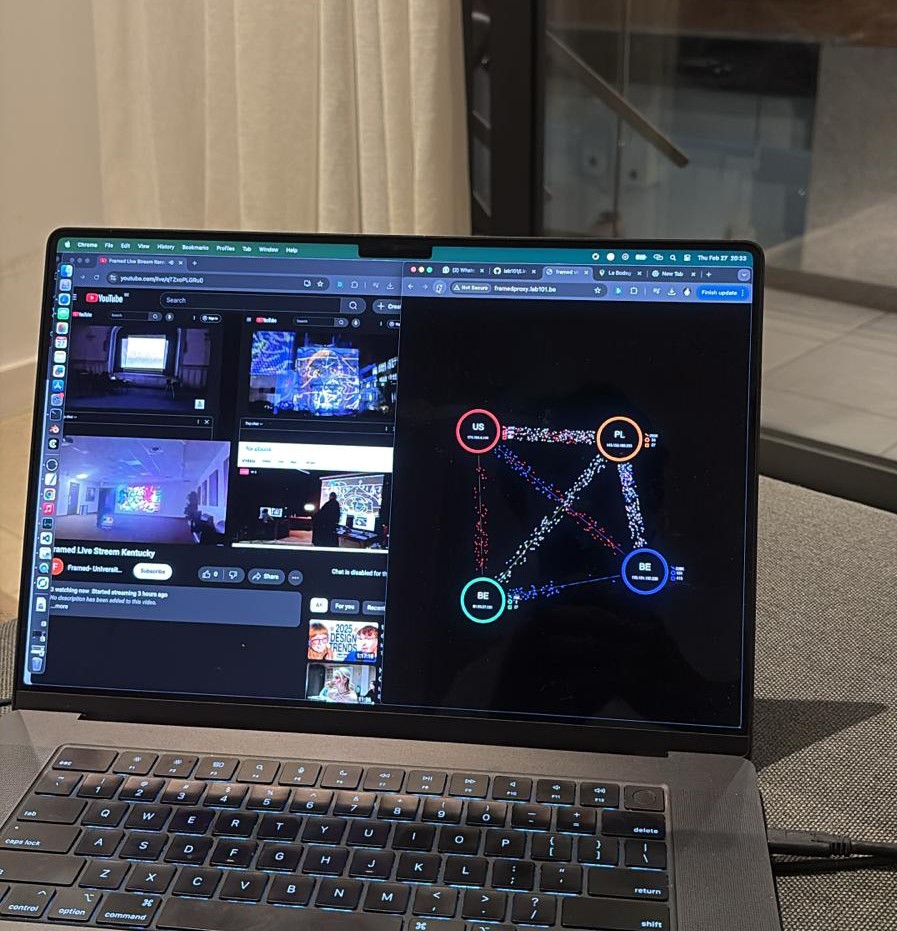
On the right, the screen displays a data visualization of the drawing participants; on the left, multiple YouTube feeds from international locations are streamed, 2025, Barcelona. Source: LAB101, photo by Kris Meeusen.
The networked studio thus consisted not only of software and infrastructure, but also of human relationships, coordination, and shared responsibility. Resilience emerged from a willingness to distribute responsibility: a continuous balancing act between initiative and receptivity.
The development of FRAMED required deliberate design choices concerning accessibility and risk. Early tests demonstrated how strongly interface decisions steer the artistic process. For example, the slow filling of color fields led to frustration, after which a fill function was added. The platform evolved in dialogue with its users: more than three hundred artists, designers, researchers, and participants took part. Verbal feedback and observations of interaction generated actionable insights that guided design decisions.
Technological collaboration sometimes requires specific expertise, yet within FRAMED technology was never treated as a purely passive tool. Infrastructure evolved in close interplay with artists, designers, and researchers. Tools and set-ups emerged in direct alignment with practice. Technology functioned as an active co-player: those who drew, reflected on the interface; those who observed, suggested technical alternatives. Collaboration arose where disciplinary boundaries became porous.
Although the project is embedded within an institutional context, the process carries a punk-like ethos of improvisation, unpredictability, and direct action. The digital canvas functions as a form of digital graffiti: fleeting, anonymous, and difficult to fix. Public projection amplifies this effect by allowing the drawing process to leave the studio and become visible to incidental passers-by.
An important, often invisible aspect is the choice for open-source technology. With FRAMED, the project positions itself outside commercial big-tech ecosystems. Unlike closed infrastructures such as Google Jamboard or Miro, FRAMED offers a shared space in which users are co-owners. Designed with simplicity as a guiding principle, it runs reliably on older systems, promoting digital inclusion and enabling collaboration with communities such as those in Cuba and South Africa, where heavier or licensed software is often impractical.
In South Africa, FRAMED was integrated into the curriculum not to teach digital drawing per se, but to cultivate digital literacy. Through workshops in townships, points of contact emerged within a context of profound social inequality.
Within an earlier project in Cuba, a temporary initiative emerged in which a local musician, after receiving a Wacom tablet, organized small performances using an old laptop and a borrowed projector. Due to economic decline, the initiative quietly disappeared, leaving no tangible documentation behind. What remains are stories, memories, and oral feedback, forms of knowledge that are difficult to archive, yet resonate powerfully. During a workshop session in Havana, a devout girl drew alongside a lightly dressed graffiti artist with blue hair; their differing social and cultural backgrounds were a given, yet within the shared, silent act of drawing, it became visible how a connection could emerge.
Yet open source is no guarantee of neutrality. Drawing Across Borders demonstrates that autonomy in digital art practices does not arise solely from technological choices, but from ongoing negotiation between intention, infrastructure, and social position. Open source here is not only technical, but also political. Trust is not a peripheral condition, but the core. Participation is voluntary; every line is a deliberate intervention. The openness of the system calls for an ethics of shared ownership and mutual recognition. In a context where visibility is quickly personalized and self-promotion beckons, the networked studio model demands a different mode of presence, one oriented not toward dominance, but toward attunement.
These insights form the point of departure for understanding the broader impact of Drawing Across Borders: as an artistic experiment, but also as a pedagogical challenge and a political practice within the digital field.
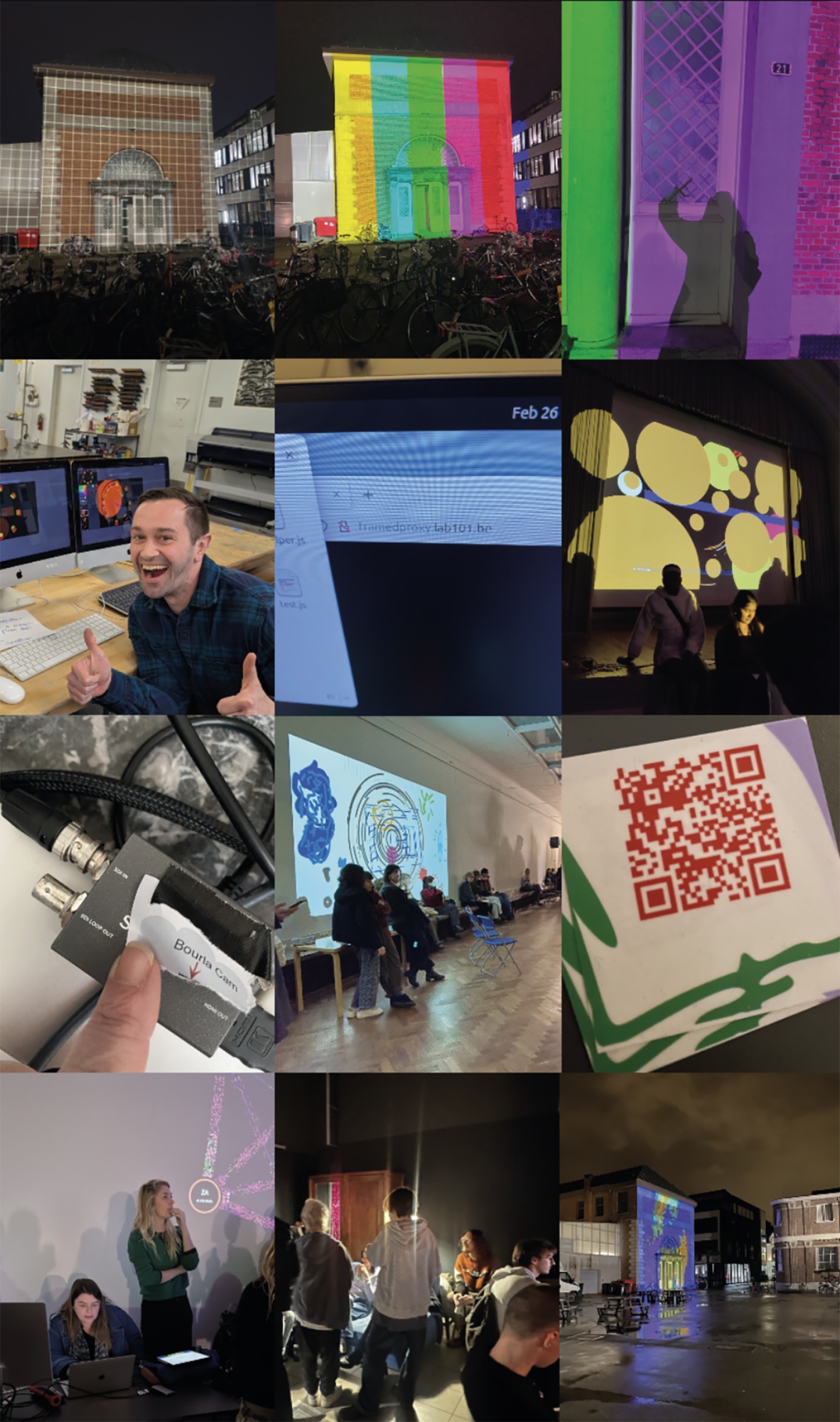
These behind-the-scenes images show the technical set-up and testing phase of Drawing Across Borders. Visible are projection tests across different locations, Wacom tablet configurations, and coordinated screen calibrations across continents. Also shown are the printed QR stickers linking to the prompt app, 2025, Antwerp / Durban / Kentucky / Kraków. Photos by various participants.
Artistic and pedagogical impact
Drawing Across Borders positions artistic collaboration not as the sum of individual contributions, but as a process of continuous negotiation and collective improvisation. Rather than striving for recognizable signatures, the work emerges within a shared field of actions in which no intervention remains protected.
Yet openness does not automatically produce harmony. As art historian Claire Bishop notes in Artificial Hells, participatory art often exposes friction: between intention and interpretation, between visibility and disappearance, between participation and exclusion.9 Within Drawing Across Borders, some contributions were overwritten too quickly or went unnoticed due to technical latency, leading to hesitation among certain participants.
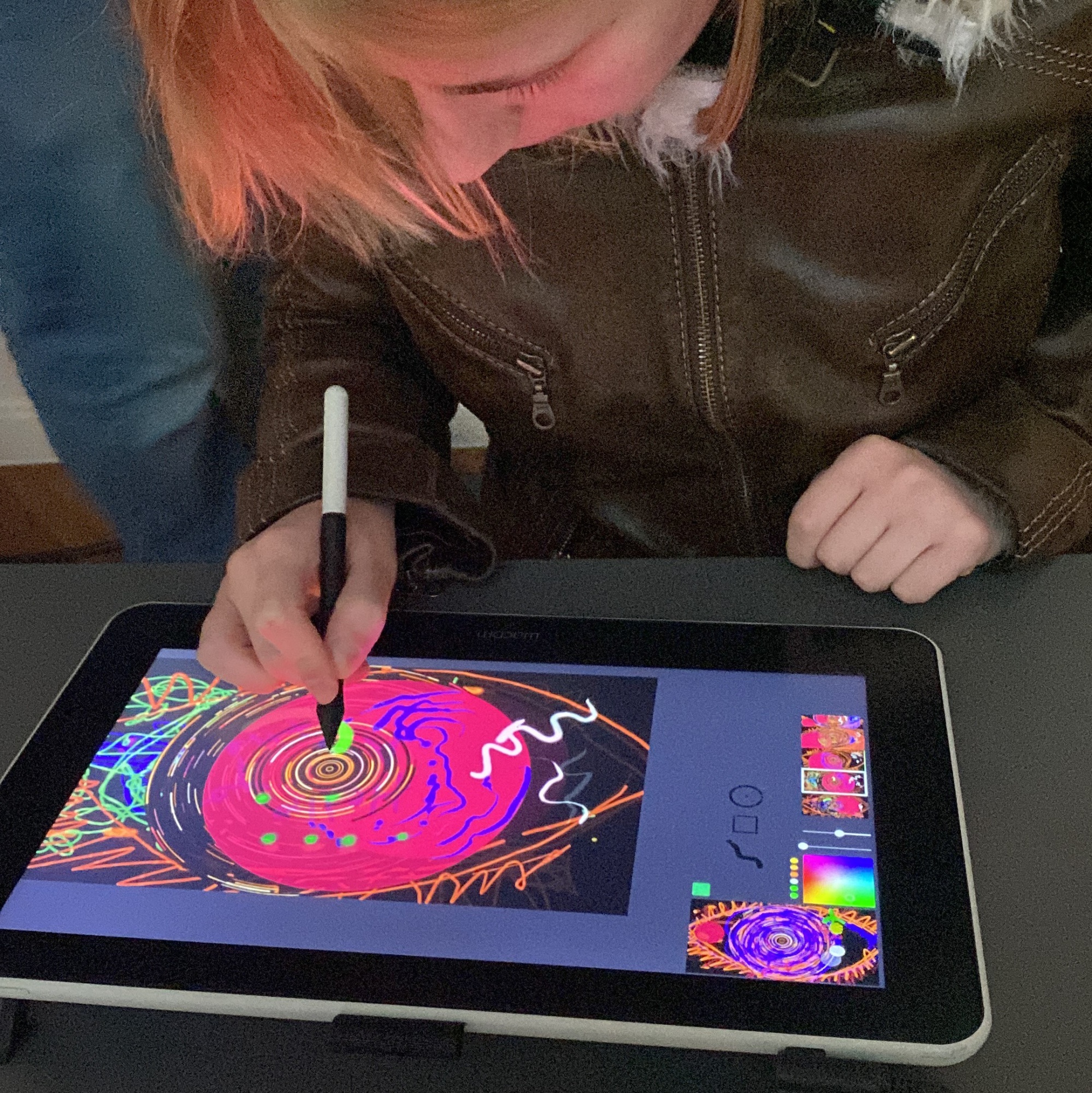
Aleksandra uses the FRAMED interface on a Wacom tablet, arrow keys within reach, fully immersed in the collective drawing session, 2025, Royal Academy of Fine Arts Antwerp. Photo by one of the participants.
Others, however, embraced this unpredictability as an invitation to improvise, to engage in visual dialogue, to exchange roles, or to establish spontaneous agreements. Through such self-organization, participants adopted a generous stance toward one another and toward the process itself: ideas were not protected but shared; impulses were not claimed but passed on. This generosity fostered a mode of working in which ownership shifted from the individual to the network.
Collective work, however, does not imply the disappearance of autonomy. On the contrary, the project demonstrates how individual voices and shared processes can reinforce, challenge, and temporarily overwrite one another without collapsing into functional role divisions or standardized models. Shared digital working methods do not lead to chaos; instead, they invite alternative forms of deliberation, coordination, and trust.
In an educational context, this offers valuable insights. Students develop not only digital literacy, but also relational sensitivity: the ability to respond to others, to let go, and to re-engage. This requires more than technical skills alone; ethical, social, and system-aware navigation capacities become equally essential.
This stance implicitly clashes with the dominant emphasis on individual profiling within many academic evaluation practices. Although process-oriented learning is often promoted rhetorically, portfolios and recognizable signatures remain the practical norm. Drawing Across Borders undermines this logic by demonstrating how a shared process can also generate shared value and ownership.
Herein lies a broader pedagogical task. A contemporary art education must teach students not only how to work with others, but also how to engage with technology as an actor within the process. Contemporary artistic practices unfold between people and infrastructures. Digital autonomy, the ability not merely to use technology, but to understand and question it, thus becomes an essential learning objective. Cultivating new forms of shared and critical agency is not a luxury, but a didactic necessity in a globalized and digitized world.
Education that prioritizes digital autonomy acknowledges that tools are not neutral. They are designed, embedded with choices, implications, and power structures. Learning to work with technology therefore also means learning to think with technology: not as neutral equipment, but as material, language, and zone of friction. Students should not simply obey tools, but question, bend, and pry them open. Treating the digital solely as a means misses the opportunity to understand it as an environment, shaped by logics and biases. Teaching software thus becomes not a technical instruction, but an exercise in critical observation and systemic disobedience. Artistic agency does not emerge from presenting technology as a ready-made package, but from granting access to environments that are open, legible, and hackable.
Rather than taking high-end tools as the benchmark, this practice of working and thinking with technology builds on functional, accessible systems that invite experimentation, adaptation, and meaning-making. Digital collaboration here also entails developing a personal relationship with technology, as structure and as cognitive space. Such processes need not begin with complexity. On the contrary, small, modular building blocks can serve as powerful engines for self-inquiry. Their accessibility is their strength: they create space for ownership and form the fertile ground for alternative modes of working, not to turn artists into technicians, but to enable them to actively shape technology, critically interrogate it, and integrate it on their own terms.
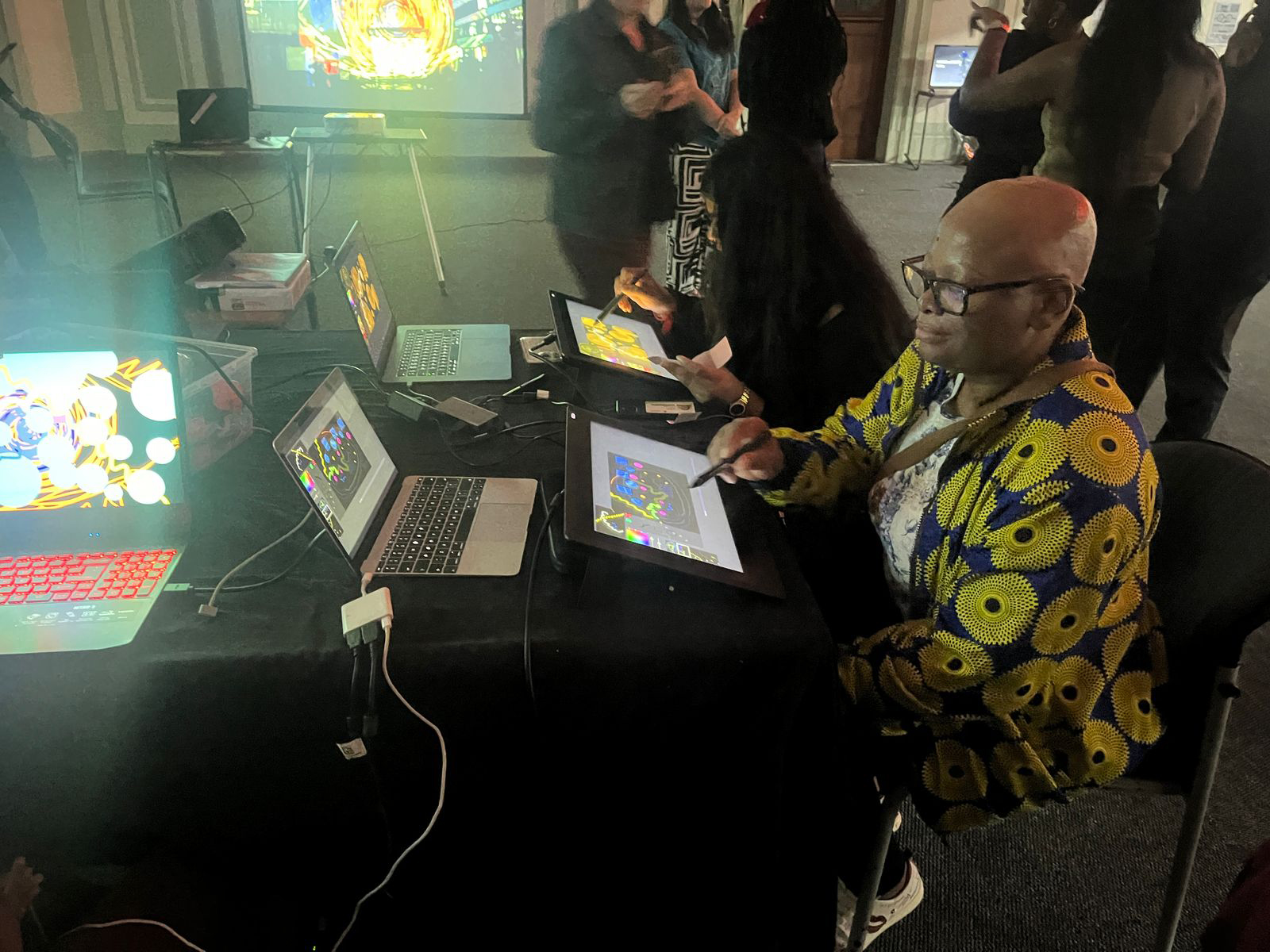
The South African set-up of Drawing Across Borders: Wacom tablets, projection screen, and artists gathered around the FRAMED interface during the live international drawing session. Pictured is Prof. Nobuhle Hlongwa, Dean of the School of Arts at the University of KwaZulu-Natal, in the Howard College building, 2025, University of KwaZulu-Natal. Source: UKZN Durban, photo by Michelle Stewart.
The networked studio remains in motion
Drawing Across Borders opens up the studio and demonstrates how digital collaboration today is not merely a technical matter, but a continuous renegotiation of space, visibility, and shared ownership. The networked studio that emerges from the project is not an endpoint but a point of departure: a mobile field in which infrastructure, people, and context continue to reconfigure one another. What appears today as a line or trace may tomorrow take shape as movement, sound, rematerialization, or performative intervention.
Crucial to this is the choice for open source, not as a style, but as an ethic: a political, pedagogical, and artistic positioning that understands digital autonomy as insight into and agency over the systems that shape our actions. Digital sustainability, moreover, proves not to be solely a global concern, but something built locally, through lightweight technologies, regional infrastructures, and practices that remain attentive to inequality.
The tangibility of the shared studio remains essential. By making digital processes visible in public space, in encounters, and on paper, it becomes clear that networked practices need not be distant, but can remain socially grounded. Artistic research in digital networks does not need to depart from grand technological promises, but from concrete situations, small and robust systems, and the alliances that emerge from them. Many of the collaborations that developed within this project have since outgrown their provisional nature and continue in new configurations, research questions, and formats.
It is precisely the frictions, glitches, delays, and breakdowns, that render the limits of digital systems visible and open moments of renewal. Friction does not need to be smoothed away, but can be embraced as a motor of artistic expression, as the moment when the system creaks and alternatives begin to surface. The strength of Drawing Across Borders lies not in control, but in generosity: the sharing of time, bandwidth, and frustration as a form of artistic proximity. No polished results, no aesthetically packaged solutions, but vulnerable points of contact where meaning settles into the noise.
There remains a need for research that does not embrace technology for its novelty, but interrogates it through artistic logics: open, simple, adaptable. Not a quest for yet another “next tool,” but practices that invite thinking along, imagining, and shaping from within. Digital autonomy is not a destination but a task: a continuous exercise in community, in the margins, in experimentation.
At the same time, the need for digital awareness is growing as technological systems become increasingly complex and opaque. Where the personal computer once emerged in a garage, with the promise of accessible self-building, we now live in a time in which millions of people use generative tools without insight into the mechanisms that steer their actions. Artistic research can form a necessary counter-movement here: not as a nostalgic return to the analogue, but as a critical practice that exposes how technology works, which assumptions it carries, and how it might be redrawn. This critical stance is essential to prevent the digital future from becoming a globalized reissue of existing paradigms, merely presented as progress.
By actively involving artists, designers, and researchers in the development, application, and reflection on technology, space opens for other ways of working: small-scale, contextual, sensitive to inequality, and driven by curiosity. This does not offer plug-and-play solutions, but rather working methods that shape systems from within, with those involved positioned as makers, not users.
Drawing Across Borders has marked a beginning. What follows is work: research, design, alignment. Not to fix things in place, but to keep them in motion. Not to offer a single model, but to continually rethink the studio as shared, mutable, and radically negotiable. Drawing Across Borders is not an answer; it is a proposition. And an invitation to keep drawing toward what has not yet been defined.
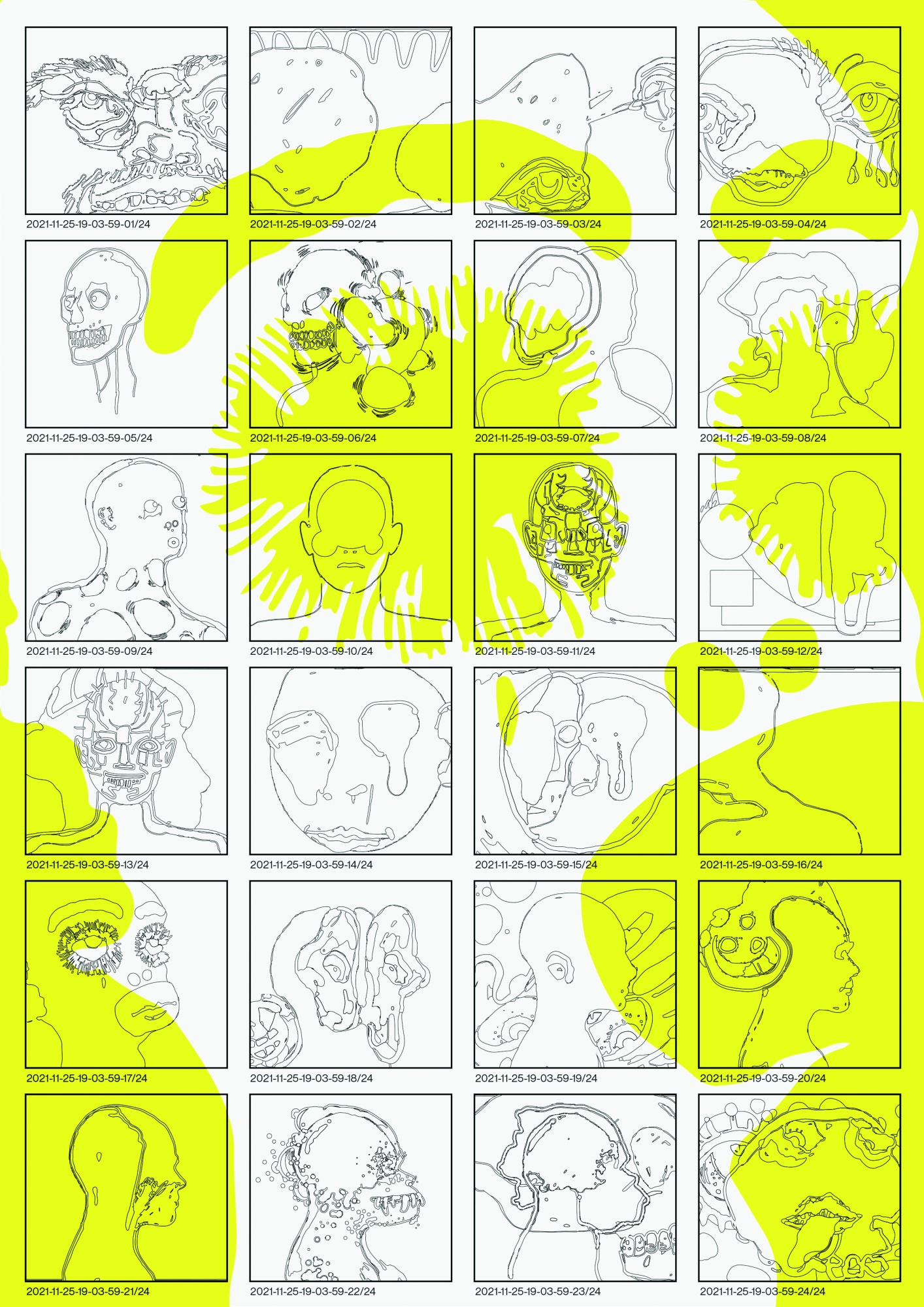
yellow?, graphic representation of one of the FRAMED events. The code indicates the date, the exact time the frame was saved, and the frame number, 2024, Royal Academy of Fine Arts Antwerp. Design by Annelise Cerchedean.
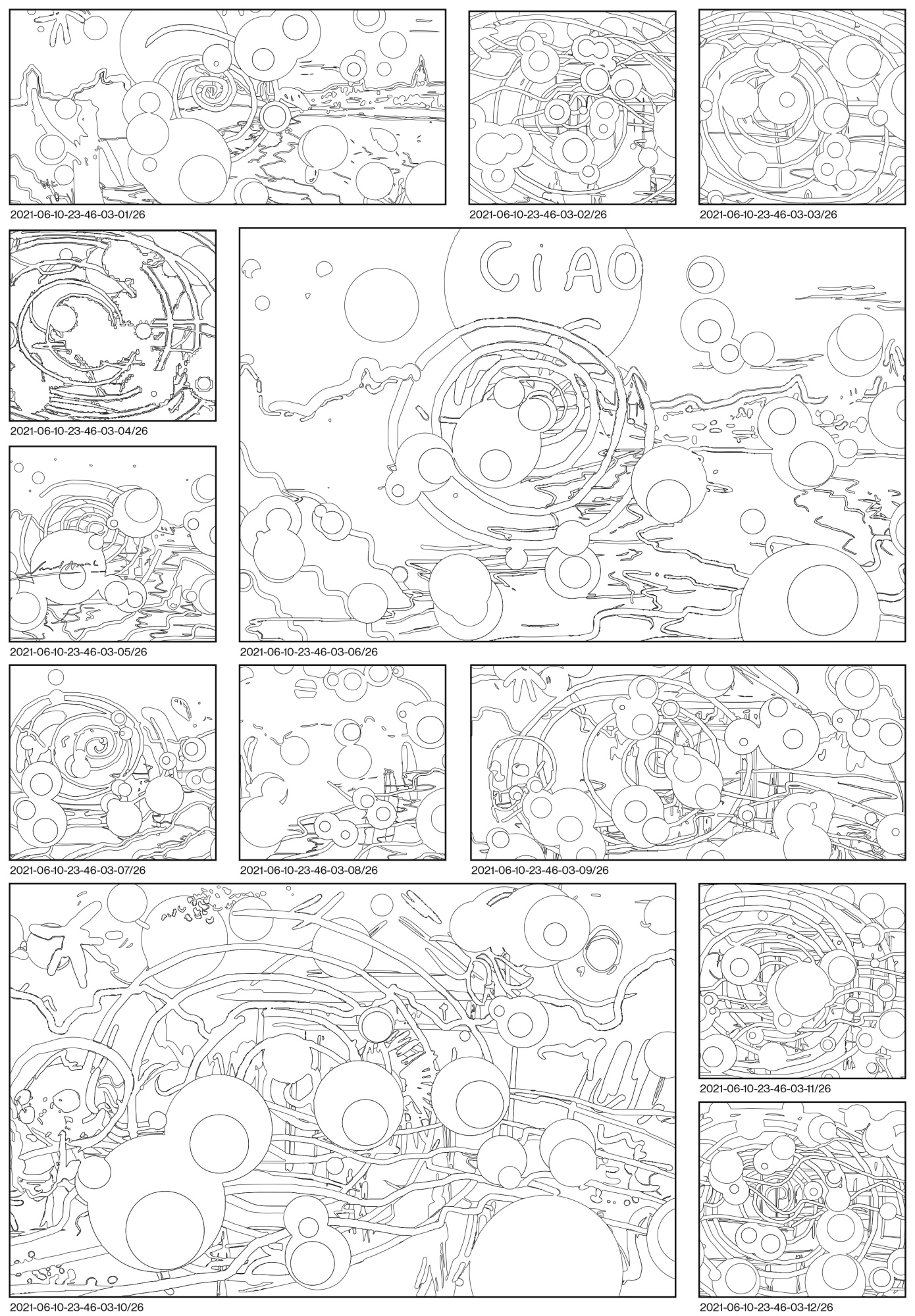
CIAO / FRAMED, graphic representation of one of the FRAMED events. The code indicates the date, the exact time the frame was saved, and the frame number, 2024, Royal Academy of Fine Arts Antwerp. Design by Annelise Cerchedean.
Acknowledgements
I would like to thank Kristí Fekete, Gina Poortman, and Philippe Meers for their valuable feedback on earlier versions of this article. Their insights helped refine the structure, focus, and clarity of the final text. My thanks also go to the collaborating teams in Antwerp, Kraków, Kentucky, and Durban, whose commitment made Drawing Across Borders possible. In particular, I would like to acknowledge the technical developers, local facilitators, and coordinators for their crucial role in building and supporting the networked studio environments.
Parts of this article were developed with the assistance of automated text refinement tools; the final work, however, remains my own, shaped through an iterative process of writing, rewriting, and critical reflection. The English-language review of the text was conducted by Jeremy Hugh Aston.
+++
Janna Beck
is an artist, designer, and researcher at the Royal Academy of Fine Arts Antwerp. Her work focuses on digital collaboration, shared authorship, and the studio as a mutable network. As the founder of the Maxlab research group, she develops projects that position technology as a co-creator.
Footnotes
- Király, Iosif. “Behind the Poster: The ‘Mail Art’ Movement.” House of European History – News, 28 Oct. 2022, www.historia.europa.eu/en/our-work/news/behind-poster-mail-art-movement. Accessed 2023; Chahil, André. “Vienna 1985: The Fax Art Phenomenon – Beuys, Warhol and Higashiyama Send a Signal to the Cold War.” andrechahil.com, n.d., www.andrechahil.com/vienna-1985-fax-art-phenomenon-beuys-warhol-and-higashiyama-send-a-signal-to-the-cold-war/. Accessed 2023. ↩
- Ascott, Roy. “La Plissure du Texte: A Planetary Fairy Tale.” Fondation Daniel Langlois, 1983, www.fondation-langlois.org/html/e/page.php?NumPage=200. Accessed 2024; Sermon, Paul. “Telematic Dreaming.” Paul Sermon – Telematic Art Projects, n.d., www.paulsermon.org/dream/. Accessed 2022; Goldberg, Ken. “The Telegarden.” Ken Goldberg / Telegarden Archive, 1995–2004, goldberg.berkeley.edu/garden/Ars/. Accessed 2023. ↩
- Goldberg; Castells, Manuel. The Rise of the Network Society. 2nd ed., Wiley-Blackwell, 2010. ↩
- Russell, Legacy. Glitch Feminism: A Manifesto. Verso, 2020, pp. 30, 133. ↩
- Engelbart, Douglas C. Augmenting Human Intellect: A Conceptual Framework. Stanford Research Institute, 1962, www.dougengelbart.org/pubs/papers/scanned/Doug_Engelbart-AugmentingHumanIntellect.pdf. Accessed 2024. Relevant pages for the description of “artifacts shaping human capability” and interaction logic: pp. 3-7, 19-25. ↩
- Beck, Janna, and Annelise Cerchedean. “FRAMED. Track Report.” Royal Academy of Fine Arts Antwerp, 2023. ↩
- On relationality and shared authorship in digital spaces: Bourriaud, Nicolas. Relational Aesthetics. Les Presses du Réel, 2002. ↩
- On participatory culture and collective meaning-making: Jenkins, Henry. Convergence Culture: Where Old and New Media Collide. NYU Press, 2006. ↩
- Bishop, Claire. Artificial Hells: Participatory Art and the Politics of Spectatorship. Verso, 2012, pp. 18–24; Bell, David M. The Politics of Participatory Art. 28 May 2015, eprints.whiterose.ac.uk/86339/4/WRRO_86339.pdf. Accessed 2023. ↩
More from this theme
Editorial
Falk Hübner
More from this edition
De mythe van het document. Naar een probabilistisch theater
Sandra Sara Raes Oklobdzija
The state of collective creativity within the site and upon arrival. Artists’ perspectives on the Liminal Lab project
Marija Griniuk
Double or nothing. A duet on mothering and artistic research
Mariske Broeckmeyer, Eva Moulaert