This article was part of FORUM+, pp. 20-21
Co-learning: Conversational, situated, and more-than-human pedagogies at Master’s level
Guus Vandeweerd, Anneleen Swillen
The Master’s seminar “S (or: exploring more-than-human entanglements in a post-digital culture)” at PXL-MAD grew from our research into more-than-human, co-creative practices, post-digital worlds, and phygital embodiment. Organized for, and with, students from Fine Arts, Graphic Design, and Object & Jewellery Design, the seminar draws from James Bridle’s Ways of Being to critically and creatively explore technological, ecological, cultural, and socio-political questions.
Het Masterseminarie “S (or: exploring more-than-human entanglements in a post-digital culture)” aan PXL-MAD groeide vanuit ons artistiek onderzoek binnen meer-dan-menselijke, co-creatieve praktijken, postdigitale werelden en fygitale belichaming. Het seminarie wordt georganiseerd voor, en met, studenten Vrije Kunsten, Grafisch Ontwerp en Juweelontwerp & Edelsmeedkunst en vertrekt van James Bridles Ways of Being om technologische, ecologische, culturele en socio-politieke vraagstellingen kritisch en creatief te onderzoeken.
Digital technologies are often developed from human-centred perspectives, overlooking relations with more-than-human actors, such as plants and animals, as well as machines and artificial intelligence.1 The book Ways of Being, by writer, artist, and technologist James Bridle, addresses this tension through “the interrelationships between technology and the world, its meaning and materiality, its impact and uses, beyond the everyday, deterministic fact of its own existence.”2 Each class of the Master’s seminar “S (or: exploring more-than-human entanglements in a post-digital culture)” at PXL-MAD School of Arts, Hasselt, takes one chapter of Ways of Being as a starting point for critical and creative reflections on themes, questions, and case studies from the book, and relates these to the works and exhibitions of contemporary artists and designers.
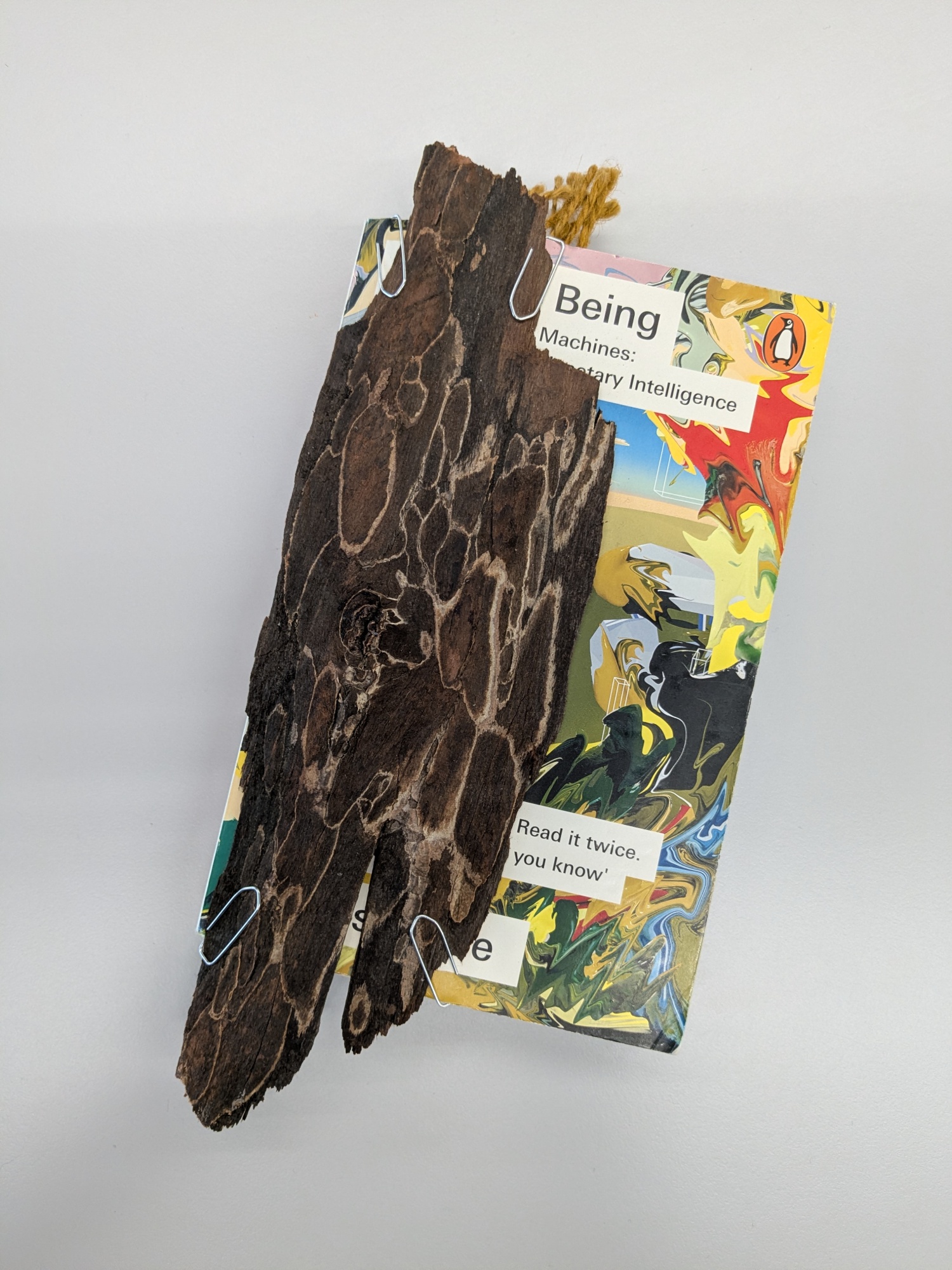
Fig. 2: Anneleen Swillen and Guus Vandeweerd, a participant’s book at the start of the semester, gradually layered with materials gathered in response to the readings, 2025-2026, mixed media. Photo by Anneleen Swillen.
Co-learning ecologies
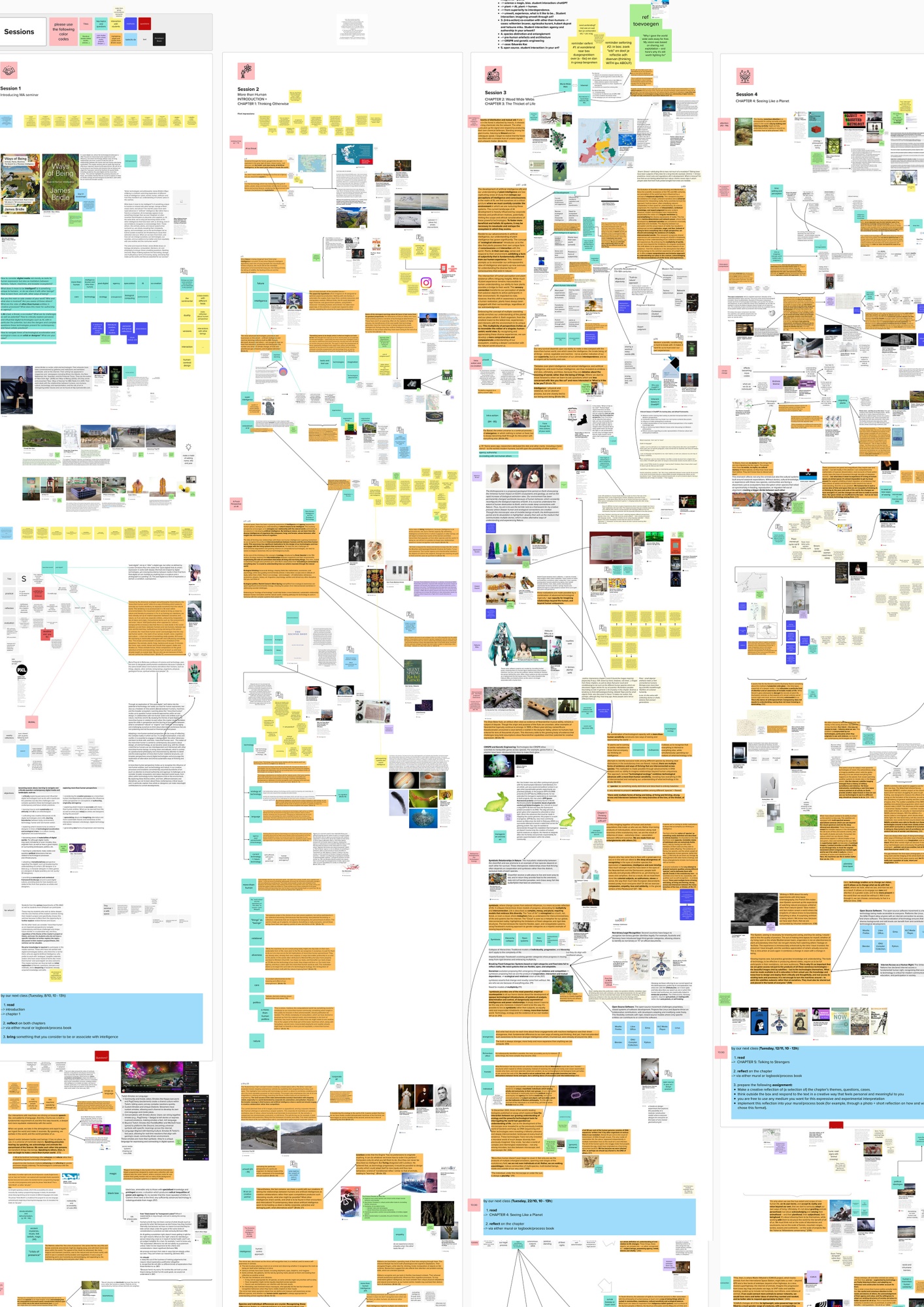
Fig. 1: Anneleen Swillen and Guus Vandeweerd, detail of digital mapping within the Master’s seminar “S (or: exploring more-than-human entanglements in a post-digital culture)”, 2024-2025. Digital whiteboard (Mural), screenshot. Photo by Guus Vandeweerd.
Throughout the seminar, we experiment with co-learning methods. Our approach is inspired by Donna Haraway’s idea of “sympoiesis”, or “making-with”, in which knowledge forms through relations.3 By working across diverse media and formats – literature and case studies, group discussions, presentations, walking, writing, artistic experiments – we aim to practise ecological thinking: attending to how ideas form through relations among environments, bodies, and technologies. This reflects a central concern in Bridle’s work, with particular attention to complexity, interrelatedness, interdependence, and the (re)distribution of control and agency. Alongside this, Calculating Empires: A Genealogy of Technology and Power Since 1500 (2023), created by researchers and artists Kate Crawford and Vladan Joler, serves as a key reference, tracing the entangled histories of power, technology, and ecology.4 Exploring non-linear mapping, participants develop their own research documents, in digital or analogue form, to reflect on Bridle’s book and connect ideas from their own practice (see Figs 1 and 2).
Nomadic co-teaching and more-than-human thinking
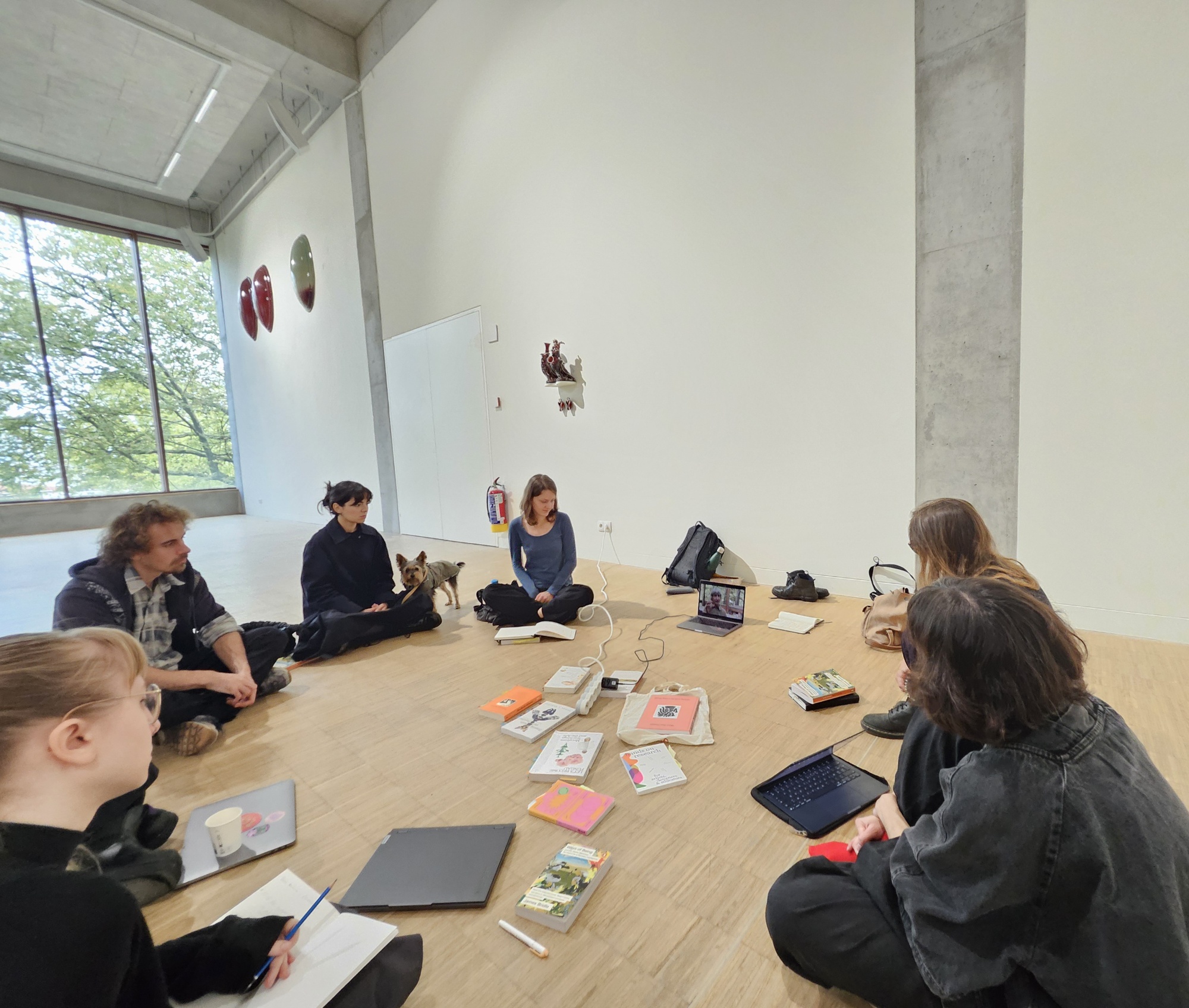
Fig. 3: Anneleen Swillen and Guus Vandeweerd, session “The Thicket of Life”, hosted in an exhibition by Marieke Pauwels at the MAD Gallery, reflecting on symbiosis, becoming-with, and shared forms of living, through visiting the exhibition, collective reading and watching Donna Haraway: Story Telling for Earthly Survival (directed by Fabrizio Terranova), PXL-MAD, 2025-2026. Photo by Guus Vandeweerd.
Each class is preceded by the individual reading of a chapter from Bridle’s book. During the live sessions, we gather in different environments, impacting how participants engage with the text, and with each other. So far, we have hosted sessions in cities, in parks, on buses, at exhibitions, and during second-hand book sales (see Figs 3-5). We aim to explore “nomadic co-teaching”, in line with philosopher and feminist theorist Rosi Braidotti’s understanding of nomadic subjectivity: “a situated and embodied consciousness that is critically aware of the conditions of its own production”.5
For the chapter “Wood Wide Webs”, we organized a session in a park. Participants engaged with the text by drawing, recording sounds, collecting materials, and writing. Through these actions, the park entered the conversation, allowing the text to be read together with what, and who, was present. Sitting on a path made of cut trees while discussing underground mycelium networks raised questions about origin, extraction, and connection. “Is this wood from the same environment, or does it come from elsewhere?” one of the students asked. The conversation shifted towards how connected systems become fragmented through deforestation.
In a session reflecting on the chapter “Talking to Strangers”, guest lecturer, artist and researcher Alicia Monreal presented her research practice. Drawing on collective sourdough bread making and the more-than-human organisms that constitute human bodies, she proposed cannibalism as a metaphor for becoming. Rather than framing consumption as extraction, Monreal considers cannibalism to be an ongoing process of mutual transformation, in which bodies, ideas, and environments continuously participate in each other’s making.6 The transformation of text, then, cannot be separated from the change of context.7 Reading becomes a form of digestion, in which meaning emerges through the conditions of its consumption. In this regard the presence and influence of nonhuman entities can be seen as part of the relational field in which thinking takes place, understanding space as a co-producer of thought and a pedagogical condition (see Fig. 6).
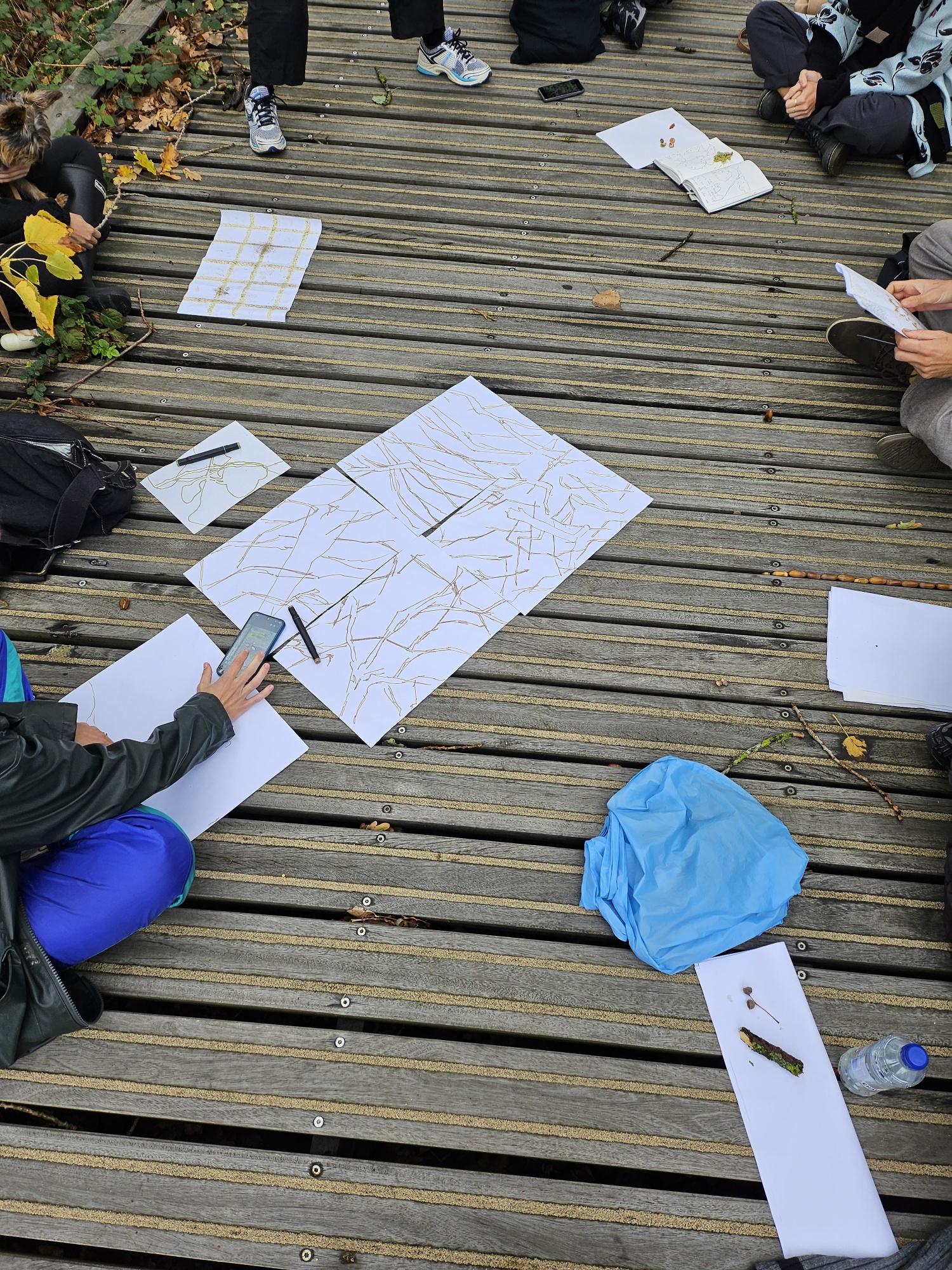
Fig. 4: Anneleen Swillen and Guus Vandeweerd, collective mapping during the session “Wood Wide Webs”, exploring different ways of engaging with the park at Prinsenhof, Hasselt, 2025-2026. Photo by Guus Vandeweerd.
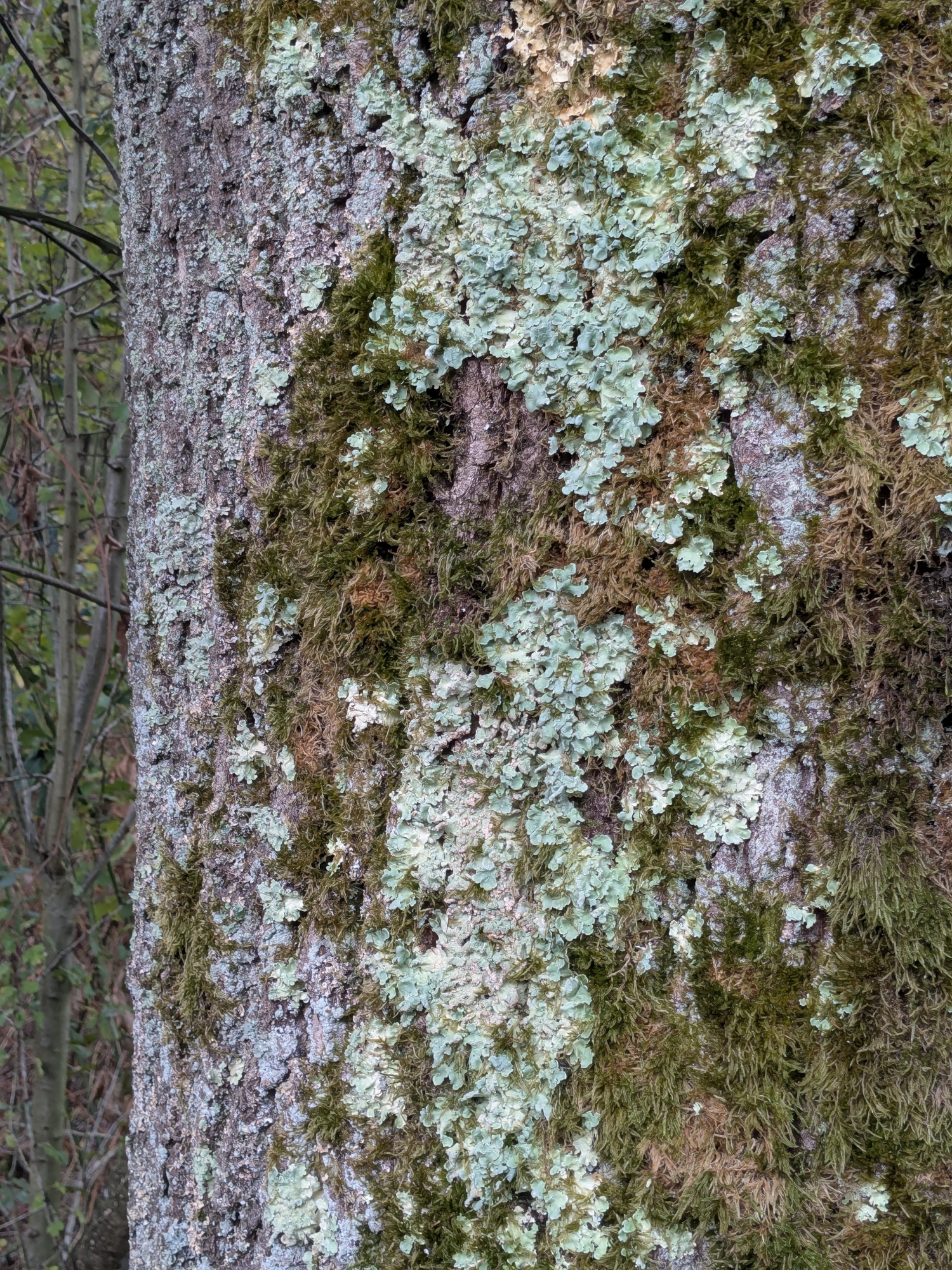
Fig. 5: Anneleen Swillen and Guus Vandeweerd, close-up of lichen and moss growing on tree bark, observed as part of a shared practice of listening to and mapping a park during the session “Wood Wide Webs”, Prinsenhof, Hasselt, 2025-2026. Photo by Anneleen Swillen.
Meaningful meandering
With artistic research at its core, the seminar focuses on how various kinds of knowledge emerge through relations between practices in which thinking and making are in a continuous dialogue. As part of the learning outcomes, students explore visual and conceptual languages that engage with social, cultural, and political questions; situate their work within broader historical and contemporary discussions; and question the role of the artist or designer within these contexts (see Fig. 7).
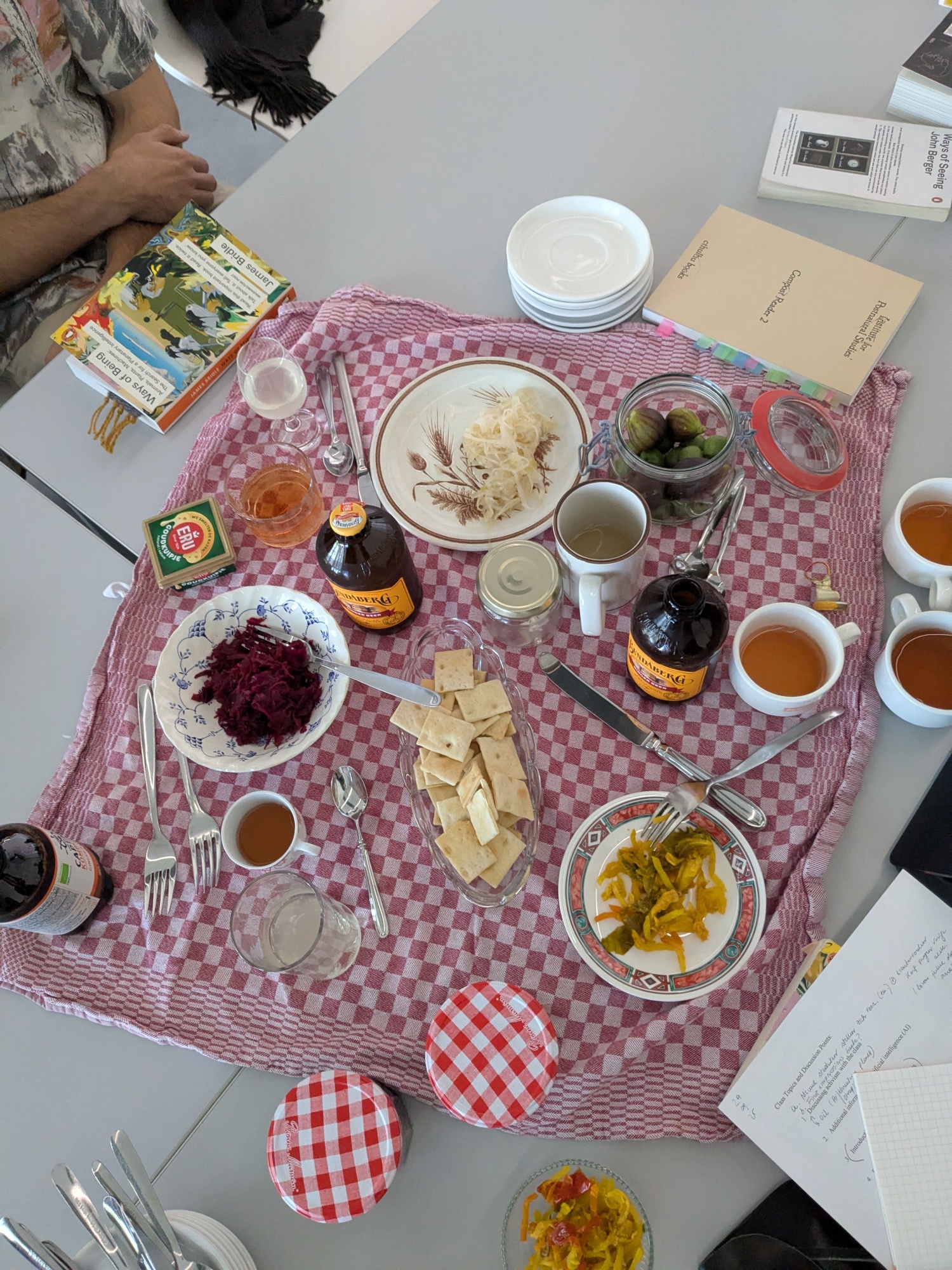
Fig. 6: Anneleen Swillen and Guus Vandeweerd, session on “Thinking Otherwise”, a gathering with fermented and pickled foods, exploring eating as a relational practice involving living ecosystems, 2025-2026. Photo by Anneleen Swillen.
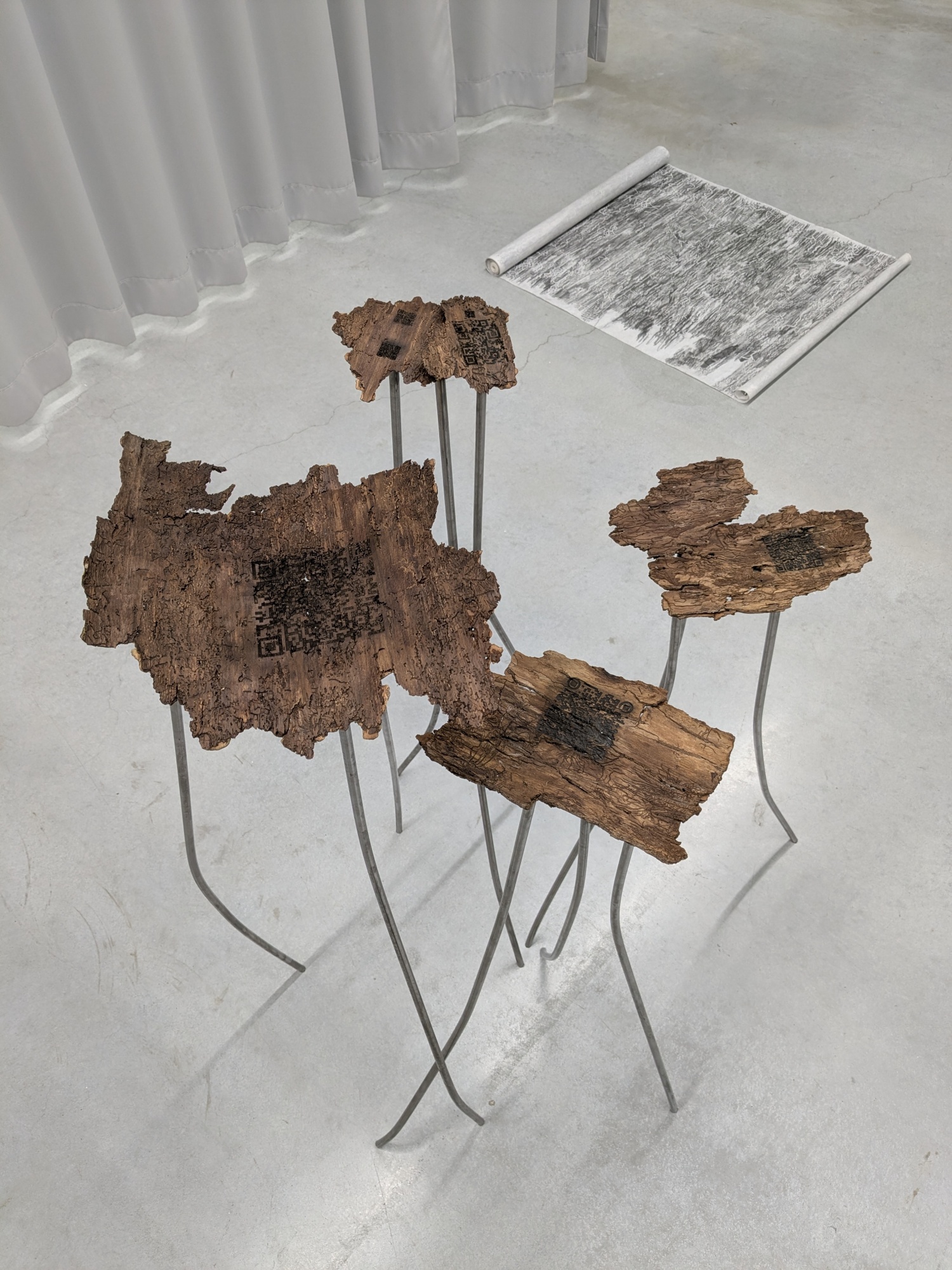
Fig. 7: Lise Van den Broucke, “Root Reader QR”, unreadable brain cloud of floating data, steel and laser-printed bark, part of an installation, 2025-2026. Photo by Anneleen Swillen.
Reflecting on the seminar’s first iteration (academic year 2024-2025), several considerations shaped our organization for 2025-2026. For example, we began experimenting with “nomadic co-teaching” and encouraged students to bring connections from a broader range of contexts. These included items from popular culture alongside artists’ and designers’ work and exhibitions, in an attempt to question the implicit hierarchies that tend to govern what counts as an appropriate reference in academic contexts, while remaining open to the value that can emerge from unlikely connections (a key strength of artistic practice). As the classes are conversation-driven, an ongoing question, and exercise, concerns how closely to remain with the assigned material (the text or topic at hand) and how much to welcome digression. This resonates with a reflection by one of the students:
What stayed with me most was the freedom and safety the format created. The group discussions felt like a book club, an accessible way to share and debate ideas, where digressing was just as welcome as staying on topic. Ways of Being changed the way I looked at everything I thought I already knew. The freedom of the seminar allowed me to relate to knowledge differently, and it has had more influence on me as a maker than I realized at the time. I think people underestimate the power of a book club. What I valued most was the space – in an educational context, but also beyond it – to open things up, which influenced me as a person and as a thinker, and, through that, indirectly as a maker.
Some sessions felt genuinely alive with student-driven conversation, while others gravitated towards a more conventional classroom setting, with the teachers’ voices central and the students mainly listening. This led us to reflect on how participation can be further supported through the seminar’s structure, and how responsibility for the conversation might be shared more openly – for example, by inviting students to take turns leading a session. This also ties in with our attempt to create space for different kinds of knowledge and ways of knowing, encouraging students to share from their experience, trust their own voice, and recognize that even a seemingly small skill or idea can be valuable. In this way, we are pursuing a more horizontal model of knowledge-sharing, one without a fixed hierarchy, where expertise can take many forms, recognizing that we are all continuously learning, and that we can do so in many ways. This calls for truly, and respectfully, listening to one another, mindful that understanding is itself plural.
Overall, participants shared that they valued the connections formed with one another, the conversational format, the atmosphere of trust, the breadth of themes explored, and the insights gained into artistic research. These reflections affirm our commitment to continuing this course as an ongoing invitation to (re)read, (re)think, (re)make, and question together. Looking ahead, we hope to open the seminar to students from various departments and universities, fostering even broader cross-disciplinary collaborative exploration.
Acknowledgements
We would like to extend our gratitude to all participants in the seminar, both human and more-than-human, and to PXL-MAD for their invaluable support in making this experimental course possible. Thank you for the time, space, resources, and trust that allowed this work to unfold.
+++
Guus Vandeweerd (he/they)
is a designer and researcher focusing on nonhuman avatars and more-than-human design. He is a PhD researcher in the arts at PXL-MAD and Hasselt University. His work spans research-led teaching, writing, and speculative design.
Anneleen Swillen (she/her)
works as a researcher and lecturer at PXL-MAD and Hasselt University. Through research in the arts, education, curation, and writing, she explores futures adornment, more-than-human co-creation, and (e)merging bodies in a post-digital age.
Footnotes
- The term “more-than-human”, theorized and popularized by philosopher and ecologist David Abram (1996) but rooted in Indigenous ontologies that view humans and “nature” as inseparable, encompasses “non-humans and others than humans, such as things, objects, other animals, living beings, organisms, physical, geological forces, spiritual entities and people” (de la Bellacasa, María Puig. Matters of Care. Speculative Ethics in More Than Human Worlds. University of Minnesota Press, 2017, p. 1). It stresses humans’ intrinsic interdependence with larger ecosystems, foregrounding how human intelligence is always already interwoven with other thinking and sensing entities (Jaque, Andrés, Marina Otero Verzier, and Lucia Pietroiusti, editors. “Editorial.” More-than-Human, Het Nieuwe Instituut, Serpentine Galleries, Office for Political Innovation, Manifesta Foundation, 2020, pp. 6-9). Using this term helps to focus on relations with other beings and how these relations affect us mutually. We favour this term over “non-human” or “other-than-human” in this text: the former risks the kind of erasure-through-negation seen in terms like “non-male” or “non-white” (Donna Haraway, cited in More-Than-Human Design in Practice, 2024), while the latter, though valuable in stressing difference rather than what mistakenly can be seen as a hierarchy, does not (yet) carry the same grounding in an established academic framework that we wish to refer to here. For a more detailed discussion on the terms “more-than-human”, “non-human” and “other-than-human” and their potential use and meaning within design research, see “Introduction” by Rosén and others in More-Than-Human Design in Practice. ↩
- Bridle, James. Ways of Being: Animals, Plants, Machines: The Search for a Planetary Intelligence. Penguin Random House, 2022, pp. 14-15. ↩
- Haraway, Donna J. Staying with the Trouble: Making Kin in the Chthulucene. Durham, NC, Duke University Press, 2016. ↩
- Crawford, Kate, and Vladan Joler. Calculating Empires: A Genealogy of Technology and Power since 1500. 2023, www.calculatingempires.com. Accessed 16 Dec. 2025. ↩
- Minozzo, Ana Carolina. “Rosi Braidotti’s ‘Nomadic Subjects’.” The Palgrave Handbook of Psychosocial Studies, edited by Stephen Frosh et al. Palgrave Macmillan, 2022, pp. 1-21. ↩
- Monreal, Alicia. Guest lecture on cannibalism, collective sourdough practices, and more-than-human entanglements. Master’s seminar “S (or: Exploring More-Than-Human Entanglements in a Post-Digital Culture)”, PXL-MAD School of Arts, Hasselt (online), 1 Dec. 2025. ↩
- See also Donna Haraway’s concept of situated knowledges, which holds that all knowledge is produced from a particular, embodied position rather than a neutral standpoint: Haraway, Donna. “Situated Knowledges: The Science Question in Feminism and the Privilege of Partial Perspective.” Feminist Studies, vol. 14, no. 3, 1988, pp. 575-99. ↩
More from this theme
Educational research in the arts: a practice-based and nomadic perspective
Joost Vanmaele, An De bisschop
The Museum of Internet
Nanó Wallenius
More from this dossier
The future of research in the arts: challenges and opportunities
Anne-Sophie Van Schepdael
Nurturing musician-educators’ reflective practice through a Blended Intensive Programme on practitioner research
Mathias Moors, Adri de Vugt, Thomas De Baets
More from this edition
From the mountain I see the mountain. Shifting landscape perception through filmmaking, encounters, and indigenous archives
Julián García Long