Dit artikel verscheen in FORUM+, pp. 8-9
Thinkering as method. Two educational laboratories at the nexus of research and artistic practice at Koninklijk Conservatorium Brussel
Jeroen Billiet
This article presents two student-centred educational laboratories at Koninklijk Conservatorium Brussel: the 19th-Century Salon (2022) and the Synthetists Brass Ensemble Project (2023). Rooted in staff research within #RES19+, both projects invited students to explore the past through hands-on engagement with historical technologies, repertoire, and ensemble practices. They show how thinkering can operate as a method through which artistic research, education, and performance practice become mutually reinforcing.
Deze bijdrage presenteert twee studentgerichte educatieve laboratoria aan het Koninklijk Conservatorium Brussel: de 19th-Century Salon (2022) en het Synthetists Brass Ensemble Project (2023). Beide initiatieven bouwden voort op onderzoek van medewerkers binnen #RES19+ en nodigden studenten uit om het verleden al doende te verkennen via historische technologieën, repertoire en ensemblepraktijken. Zo tonen zij hoe thinkering kan functioneren als methode waarbij artistiek onderzoek, onderwijs en uitvoeringspraktijk elkaar versterken.
Introduction: Artistic research as an experiential encounter with the past
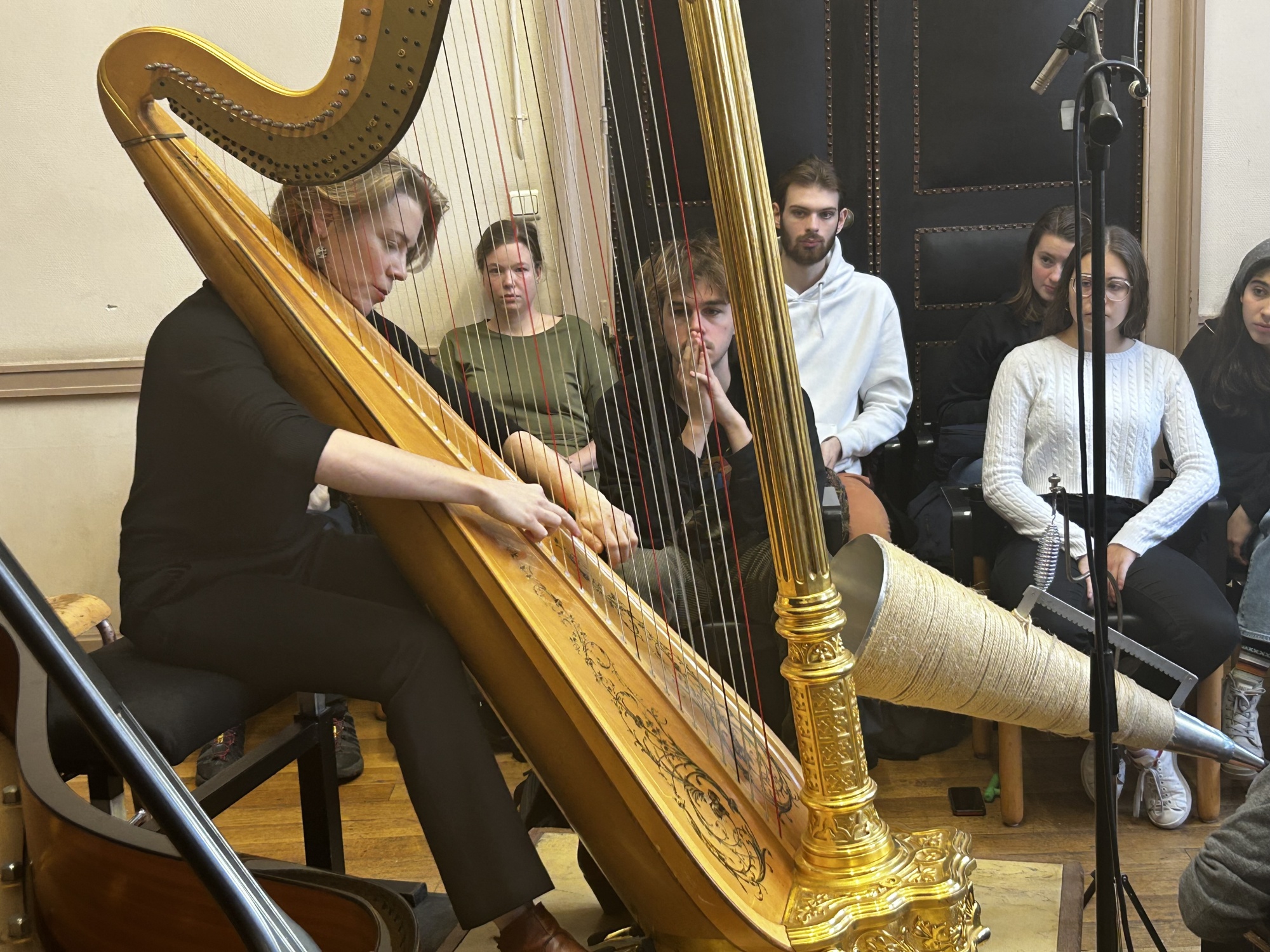
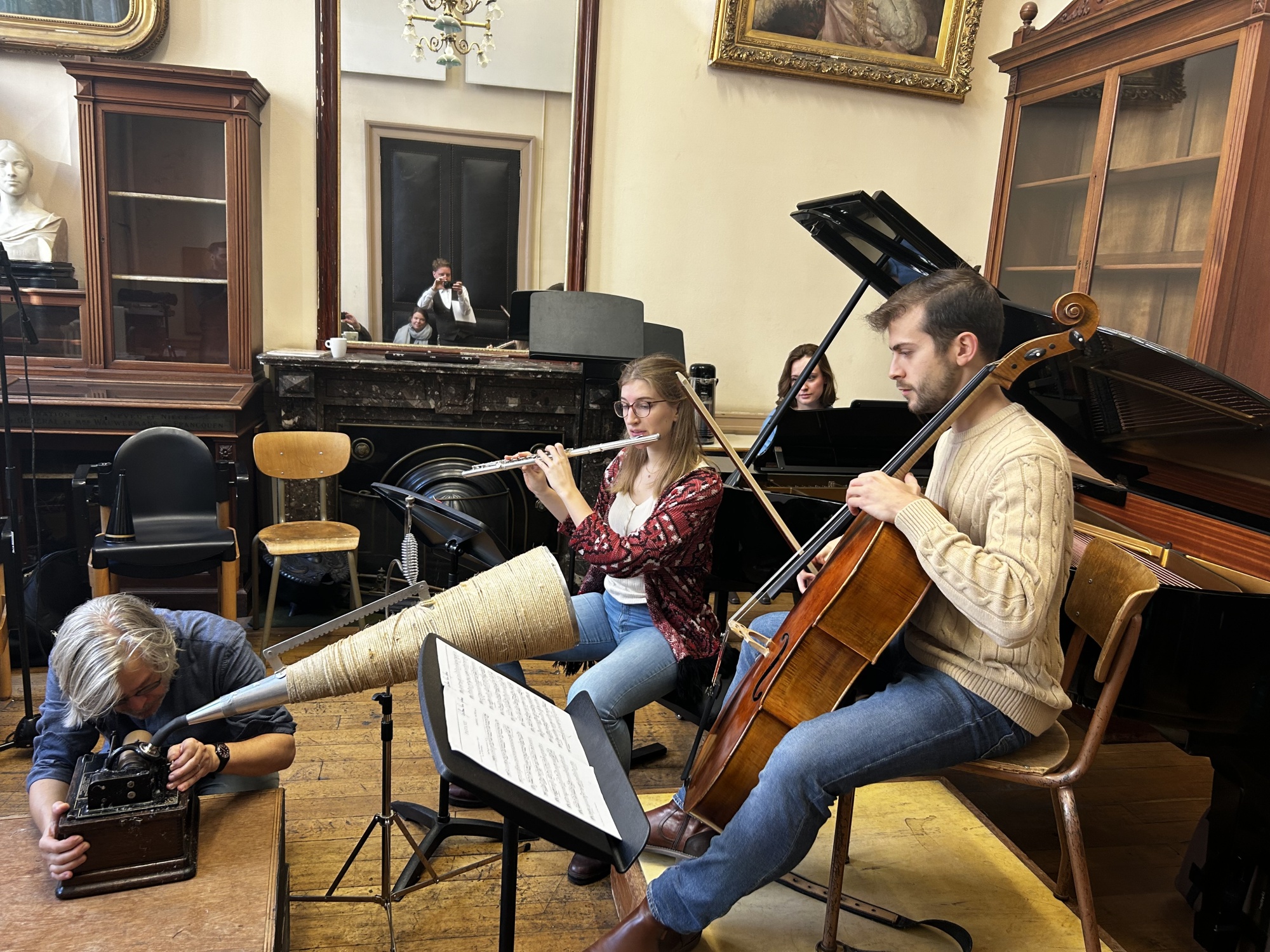
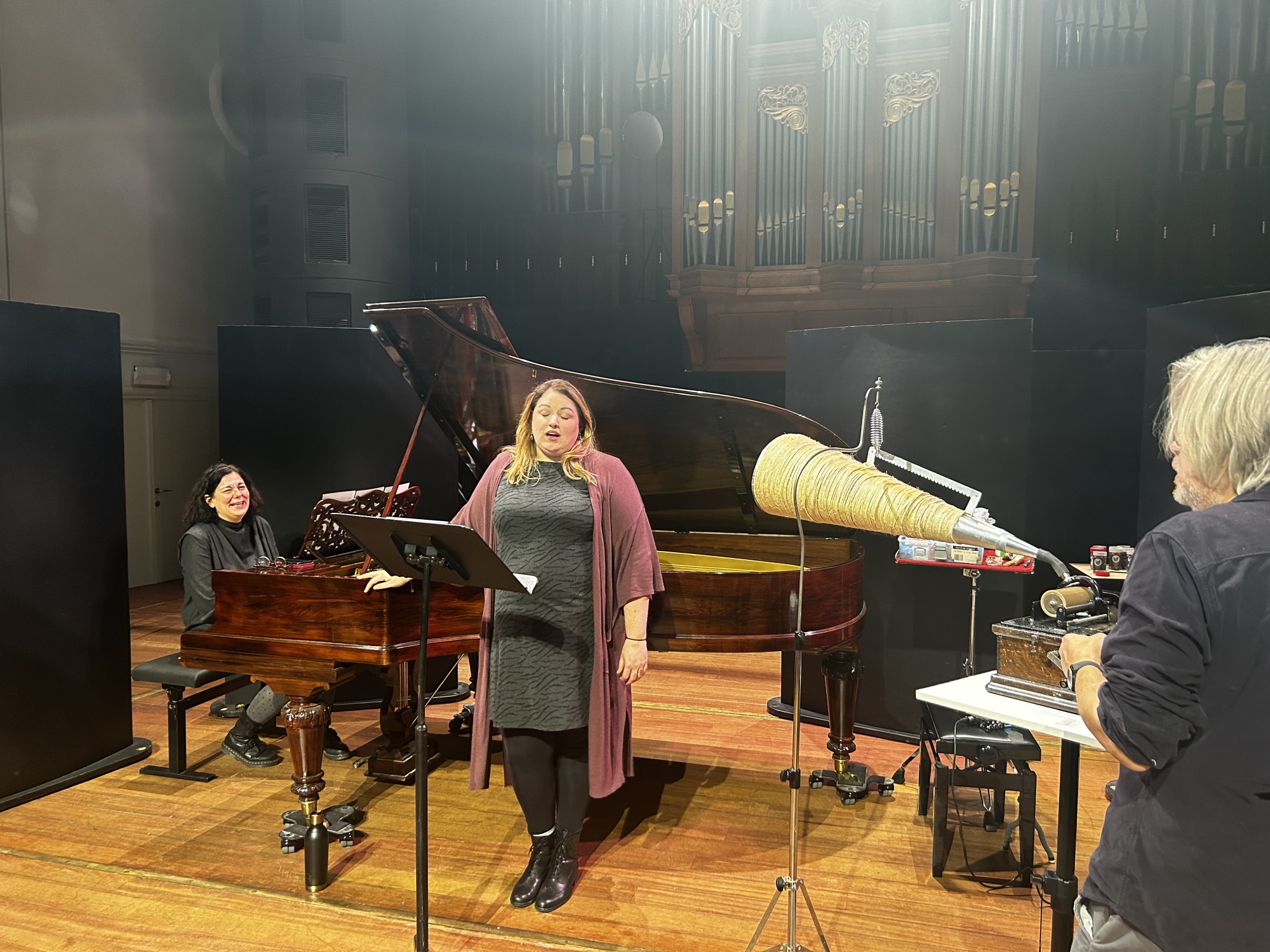
Figs 1-3: Koninklijk Conservatorium Brussel and KASK & Conservatorium. Students, alumni and teachers of KCB and KASK & Conservatorium thinkering with acoustic recording processes, December 2022.
Koninklijk Conservatorium Brussel (KCB) encourages researchers, teaching staff, and students to approach research as a way of “being in practice” – a reflective and inquisitive stance embedded in creative processes. These two case studies on linking research projects to this vision rest on the conviction that research thrives when it is rooted in experience, in practice, and in the dialogical encounter between performer, repertoire, and context.
Within this framework, the KCB research group Osiris – renamed #RES19+ since 2024 – has played a pioneering role. Its focus on the long nineteenth century’s musical cultures, historical performance practices, and the ways musicians engage with the past through sound, instruments, and interpretation has generated a series of projects that blur the boundaries between education and research. Central to #RES19+ is Hans-Georg Gadamer’s understanding of “the historical experience”: the past is not a fixed body of knowledge to be transmitted, but something encountered, negotiated, and reimagined through practice.1 This resonates with a long Gevaertian tradition2 of practice-based artistic research at KCB, in which performers do not simply “reproduce” the past but “meet” it, allowing both past and present to illuminate each other.
Two recent student-focused initiatives embody this research ethos: the 19th Century Salon (2022) and the Synthetists Brass Ensemble Project (2023). Both were inspired by research projects of KCB staff and were designed as environments where students could explore the past through doing – through hands-on engagement with historical technologies, repertoires, and ensemble cultures. Media archaeologist Erkki Huhtamo introduced the term ‘thinkering’ for a learning method based on reflective practices while handling objects.3
Andreas Fickers and Annie van den Oever further describe how students not only deepen technical and stylistic understanding through experiential engagement but also participate directly in research processes while negotiating – and thinkering – with historical materials, confronting unfamiliar sound worlds, reflecting on stylistic choices, and discovering how the past becomes meaningful through performance.4 Thus, research becomes an integral part of the artistic trajectory rather than an academic add-on.
1. The 19th-Century Salon: Media-archaeological learning in practice
The 19th-Century Salon brought together an international team of performer-scholars associated with the Early Recording Association – Inja Stanović (University of Surrey), George Kennaway (University of Leeds), David Milsom (University of Huddersfield), Emily Worthington (University of York), and Jeroen Billiet (KCB) – for an immersive exploration of nineteenth-century performance practice.5 This was realized through two acoustic recording sessions held on consecutive days, the first at KCB and the second at KASK & Conservatorium, with a morning lecture by researchers in the field between the two sessions. The project aligned with Jeroen Billiet’s own research practice at KCB, strongly embedded within #RES19+.
At the centre of the project stood a simple yet transformative act: students and teachers recorded short musical excerpts on wax cylinders using an original Edison phonograph, guided by Stanović and early-recording specialist Aleks Kolkowski.6 The constraints of the medium – limited duration, impossibility of editing, the direct and unforgiving responsiveness of the acoustic horn – compelled participants to rethink their musical strategies. Instead of analysing early recordings from a distance, students engaged in a direct, physical dialogue with the technology that shaped them. The project operationalized the very premise articulated in Stanović and Billiet’s 2023 article in Music and Practice, that early recording technologies can function as methodological partners in artistic research.7
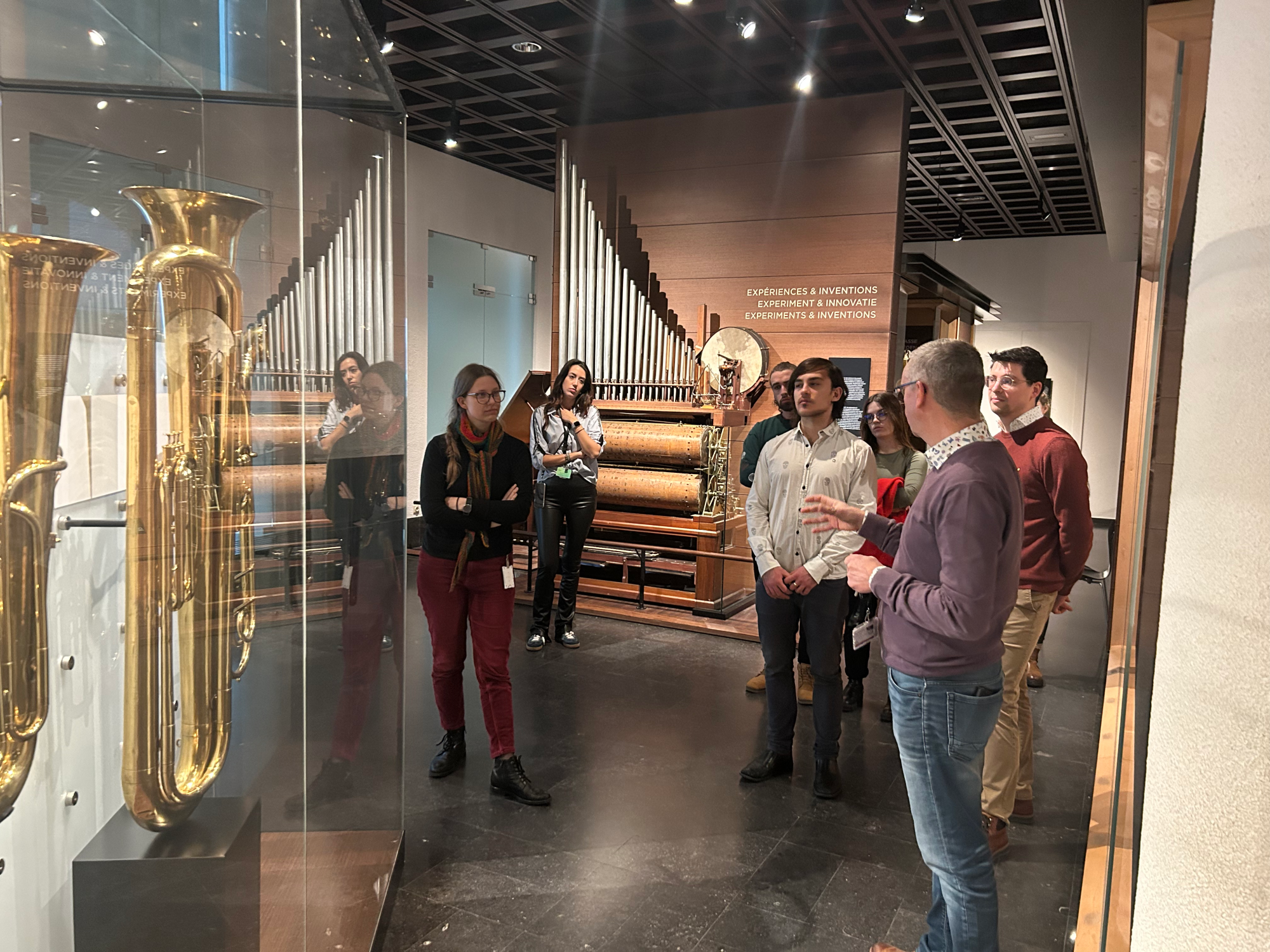
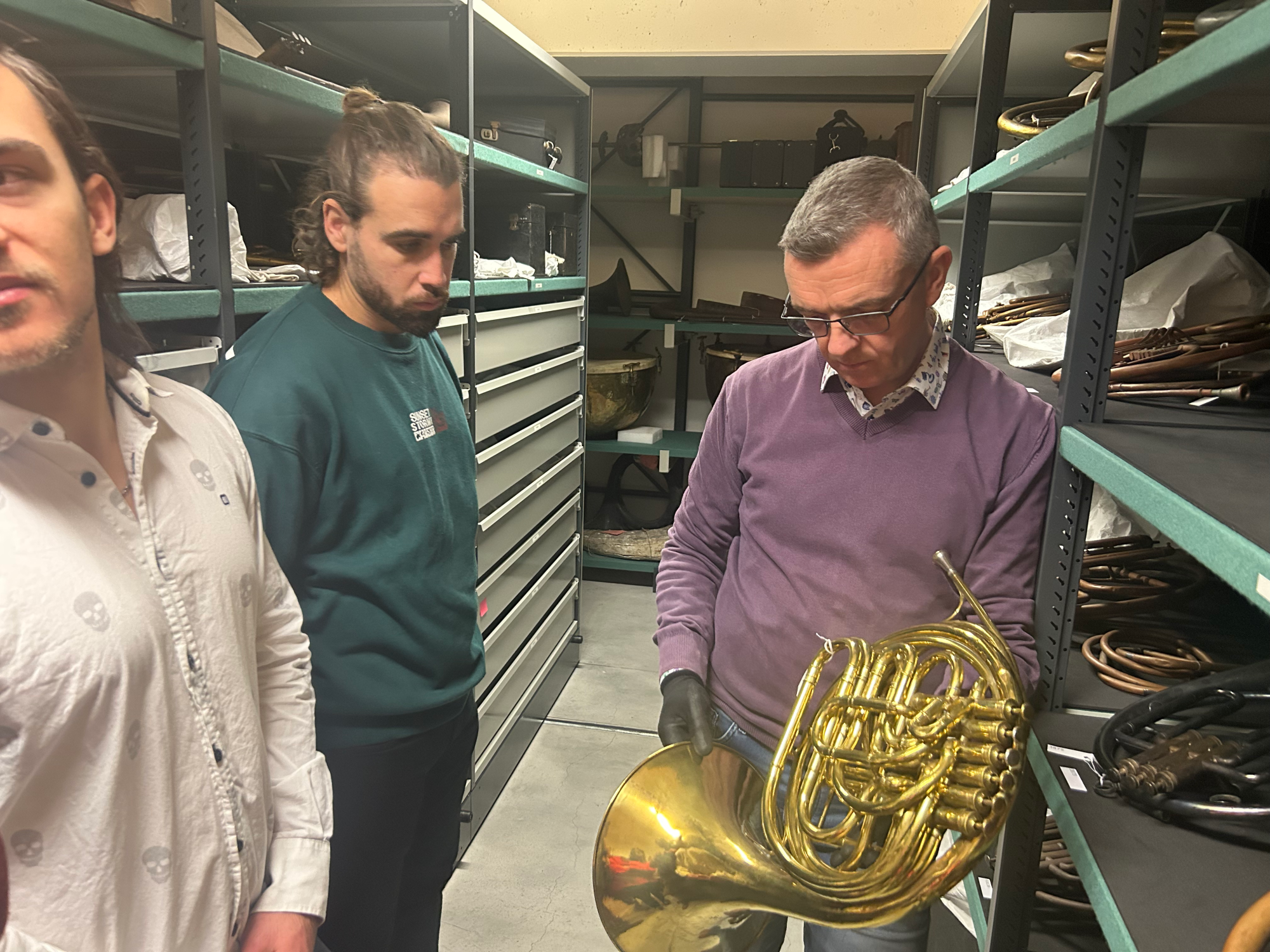
Figs 4-5: Koninklijk Conservatorium Brussel and KASK & Conservatorium. Visit to the Musical Instruments Museum reserves in Brussels, November 2023.
Over two days, the Salon produced a wide spectrum of recordings: solo piano, voice, horn, cello, harp, clarinet, mixed chamber ensembles, and even a jazz combo. It included also public sessions with KCB professors such as Jan Michiels, Agnès Clément, and Philippe Lamouris, and key people in the Belgian musical field such as soprano Jolien De Gendt. This diversity revealed how different sound worlds interact with the phonograph, highlighting its sensitivities to register, attack, projection, and spatial placement. The thrill and excitement of the attending audience seemingly brought the atmosphere of the early recording era truly back into life: after each take, performers and audience gathered around the machine to hear the playback directly from the wax cylinder – an auditory experience described by students as “magical,” “fragile,” or “strangely intimate”. Students also reported significant shifts in how they perceived their own playing. Across these materials, students learned that early recordings are not primitive versions of modern technology, but distinct artistic environments with their own aesthetics, demands, and expressive possibilities. In this way, the Salon became a laboratory where the past revealed itself through practice – not as a stable object, but as an experience that unfolds in the act of making music.
A pianist noted that he had to phrase “more directly, with fewer colouristic nuances”, which paradoxically made his expression more intentional. A clarinettist found herself amplifying articulation and dynamics far beyond her usual practice. A horn player remarked that the medium forced him to “physically redefine” his sound to be captured at all.
A constant interplay emerged between historical inquiry, physical experience, and artistic reflection. The cylinders that failed, the balance issues, the near-impossibility of capturing the sound of the piano in a balanced way– all became catalysts for discovery. The Salon shaped an encounter with historical sources in which the experiment was the very source of insight. Rather than teaching concepts, the project created conditions in which students had to think conceptually and methodically. In this way, the Salon became a model for integrating artistic research into education: by allowing understanding to arise from doing, testing, and confronting the unexpected.
2. From “Fanfare Wagnérienne” to “Les Synthetistes”: Reconnecting with a lost pedagogical tradition
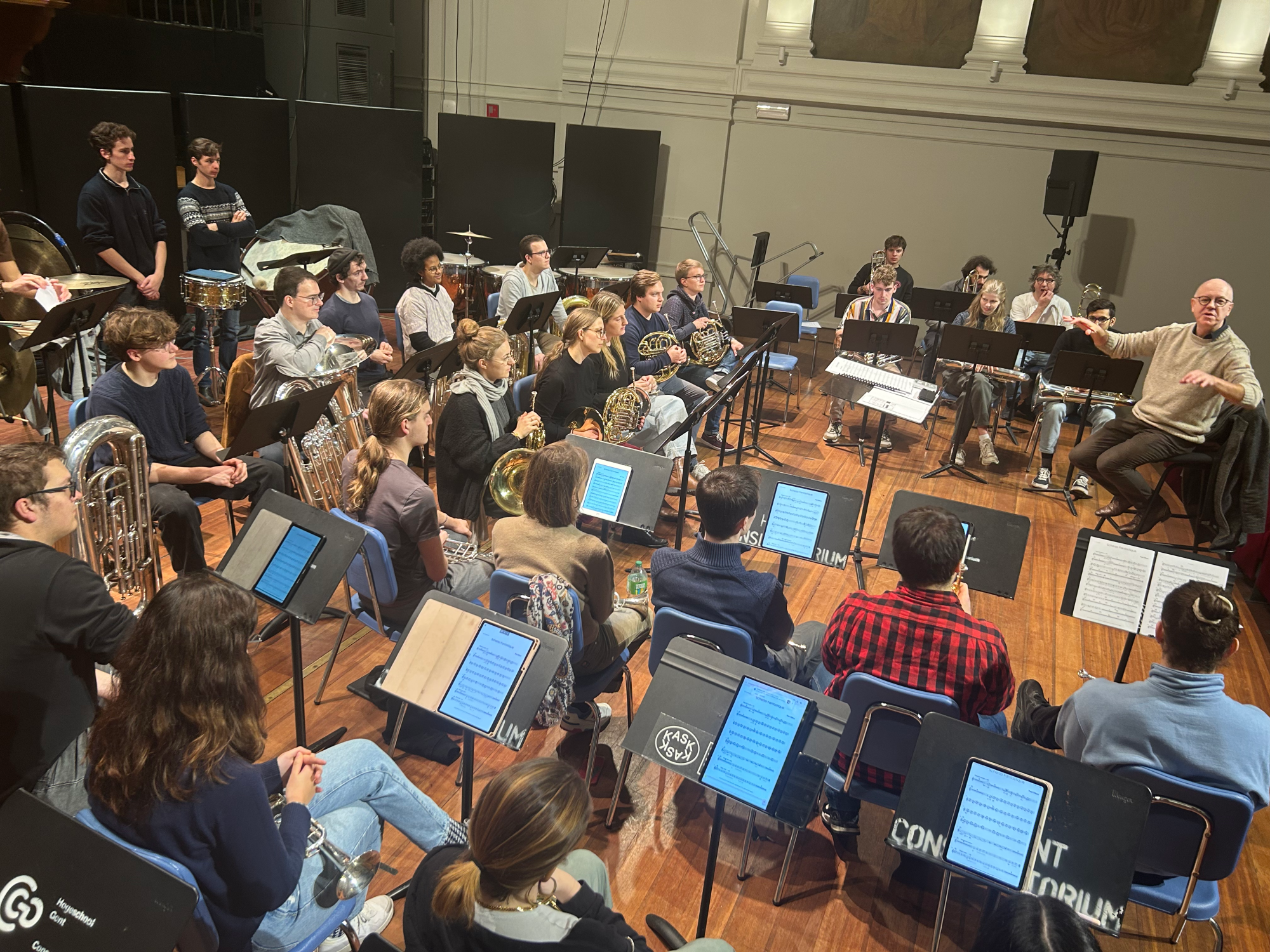
Koninklijk Conservatorium Brussel and KASK & Conservatorium. Rehearsal in Miry hall, Ghent of the alliance brass ensemble, Synthetists project, November 2023.
The second project, Synthetists Brass Ensemble Project, brought together music students from KCB, KASK & Conservatorium, and the Royal Conservatoire Antwerp in a large brass ensemble that functioned as a historical laboratory in its own right. The initiative was grounded in the doctoral research of Luc Vertommen, whose work has reconstructed the repertoire, instrumentations, and cultural context of the “Fanfare Wagnérienne” (established at KCB in 1894) and its later continuation within the interwar composers’ circle “Les Synthetistes”. Vertommen’s doctoral research provided the musical and historical foundations on which this ensemble project could be built.
Originally conceived by Gevaert as a training environment for the KCB brass class, the Fanfare Wagnérienne introduced students to ensemble playing from 1894 onwards. It was developed in collaboration with acoustician Victor-Charles Mahillon and trombonist Henri Séha. Because no repertoire existed for this new type of ensemble, Gevaert commissioned original works from composers such as Paul Gilson and August De Boeck, thereby launching a tradition that would later be continued by Belgian modernists including Marcel Poot, Gaston Brenta, Jules Strens, and René Bernier. The 2023 project returned to this moment with explicit educational intent: not only to revive a largely forgotten repertoire but also to reconnect with the original pedagogical logic through which it emerged. In collaboration with the Brussels Musical Instrument Museum, a study day was organized, including visits to the museum’s rich instrument collections. This widened the project’s scope, extending towards that of an organological specialist course. Three concerts with the ensemble at different locations allowed the students’ entry into a largely unfamiliar sound world.
A notable dimension of the project was the way Vertommen’s research effectively closes a historical circle: by re-establishing the brass ensemble as a central artistic and pedagogical practice, KCB reconnects with a tradition that once lay at the core of conservatoire training. What began as archival research now returns as a living artistic-educational model. Based on the insights and outcomes of this project, the KCB brass faculty now intends to integrate a large brass ensemble project at least twice across the five-year educational programme.
Conclusion
Both featured projects embodied the performance-oriented research ethos of KCB and #RES19+: research and education become meaningful when they unfold through experiment rather than prescription. Instead of presenting historical knowledge as fixed, the Salon and the Synthetists ensemble invited students and teachers to construct understanding together, through practice. Crucially, the workshops were led by performing researchers who combined theoretical insight with hands-on experiments – giving these encounters a depth and immediacy that cannot be achieved in traditional theory classes or standard music productions. In doing so, the projects reflected the research vision of Koninklijk Conservatorium Brussel, where artistic research is conceived as an open, participatory, and practice-based process. At the same time, these projects offered the researchers themselves valuable opportunities: working with a new generation of practitioners widened their artistic and scholarly perspective, exposing them to aspects of performance and interpretation that only emerge in real, embodied situations. By encouraging this reciprocal exchange, the projects made research something not merely taught but genuinely lived.
[Disclaimer]
GPT-5.4 was used in a supportive editorial capacity for translations, language enhancement, and the structuring of the abstracts. All intellectual content, research arguments, and final substantive choices remain the responsibility of the author.
+++
Jeroen Billiet
is professor of horn and natural horn, researcher, and educational developer at Koninklijk Conservatorium Brussel. He holds a doctorate in the arts from Ghent University and develops research at the intersection of performance, history, and pedagogy, with a focus on horn history, changing educational paradigms, and the study and re-enactment of early recordings.
Noten
- Gadamer, Hans-Georg. Truth and Method. Part 1. Continuum International Publishing Group, 1975. ↩
- At the end of the nineteenth century, director F. A. Gevaert installed an immersive education model for artistic education based on research, performance and instruction at the Brussels conservatoire. See Billiet, Jeroen. “C’est Aux Fruits Qu’on Connaît l’arbre. Het Belgische Muziekonderwijs Tijdens Het Civilising Offensive van de Belle Époque”. FORUM+, vol. 30, no. 3 (2023), pp. 48-57. doi.org/10.5117/FORUM2023.3.009.BILL. ↩
- Huhtamo, Erkki. “Thinkering with Media: On the Art of Paul DeMarinis”, in Buried in Noise, edited by P. DeMarinis. Heidelberg: Kehrer, 2011, pp. 33-39. ↩
- Fickers, Andreas, and Annie van den Oever. Doing Experimental Media Archaeology – Theory. Doing Experimental Media Archaeology 1. De Gruyter, 2022. ↩
- See also: www.youtube.com/playlist?list=PL04AVub12r4EK0bEEY6Sk6bG4apZROEw4. Accessed 1 Aug. 2026. ↩
- For more information about the practice, purpose, and goal of acoustic recording re-enactments see Kolkowski, Aleksander, and Tim Van der Heijden. Doing Experimental Media Archaeology – Practice. De Gruyter, 2023; also Moreda Rodríguez, Eva, and Inja Stanović, editors. Early Sound Recordings: Academic Research and Practice. London: Routledge, 2024. ↩
- Stanović, Inja, and Jeroen Billiet. “(Re)constructing Early Recordings: Reviving the Brave Belgians”. Music and Practice, 10 (2023). ↩
Meer van deze auteur
Meer in dit thema
Dwell / Act / Transform. Drie perspectieven op een expo over artistiek onderzoek
Anke Coumans, Peter Sonderen, Ruth Benschop, Sara Malou Strandvad
Meer uit dit dossier
The Winter School as a research laboratory. A pedagogical interruption in the curriculum
Ellen Gillard, Jori Galama