This article was part of FORUM+ vol. 33 no. 1, pp. 74-75
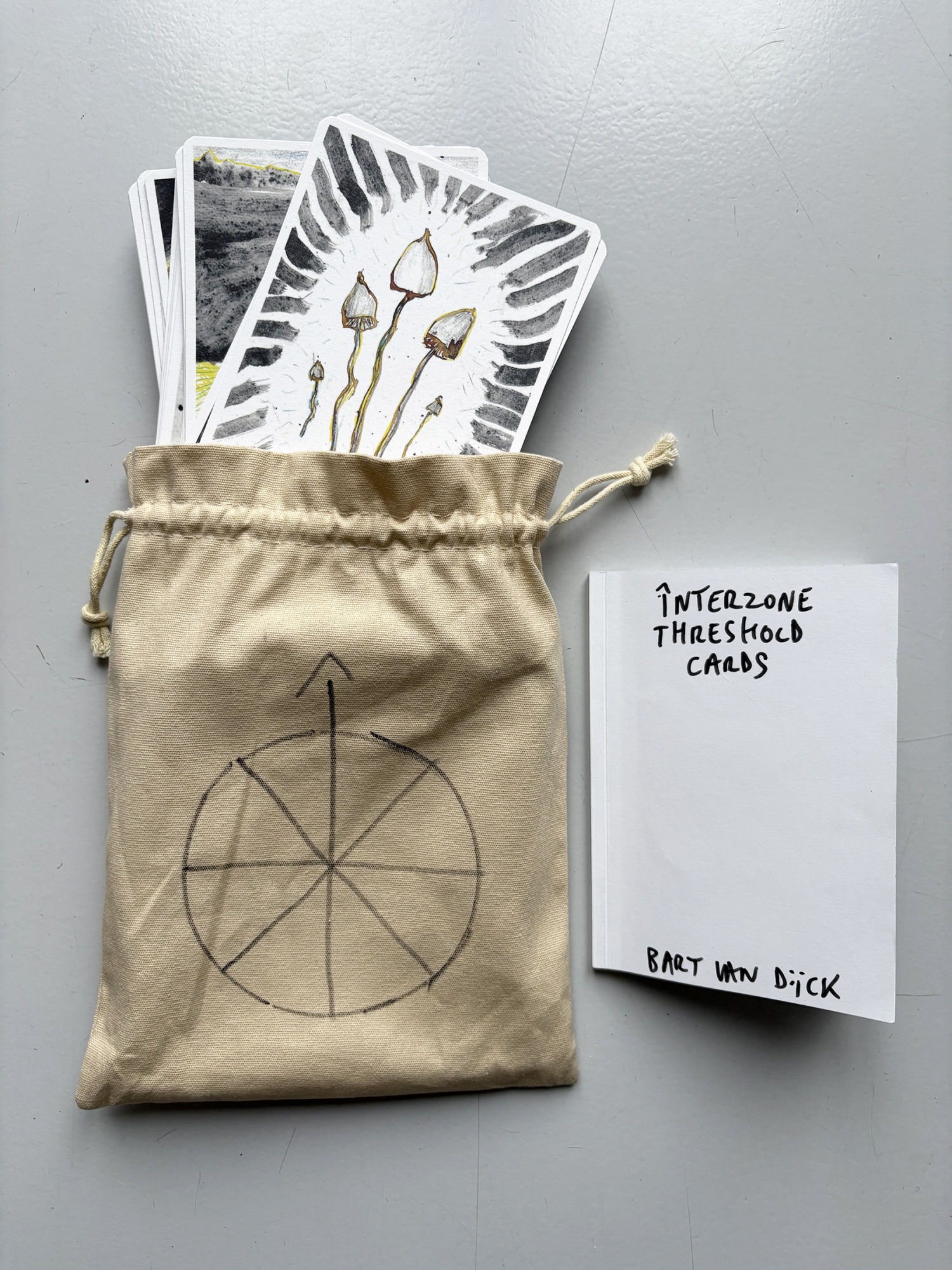
Van Dijck, Bart. ÎNTERZONE Threshold Cards deck, Royal Academy of Fine Arts Antwerp, 2025. Photo by Tina Lenz.
By reviewing Bart Van Dijck's ÎNTERZONE Threshold Cards deck, I was triggered in the direction of various associations. I have a Rider Tarot Deck illustrated by Pamela Colman Smith, which I consult from time to time to reflect on the visual elements of the chosen cards.1 Over the last years, I have drawn several wands cards, with “Queen of Wands” emerging as a recurring encounter. Then a friend introduced me to The Wild Unknown Animal Spirit Deck and Guidebook, spreading out all its animal cards, illustrated by Kim Krans, on a table before us.2 I drew the card that intuitively invited me to turn it over. The illustration of the whale, described in the guidebook as a “sensitive delver with profound peace and ancient wisdom”, resonated deeply with me.
Speaking of ancient wisdom, I am reminded of philosopher Bruno Latour’s discussion of how the Earth was once perceived as a symbolic force, a meaningful cosmos. There has always been a connection between the cosmos and politics. Nowadays, the Earth is literally present in our politics, and Latour warns us: we’re not equipped for that. We can’t vibrate with the disruptions of the Earth system anymore.3 According to Latour, raising awareness about ecological changes is necessary to make the Earth’s vibration visible.
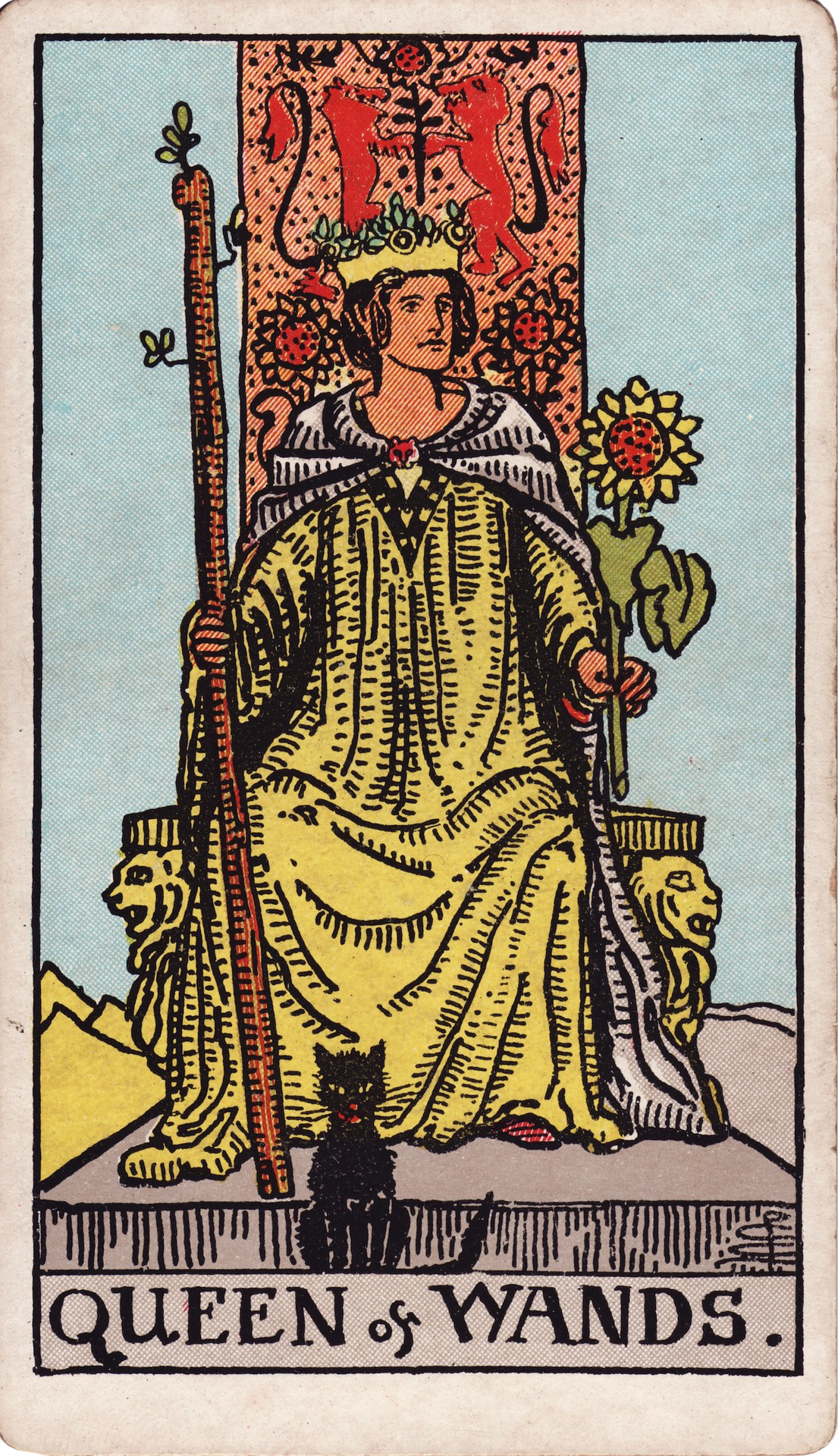
Queen of Wands, 75 x 120 mm, Wikimedia Commons.
In examples of ways to evoke (super)natural awareness, I was motivated by sociologist Richard Sennett, reading his book Together: The Rituals, Pleasures and Politics of Cooperation. He advocates for cooperation through the creation of rituals that teach us to navigate together and bridge differences. Sennett demonstrates, throughout history, modern social networks and online interactions, how collaboration has eroded, and how we can restore it by communicating in a deeper way through specific, learned behaviours, and rituals.4 As anthropologist and cognitive scientist Dimitris Xygalatas writes:
The performance of collective ceremonies allowed people to set their everyday worries aside and be transported, albeit temporarily, to a different state. And as a ritual must always adhere to a rigid structure, participation in collective ceremonies established the first social conventions for early humans.5
This return to rituals finds unexpected expression in contemporary art. Where art and religion used to be at odds, a growing movement of artists now embrace spirituality inspired by all kinds of religions and folklore beliefs. Reclaiming the value of rituals allows us to create new meanings in modern society, where relics and imaginary spaces create a vital role in fostering trust and collective recognition. Xygalatas elaborates:
We humans appear to be unique in our ability to communicate complex abstract ideas and concepts, not only about the here and now but also about other times and places – even imaginary ones. We do this not just through art, narrative and myth but also through ritual.6
Researcher and artist Bart Van Dijck gives emotions and perceptions a visual place at the intersection of art and science, helping people to think beyond existing systems. In 2025 he presented his doctoral defence ÎNTERZONE (architecture of the ritual space) at the Royal Academy of Fine Arts Antwerp. His art practice is based on experimenting with participation, collaboration, and ritualization, using ecology and spirituality in a social context by creating ritual spaces and sparking radical imagination within communities.
During his research, Van Dijck became inspired by the traditional rites of passage, as studied by anthropologists Arnold Van Gennep and Victor Turner. These transition rituals were organized and enacted by entire communities, where elders passed on their knowledge. Van Dijck observes that today, however, organizing a rite of passage has become increasingly difficult, because most of us no longer live in such communities. Yet he finds the zeitgeist on his side in the philosopher Byung-Chul Han who, in his manifesto The Disappearance of Rituals: A Topology of the Present, defines rituals as symbolic techniques of stabilizing life to make oneself at home in the world. Today, time lacks this solid structure: “we might expect a re-enchantment of the world to create a healing power that could counteract collective narcissism”.7 Han experiences the way in which the erosion of shared rituals has triggered a crisis within communities, resulting in fragmented identities, extreme individualism, and increased reliance on digital communication. He encourages a return to performing rituals together, for grounding meaning through the binding power of collective feelings.
Rites of passage give structure to life in the same way seasons do. Whoever passes a certain threshold has concluded a phase of life and enters into a new one. Thresholds, as transitions, give a rhythm to, articulate, and even narrate space and time. They make possible a deep experience of order.8
Van Dijck’s dissertation offers an incredible performative oeuvre around self-made rites of passage. His publication ÎNTERZONE Threshold Cards embodies the collection of rituals for liminal phases he has performed over recent years. The 91-page handbook reads as an exhibition catalogue, with all cards represented by visualizations dealing with change, growth, decay, and the cycle of the seasons. However, his intent goes further. In Van Dijck’s advice, the cards are even designed to be used independently: “You can consult the cards for inspiration. They can offer answers to specific questions or inspire new insights. They can spark conversation or interaction. They can be particularly helpful in a ritual context, at threshold moments, or during a period of change. Sometimes they can even behave like magical helpers. They can confirm, suggest, or question.”9
Nonetheless, when testing the threshold cards, it’s hard to do the reading autonomously with the narratives of their illustrations. Building a spiritual deck takes more than a set of beautiful drawings with explanatory text. To develop an engaging card activity, a prototype should be iterated and tested with participants to understand what questions they bring in and in which way they interact with the symbols in the absence of the creator. It requires knowledge of oracle card history – how illustrations of tarot operate. The Rider Tarot is a popular deck first published by manufacturer William Rider & Son in 1909, based on the instructions of academic and mystic scholar A. E. Waite and illustrated by visual artist Pamela Colman Smith. The deck is mythical in scope, with Waite’s vision for allegorical characters like The Fool, The Sun, The Lovers, and so on. Smith transformed these symbols into image-laden scenes, which make the cards more generative instead of prescriptive.
In the 19th century, there was an idea that art was an expression of the unconscious and that it would elicit unconscious non-rational ways of thinking about the world. Smith represents a strain of artists in early American Modernism who were disaffected with materialism and rationalism, but who were also unsatisfied with organized religion and so turned toward more occult pursuits.10
Smith possessed a deep understanding of iconography, revealing subtle layers of information. Her illustrations encode meaning and evoke contemplation. Van Dijck’s deck has the same appeal, but his design lacks this gentle grounding. Decoding the symbolic thresholds of his oracle deck produces little resonance. Searching for guidance and structure, without clear orientation, I find myself in transit, unsure how to navigate my imagination. For insights of ancient wisdom and to explore radical meaning about the universe, I hope to encounter the PhD researcher himself and receive the magical help of a personal card reading or ritual gathering.
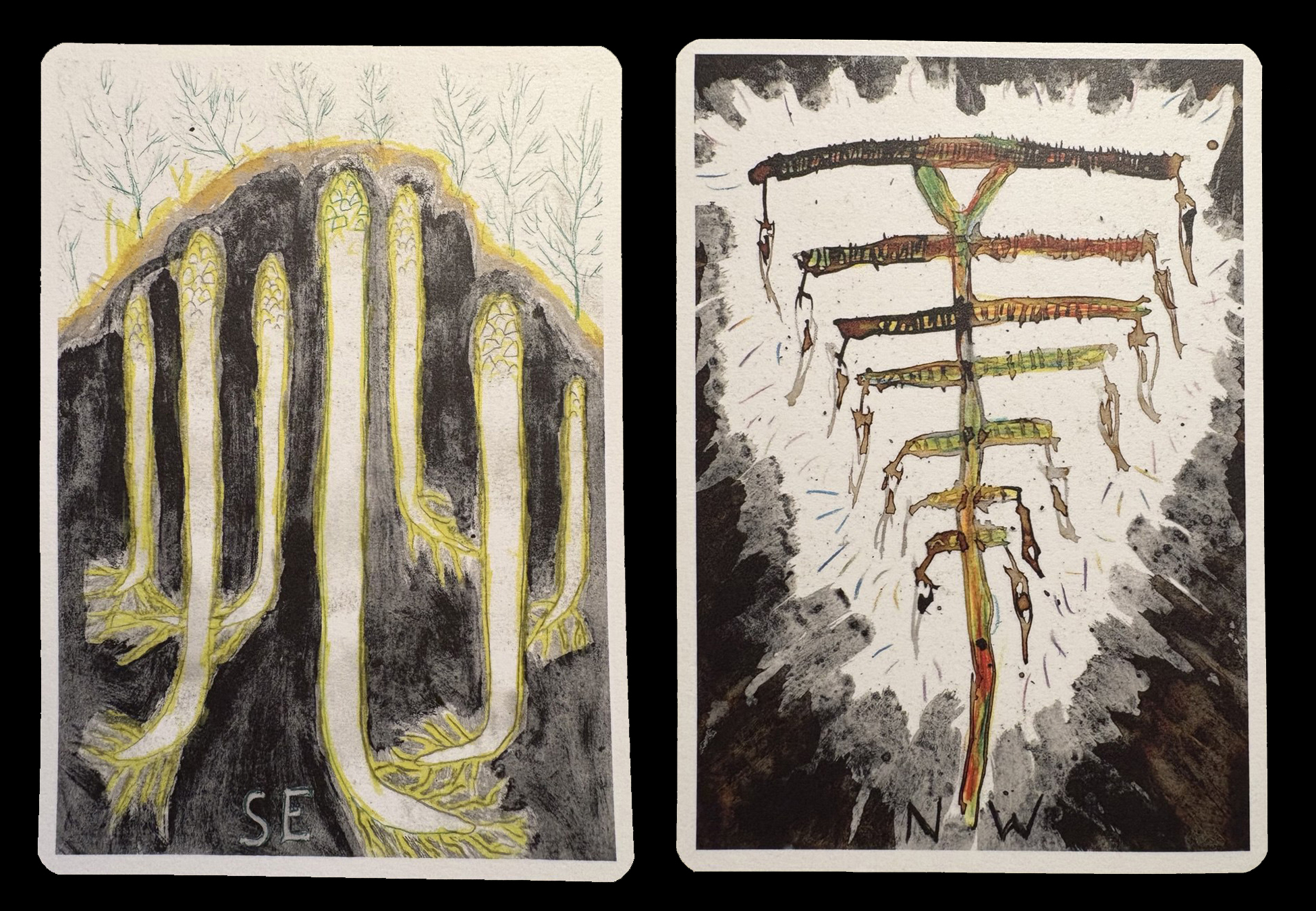
Bart Van Dijck, “Seven White Asparagus” and “Ancestor Sculpture”. ÎNTERZONE Threshold Cards deck, 2025. Photo by Tina Lenz.
+++
Tina Lenz
works at the intersection of design, anthropology, and participatory art. Her fieldwork is based on cultural sensitivity, using daily tools in co-creation, to activate radical imagination. Existing conditions, places and rituals are collectively mapped, visualized and reimagined to let alternative futures unfold.
Footnotes
- Waite, A. E. The Rider Tarot Deck: The Authentic Rider-Waite Tarot Deck. Illustrated by Pamela Colman Smith, U.S. Games Systems. ↩
- Krans, Kim. The Wild Unknown Animal Spirit Deck & Guidebook. HarperCollins Publishers Inc. ↩
- Van Rootselaar, Florentijn. “Bruno Latour: ‘We kunnen ons de veranderingen nog niet voorstellen’.” Filosofie magazine, 2016, www.filosofie.nl/bruno-latour-we-kunnen-ons-de-veranderingen-nog-niet-voorstellen/. Accessed 7 Feb. 2026. ↩
- Sennett, Richard. Together: the rituals, pleasures, and politics of cooperation. Yale University Press, 2012. ↩
- Xygalatas, Dimitris. Ritual: How seemingly senseless acts make life worth living. Little Brown Spark, 2022, p. 31. ↩
- Xygalatas, p. 27. ↩
- Han, Byung-Chul. The disappearance of rituals: A topology of the present. Polity Press, 2020, p. 26. ↩
- Han, p. 35. ↩
- Van Dijck, Bart. Handbook for ÎNTERZONE Threshold Cards deck. Track Report (Royal Academy of Fine Arts Antwerp), 2025, www.ap-arts.be/publicatie/interzone-threshold-cards-bart-van-dijck. Accessed 11 Feb. 2026. ↩
- White, Katie. “Pamela Colman Smith Was the Artist and Occultist Who Designed the Iconic Tarot Deck. Why Has No One Ever Heard Her Name?” Artnet News, 2022, news.artnet.com/art-world/pamela-colman-smith-rider-waite-tarot-2163627. Accessed 7 Feb. 2026. ↩
More from this theme
Precipitates*
Robbert&Frank Frank&Robbert
(RE)REGISTERED
Anton Cotteleer
Disruption in the research studio
Thomas Crombez
More from this edition
Double or nothing. A duet on mothering and artistic research
Mariske Broeckmeyer, Eva Moulaert
John’s care
Anaïs Chabeur
More in this section
Superior musical theatre
Toon Brouwers
Beyond theatre (history) confines
Edith Cassiers