Dit artikel verscheen in FORUM+, pp. 12-13
This article explains how the author translated his ‘conceptual-performative’ method into a cross-disciplinary curriculum through a research project not merely related to, but conducted as, teaching. In this method, instructions suspend the ego and structure the action to generate unexpected forms through chance, revealing personality as something embodied. Drawing on rule-based practices across visual art, music, and dance, the curriculum playfully guides individuals through ‘para-active’ approaches and a ‘site-parasitic’ exhibition towards recovering the primary joy of making.
Dit artikel legt uit hoe de auteur zijn ‘conceptueel-performatieve’ methode vertaalde naar een crossdisciplinair curriculum via een onderzoeksproject dat niet louter met onderwijs verband houdt, maar als onderwijs werd uitgevoerd. In deze methode dempen instructies het ego en structureren ze handeling om onverwachte vormen door toeval te genereren, waarbij persoonlijkheid als iets belichaamds zichtbaar wordt. Vertrekkend vanuit rule-based praktijken in beeldende kunst, muziek en dans begeleidt het curriculum individuen op speelse wijze via ‘para-actieve’ benaderingen en een ‘site-parasitaire’ tentoonstelling naar het herwinnen van de primaire vreugde van het maken.
Throughout the first half of the twentieth century, beneath and across various artistic movements, there ran a persistent subcurrent of experiments to free the process of making from ego and open it up to chance.1 In the mid-1960s, this lineage acquired a more systematic form in conceptual art.2 Slightly earlier, similar attempts became central to other artistic fields, most notably through experimental music3 and postmodern dance.4 Actively practised from the late 1950s to the early 1970s, each such tendency explored a different aspect of the world as a vehicle of chance and employed a different medium for the output, whether physical or time-based. However, by examining works and words of the relevant practitioners, we can locate a single methodological principle shared across the fields.
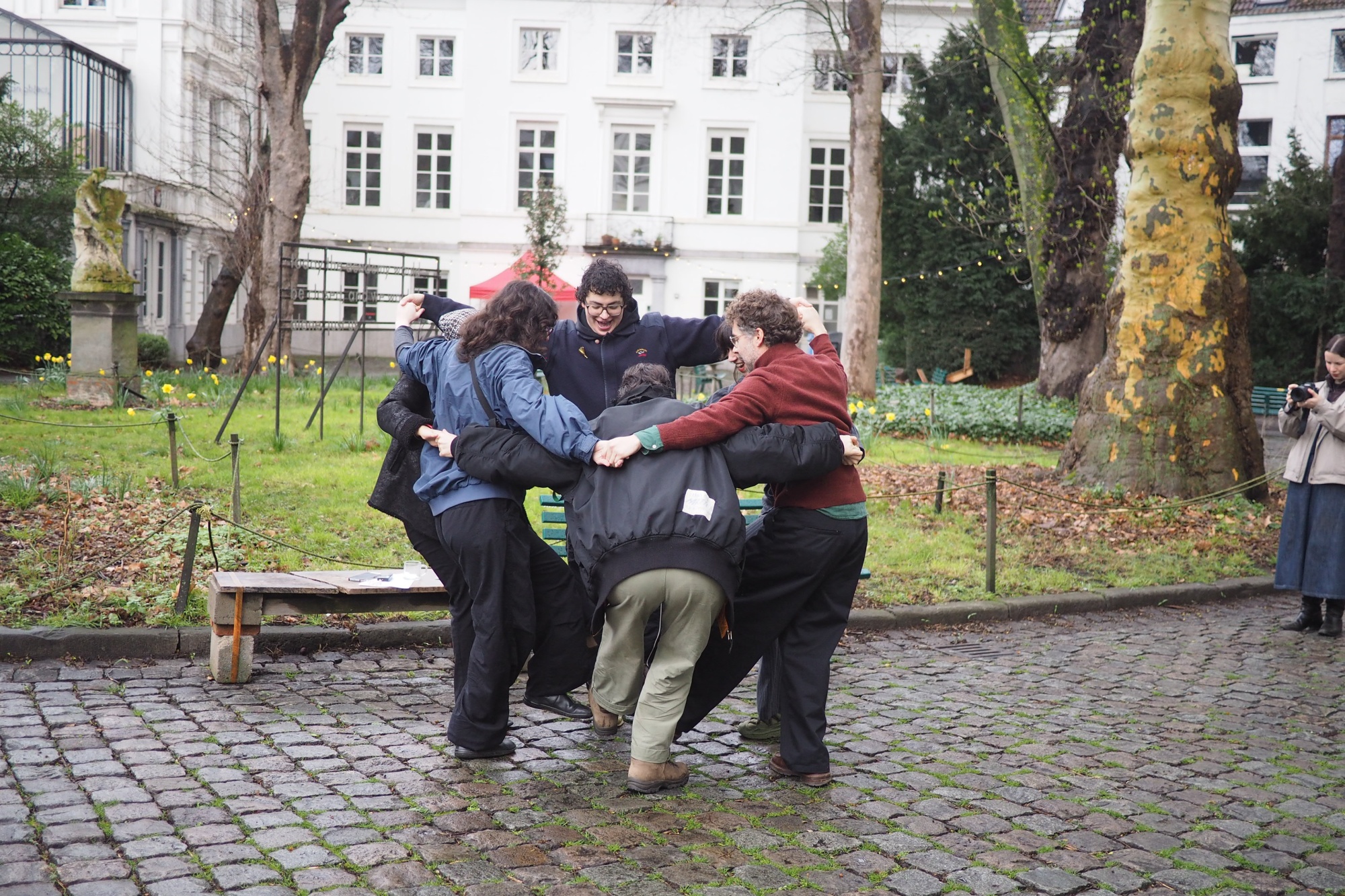
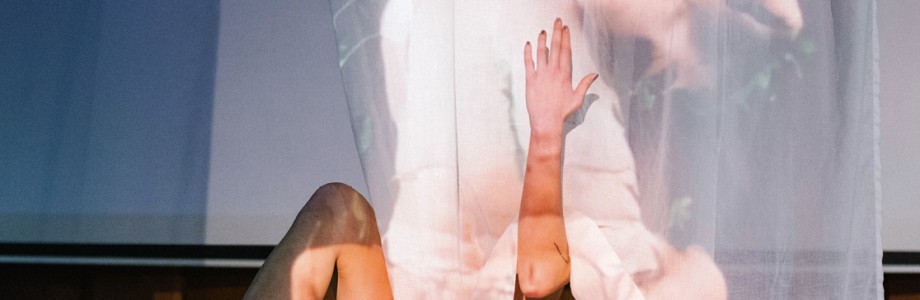
Nana, Hey, Hey, 2025. Performance view at the Royal Academy of Fine Arts Antwerp. Dancers: Eline De Clercq, Efstathia Flokatoula, Rojan Günhan, Andrea Hernandez, Sophia Kuri, Pablo Merchante. Photo by the author, 2026.
This principle takes the form of a particular workflow: an idea is conceived intuitively; a set of simple instructions is developed by concretizing its rules and conditions; the action is performed in accordance with the instructions; its immediate result is embraced as-is; and this untouched outcome is perceived as a source of new ideas.5 Here, the idea refers to a possible course of irrational and purposeless action that usually requires no skill or talent; the instruction does not determine the result, but only governs the process, giving it a rigid structure while leaving room for improvisation;6 the action is performed not for others but primarily for oneself, driven by one’s own curiosity about its unpredictable consequences. This is what I call the ‘conceptual-performative’ method.
Structured chance and embodied self-portraiture
These artists, composers, and choreographers used this method to silence the ego,7 submerge the personality,8 and avoid subjectivity,9 so as to explore how rich and complex the world is – how materials, situations, and bodies could produce unexpected forms beyond one’s control. However, each such procedure has yet another amazing effect that is rarely acknowledged: it reveals and renews the person’s innate nature – a unique set of the most fundamental physical and psychological traits etched in the body – as it manifests itself in the here and now, also beyond one’s control, choice, and knowledge. This happens in the workflow’s two key phases: the intuitive conception, in which you receive an idea, so to speak, rather than inventing it in the head, through direct contact with things you encounter; and the procedural performance, in which you naturally immerse yourself in the process and enact the action in your most idiosyncratic way – both made possible by the use of instruction, which gives structure to the initial impulse and keeps the task accessible and the result open-ended.
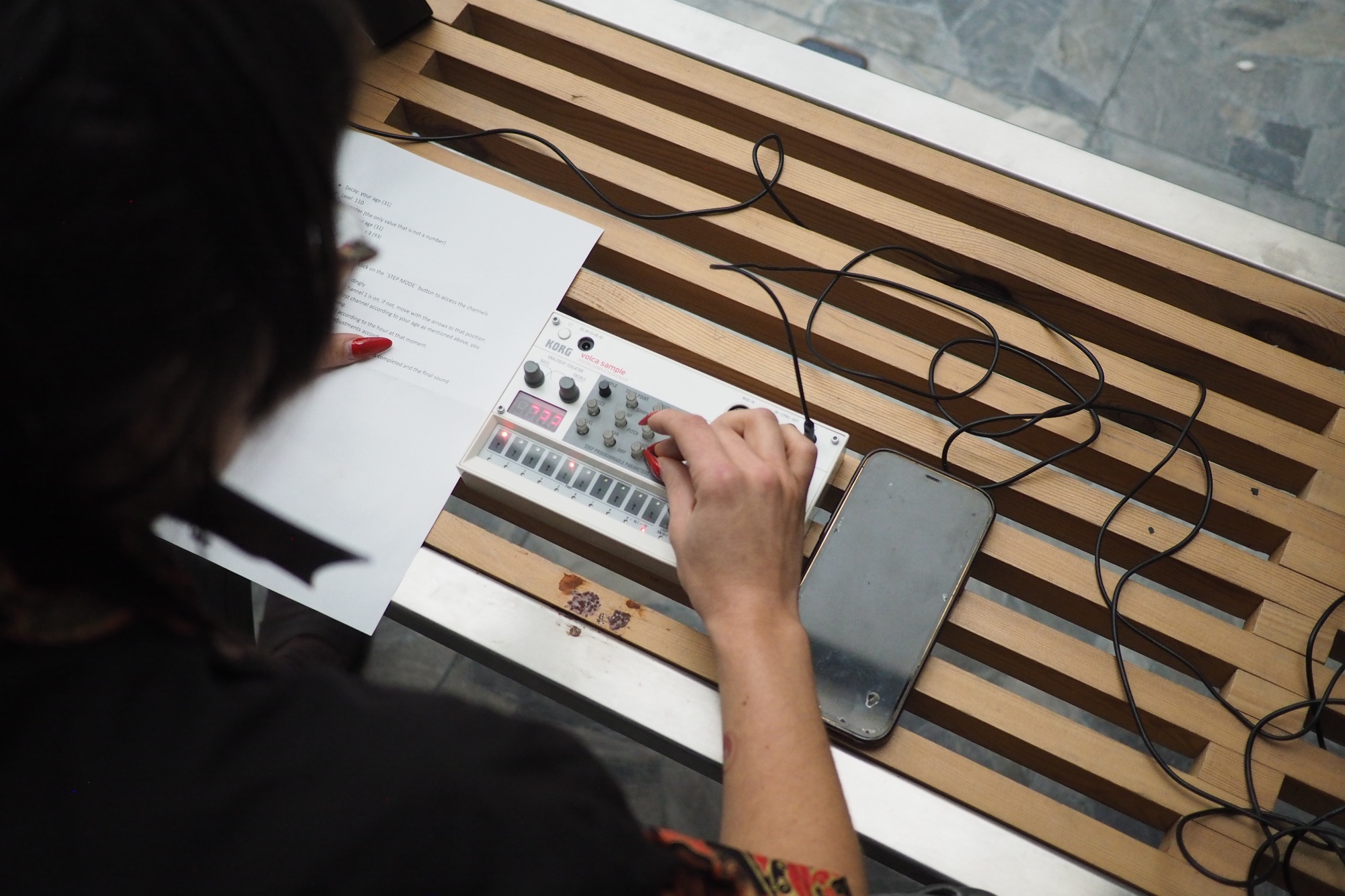
Tamara Sam Garcia, First date, 2024. Performance view at the Winter Garden, Royal Academy of Fine Arts Antwerp. Photo by the author, 2026.
The resulting form, containing traces of the direct interaction between self and world, thus becomes an embodied self-portrait. If a wonderful work of art is one that reveals the artist’s uniqueness as a person, rather than proving their exceptional genius, then carrying out such a procedure may be not only the most instantaneous but also the most enjoyable way to realize such a work. Indeed, by adapting this workflow, the act of making becomes an act of inventing and playing your own game whose outcome comes as a complete surprise, reconnecting you to the primary joy of making that you used to activate spontaneously before becoming self-conscious. In this sense, the method can liberate anybody who struggles with art-making, including not only myself at times but, more importantly, those who study in art academies, where conception is still linked to intention and performance is misconstrued as a theatrical showcase.
As a framework to incorporate the ‘conceptual-performative’ method and activate its full potential in today’s higher art education, I developed a cross-disciplinary curriculum, and this was precisely my doctoral research.
Guiding individuals through para-active approaches
The curriculum was tested and polished in my actual teaching practice, through direct interactions with students, mainly in the weekly classes of Performance, the annual elective inter-studio course that I founded and taught from 2022 to 2026 at the Royal Academy of Fine Arts Antwerp.10
The ‘conceptual-performative’ method can liberate those who struggle in art academies, where conception is still linked to intention and performance is misconstrued as a theatrical showcase.
I began to divide the course into different ways of adapting the method, calling them “para-active” approaches, each characterized by a main vehicle of chance to play with, a predominant attitude to assume, and a particular artistic tendency most associated with it. They are as follows. In “passive”, you are receptive to events that unfold, in line with experimental music, a genre defined by John Cage, including Fluxus scored events that George Brecht considered an “extension” of music.11 In “inter-active”, you respond to individual bodies that act, in line with postmodern dance, marked by task-based, game-like, and structured-improvisational actions by Trisha Brown, Simone Forti, and Yvonne Rainer, among others. In “auto-active”, materials resist your mechanical gestures, in line with conceptual art as proposed by Sol LeWitt, rather than Joseph Kosuth’s Conceptual Art,12 especially lifelong, self-reflective works by artists like stanley brouwn, On Kawara, and Roman Opalka. In “inter-auto-active”, a hybrid approach, “inter-active” and “auto-active” are combined to generate concrete outputs through collective games, informed by Alison Knowles and Hisachika Takahashi, among others. In “counter-active”, you intervene in systems that function, in line with public-space interventions under state-socialist conditions by artists such as Jiří Kovanda, Ewa Partum, and Goran Trbuljak.
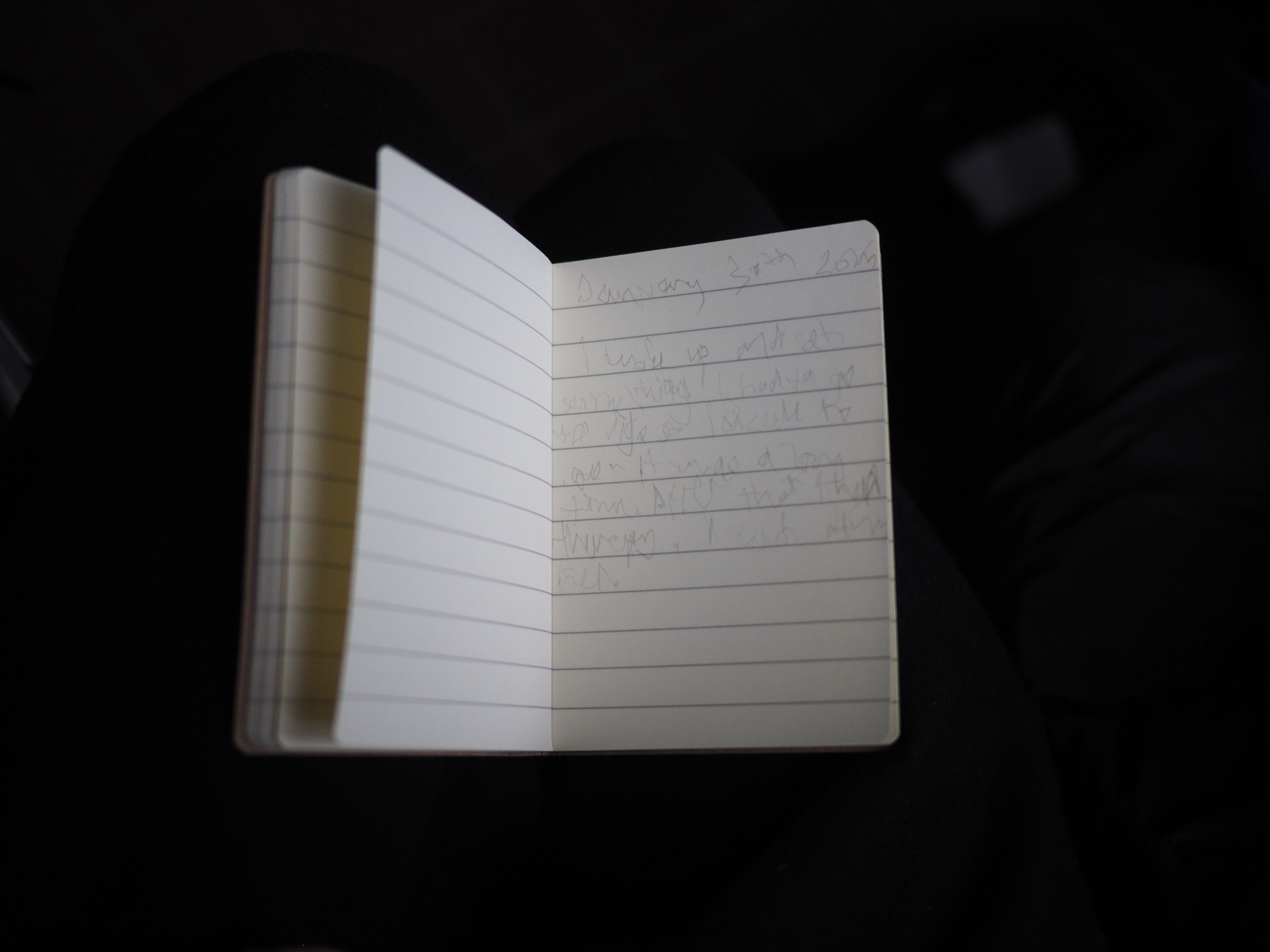
Bulut Şenyaprak, Untitled, 2025. Presentation view in Room F2.8, Royal Academy of Fine Arts Antwerp. Photo by the author, 2025.
The curriculum in its current form begins with an orientation, continues with five modules focusing on the respective “para-active” approaches, and ends with a collective exhibition as the programme’s culmination. Each “para-active” module consists of four to six classes covering an introduction to the context with historical and theoretical inputs; re-enactment exercises to become familiar with the principle first-hand; an assignment for each participant to conceive and perform their own unique actions in line with the approach, inspired by their surroundings and life conditions; and a group review. Among the five phases of the workflow, formulating one’s own instruction is almost the only phase in which I intervene to discuss possible refinements of the rules, mostly by suggesting that participants reduce arbitrary or emotional parameters or make the procedure more game-like, perhaps by introducing a taboo and a penalty, so as to allow the outcome to deviate further from intentional manipulation. Once the instruction is set, you just follow it and see what happens.
Student works made in the context of Performance include the following. In Tamara Sam Garcia’s First date (2024), the ten channels of an analogue synthesizer are programmed according to fixed and variable numbers drawn from the performer’s own body, life, and the moment of activation, generating a different sound sequence each time. In Nana’s Hey, Hey (2025), participants stand in a tangled circle, holding hands with the second-closest players on either side; they trot clockwise back to their starting positions, thrust their left foot into the centre while shouting “Hey!”, then re-cross their arms, trot anticlockwise back to their starting positions, perform the gesture with their right foot, and repeat the sequence faster each time. In Untitled (2025), Bulut Şenyaprak, whose right side of the body is mostly paralyzed, uses his left hand to hold and move his right hand with a pen, writing about daily experiences and impressions on one notebook page per day for a month, gradually increasing the number of sentences. In Shady Summons (2024), Hoyt Zhang collects flyers for various art events from the academy’s corridors and re-distributes them by slipping them through the gaps under random doors.
For the final exhibition, we make and install works at the same time in a “site-parasitic” manner, reinterpreting the strategies of institutional critique devised by artists such as Michael Asher and Mierle Laderman Ukeles.13 Concretely, everybody steps into an empty white cube empty-handed; operates an entire “conceptual-performative” workflow on the spot, freely employing one or more “para-active” approaches, while engaging with only found items, situations, and individuals; and leaves the outcome as a work where it emerged, without caring about the resulting exhibitionary composition.14
Towards truly personal practices
Overall, the curriculum is designed for those who feel lost in their practice to encounter, embrace, and explore their own limits and capabilities as unique translators of the world, while also tracing, somewhat chronologically, the genealogy of chance-driven, rule-based practices. In doing so, you slowly unlearn the conventional senses of key terms including not only “concept”, “performance”, and “personality”, but also “work”, “exhibition”, and “artist”, and release yourself from harmful art-educational norms attached to them, so that you can return to your own path with a renewed connection to the essential freedom of making.
Once the instruction is set, you just do it and see what happens.
While the curriculum is materialized in the form of a publication titled Conceptual, Performative, Personal: A Coursebook – How to Play with Chance,15 the research itself has no specific conclusion. Instead, there are as many conclusions as there are participants in the course, emerging through the development of their respective practices. If you are lost along the way, you can return to the coursebook, which is itself a single set of conceptual-performative instructions that, by definition, can be activated by anybody, anywhere, and anytime. Each time you carry it through, you will discover an updated version of who you are in the here and now. My hope is that this work will help shape an embodied autobiography over the course of your life, whatever field you pursue.
Acknowledgements
This project was developed during the artistic doctoral research Conceptual, Performative, Pedagogical: How to Guide Individuals through Courses of Instructed Simple Action Here and Now as Sites for Framed Chance Interaction between Self and World towards a Truly Personal Body of Work of Art and Life. Special thanks go to Nico Dockx and Kyoko Iwaki, my promoters; Arthur Cools and Carla Donauer, members of my individual doctoral committee; Els De bruyn, Lotte De Voeght, and Ann Daemen of the Research Department at the Royal Academy of Fine Arts Antwerp; and, above all, all those who took part in the elective course Performance from 2022 to 2026.
+++
Yuki Okumura
is an artist and PhD researcher at the Royal Academy of Fine Arts Antwerp and ARIA. He explores the intuitive conception and procedural performance of self-instructed, chance-oriented simple actions as a way of working through which anybody can translate not only the conditions and contexts of a site, but also their own personality and biography in the here and now. Recent exhibitions in which he has employed this approach to ‘navigate’ individuals include Big White Playground, Secession, Vienna; Parasite the White Cube, Het Bos, Antwerp; and Medium and Dimension: Plastic, CS-Lab, Tokyo, all 2025.
Noten
- George Brecht gives an important account of this lineage in Chance-Imagery (1957), tracing artistic uses of chance in relation to Marcel Duchamp, Dada artists, Surrealist artists, and Jackson Pollock. See Brecht, George. Chance-Imagery. Something Else Press, 1966. ↩
- The term “conceptual art” was coined and defined by Sol LeWitt, first in his 1967 essay “Paragraphs on Conceptual Art” and then further elaborated in his 1969 statement “Sentences on Conceptual Art.” See LeWitt, Sol. “Paragraphs on Conceptual Art.” Artforum, vol. 5, no. 10, June 1967, pp. 79-83; LeWitt, Sol. “Sentences on Conceptual Art.” 0–9, no. 5, Jan. 1969, pp. 3-5. ↩
- I use the term “experimental music” in the sense defined by John Cage: not to refer to a practice in which “music first exists in the composer’s mind,” but to one “in which nothing is selected in advance, in which there are no obligations or prohibitions, in which nothing is even predictable.” See Cage, John. For the Birds: John Cage in Conversation with Daniel Charles. Translated by Richard Gardner, edited by Tom Gora and John Cage, Marion Boyars, 1981, p. 77. ↩
- Following Sally Banes, “postmodern dance” refers to dance that came after modern dance and reacted against its expressive theatricality by foregrounding process, natural movement, ordinary actions, and everyday postures, thereby breaking down the distinction between art and life. See Banes, Sally. Terpsichore in Sneakers: Post-Modern Dance. Wesleyan UP, 1987. ↩
- Related statements in LeWitt’s two essays include: “Ideas are discovered by intuition”; “The process is mechanical and should not be tampered with”; and “Perception of ideas leads to new ideas.” ↩
- Trisha Brown compared her choreographic strategy, in which dancers improvise within set boundaries, to jazz, and called it “structured improvisation.” See Brown, Trisha. “Trisha Brown.” Contemporary Dance, edited by Anne Livet, Abbeville Press, 1978, pp. 44-45. ↩
- John Cage states that chance operations are a means of “silencing the ego so that the rest of the world has a chance to enter into the ego’s own experience whether that be outside or inside.” Cage, John. Empty Words: Writings ’73–’78. Wesleyan UP, 1981, p. 5. ↩
- Yvonne Rainer states that for her and her fellow choreographers, “action, or what one does, is more interesting and important than the exhibition of character and attitude,” and that “action can best be focused on through the submerging of the personality.” Rainer, Yvonne. “A Quasi Survey of Some ‘Minimalist’ Tendencies in the Quantitatively Minimal Dance Activity Midst the Plethora, or an Analysis of Trio A.” Minimal Art: A Critical Anthology, edited by Gregory Battcock, E. P. Dutton, 1968, p. 267. ↩
- Sol Lewitt states that the methodology of conceptual art, in which you “work with a plan that is pre-set”, is a “way of avoiding subjectivity”. LeWitt, Sol. “Paragraphs on Conceptual Art.” p. 80. ↩
- The course was open to third-year Bachelor’s students from 2022 to 2025, and to third-year Bachelor’s and Master’s students from 2025 to 2026, across all departments of the academy’s Visual Arts programme: Costume Design, Fashion, Graphic Design, In Situ, Jewellery Design & Gold- and Silversmithing, Painting, Photography, Printmaking & Drawing, and Sculpture. Each iteration consisted of approximately 25 weekly two-hour classes. ↩
- George Brecht’s “events” are short verbal scores that framed everyday actions as performable works. He developed them from ideas explored during John Cage’s Experimental Composition course, later stating: “Music isn’t just what you hear or what you listen to, but everything that happens. (…) Events are an extension of music.” See Brecht, George. “An Interview with George Brecht by Irmeline Lebeer.” An Introduction to George Brecht’s Book of the Tumbler on Fire, by Henry Martin, Multhipla Edizioni, 1978, pp. 83-84. ↩
- Here, following LeWitt’s and Kosuth’s respective uses of the term, lowercase “conceptual art” refers to the LeWittian, process-based mode, in which an idea initiates a procedure whose result remains open to chance, while “Conceptual Art” with initial capitals refers to the Kosuthian mode, in which the idea is treated as the actual work and the work functions as an inquiry into the concept of art itself. See Kosuth, Joseph. “Art After Philosophy.” Studio International, vol. 178, nos. 915-17, Oct.–Dec. 1969, pp. 134-37, 160-61, 212-13. Although Kosuth’s text was published after LeWitt’s “Paragraphs on Conceptual Art,” the Kosuthian mode came to predominate in later understandings of conceptual art. ↩
- Michael Asher’s interventions included dismantling the wall separating the office and exhibition space at Claire Copley Gallery in 1974, while Mierle Laderman Ukeles’s actions at the Wadsworth Atheneum in 1973 operated on the museum’s existing systems of cleaning, conservation, and security. In both cases, the artist, like a parasite, worked inside the host body of the art institution, introducing no foreign materials other than their own bodily presence and reconfiguring elements already present there through simple, task-like procedures. ↩
- The first exhibition I organized in this manner was Big White Playground, Secession, Vienna, 2025. This was a group exhibition within my solo exhibition in the main hall, featuring works by nineteen participating members of the institution’s cleaning, education, exhibition set-up, and security staff, developed through a “conceptual-performative” workshop I led on site. With students of the Royal Academy of Fine Arts Antwerp, two further “site-parasitic” exhibitions have taken place to date: Parasite the White Cube: The Productivity of the Empty Space, Het Bos, Antwerp, October 2025, and Chance Upon Our Time, at the academy’s Winter Garden, April 2026. A third, Long White Playground, will take place at its Lange Zaal in October 2026. ↩
- The book is scheduled for publication by Track Report in October 2026. ↩
Meer in dit thema
Future Shock Orchestra. Een laboratorium voor het uitvinden en bijwerken van instrumenten
Chiara Percivati
Het uur van de aap. De rol van spanning, traditie en repertoire in de toneelschool
Clara van de Broek, Sara De Roo, Jan Joris Lamers
AI in Motion. Embodied practices meet craft AI
Frederik De Bleser, Cèlia Tort Pujol, Myrthe Bokelmann, Lieven Menschaert
Meer uit dit dossier
De toekomst van artistiek onderzoek: uitdagingen en kansen
Anne-Sophie Van Schepdael
Embodied Theory
Anne-Lise Brevers
Kunstenaars denken (met of zonder academisering)
Klaas Tindemans
Meer uit dit nummer
Nurturing musician-educators’ reflective practice through a Blended Intensive Programme on practitioner research
Mathias Moors, Adri de Vugt, Thomas De Baets