Dit artikel verscheen in FORUM+, pp. 14-15
Disobedience, confrontation, contamination and rebellious cinema. How can we teach within an educational structure shaped by entrenched power relations?
Rosine Mbakam
The text explores personal and collective deconstruction through documentary cinema. Rosine Mbakam describes how disobedience, confrontation and ‘“contamination’” have shaped her practice as a filmmaker and teacher. She questions power relations within cinema and education, creating a pedagogical laboratory for deconstruction. The Heritage project, including a Safi Faye/Sita Bella retrospective, illustrates the need to reclaim African cinematic legacies, challenge Western-centred narratives, and decentralize thought to foster new perspectives between the Global South and the Global North.
Dit artikel onderzoekt persoonlijke en collectieve deconstructie aan de hand van documentairefilm. Rosine Mbakam beschrijft hoe opstandigheid, confrontatie en ‘“aantasting”’ haar praktijk als filmmaker en docent hebben gevormd. Ze stelt machtsverhoudingen binnen de filmwereld en het onderwijs in vraag en creëert zo een pedagogisch laboratorium voor deconstructie. Het Heritage-project, met onder meer een retrospectief van Safi Faye en Sita Bella, illustreert de noodzaak om het Afrikaanse filmische erfgoed terug te winnen, westers georiënteerde verhalen kritisch te bekijken en het denken te decentraliseren om zo nieuwe perspectieven tussen het Globale Zuiden en het Globale Noorden te bevorderen.
Art shapes our imagination, perspectives, and ways of thinking. Cinema, like all the arts, has contributed to systems of domination, reinforcing the legacies of both the dominant and the dominated. Throughout generations, violence – whether conscious or unconscious – takes on new forms yet produces similar consequences: war, slavery, the plundering of resources, discrimination, and social inequality. This inherited violence impacts the ways we see, think, and act. How can we interrupt this transmission? How can we personally deconstruct such a legacy?
In my practice and my PhD research (On the way to my personal decolonization: my cinematographic gaze and my cinema), film serves as a means of dismantling colonial patterns through an intimate and personal decolonization of thought, imagination, and history. I thus echo Aimé Césaire’s insights in Discourse on Colonialism, where he exposes the enduring structures of western domination.1 Decolonization has guided me towards finding my position and obtaining creative freedom, resisting conformity and reproduction of violence. As an African filmmaker, I explore how one might (de)construct one’s own viewpoint in order to search and reinvent the relationship between the Global South and the Global North.
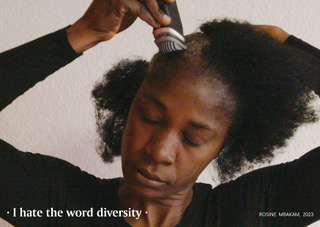
Rosine Mbakam, Installation La fin d’un temps, 2023. Photo by Rosine Mbakam.
Drawing on my PhD research, in this article I combine reflections on my pedagogical practice as a professor of film at KASK & Conservatorium, School of Arts Ghent, with the insights provided by my students. The questions explored through the lens of this nexus of research and education are: how can we teach deconstruction when the object of study consists of ourselves, our bodies, histories, and thoughts? How can we teach within an educational structure shaped by entrenched power relations? And how can the word “decolonization” be reclaimed when its widespread use often reinforces the status quo? I find it difficult to use the word “teach” because, to me, it implies imparting knowledge. Instead of “teach,” I prefer the words “share,” “introduce,” and “pass on.”
Through the screening of my films during their Master’s seminar (‘Personal decolonization: construction and deconstruction’), I confront my students with a colonial legacy that many believed had disappeared. I show them how colonialism continues to manifest itself in contemporary society: in mass tourism, in migration from the Global South as a continuation of enslavement, as well as in the colonization of thought. Students are asked to examine, within their own background as dominant or dominated, how they can be disobedient towards this history. In this way, a pedagogical laboratorium of deconstruction is set in motion, which they may continue beyond the seminar. To engage with these questions, I begin this article with the foundations of my own decolonization: disobedience, confrontation, contamination, and rebellious cinema. These terms have emerged from my personal experiences and are not based on any specific reference I associate with this process, although they are used and experienced by others. These foundations are explored in my courses, which are the Master’s Seminar, the Heritage Projects (screenings of films by pioneering filmmakers), and the Documentary Atelier.
Strategies for deconstructing my colonial heritage
As a Black woman, disobedience became essential to my survival. I had to resist the expectations imposed upon me, concerning who I should be, what films I should make, and how I should make them. Disobedience allowed me to unlearn the cult of references imposed by European film education, which had restricted my thinking. It enabled me to look at myself critically, to recognize how deeply colonized I had become, and to seek forms of liberation.
Confrontation became the only way to exist.
Because of these experiences, confrontation became necessary. I confronted the coloniality I carried, accumulated across generations since slavery. I confronted the power relations embedded in cinema and education, two central spaces through which domination is transmitted. I embraced difference, acknowledging what I would discover and who I would become through that encounter. The characters in my films convey, through their testimonies and experiences, the reality of colonial domination. Their representation confronts audiences with a reality that is often ignored or denied. My films act as a decolonial shock, inviting deconstruction. The Q&A sessions that follow screenings become a space for confronting ideas and legacies, but also for liberation and healing.
The St Louis Doc Festival in Senegal, in collaboration with Gaston Berger University, honoured my work with a retrospective. Meeting students who longed for African cinematic references reminded me of my own yearning for such encounters in my youth. Their description of my films as “rebellious cinema” enabled me to connect rebellion with disobedience. To deconstruct is to rebel against established orders: the narrative order of cinema, the structural order of society, and the ideological order governing identity, culture, and religion. Through film, I have found the vocabulary to speak openly about the mechanisms of colonization, capitalism, tradition, and religion, and about the forces through which power is exercised and reproduced.
My experience as the only Black student at the INSAS film school in Brussels shaped my understanding of contamination. I felt like an intrusion within an overwhelmingly white environment, one that showed only a single African film over five years of study. Later, as the only Black professor in the film department at KASK & Conservatorium, I came to understand contamination as an act of survival: a way of introducing imaginaries into spaces that would otherwise erase them; a contamination of genres where the line between documentary and fiction blurs, giving way to stories. Today, contamination is no longer a stigma but a methodology. It is a way of inserting African cinema into institutions that would otherwise remain closed to it. It is a strategy that acknowledges how references, pedagogies, and artistic traditions can be expanded and transformed through presence and friction.
Teaching disobedience, contamination, confrontation and rebellious cinema
At KASK & Conservatorium, I integrate these four concepts into the seminar I teach for Master’s students, which I regard as a laboratory of deconstruction in which students and I participate on equal terms. Students are encouraged to disobey established systems of reference, to refuse the expectation of producing work for the teacher, and to speak from reservoirs rooted in their own lived experiences. The aim is to confront the visible and invisible heritage we carry. Like trees that do not consume their own fruit, students share the outcomes of their deconstruction with others, both inside and beyond the classroom.
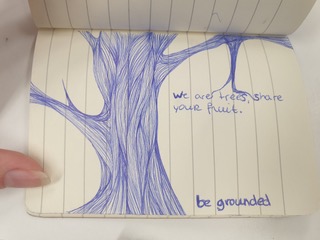
Gaia op de Weegh, Deconstruction master seminar 2024-2025. Photo by Gaia op de Weegh.
I witness the results of the students’ own process of deconstruction taking shape and receive spontaneous feedback such as: “You were able to create a space in which I felt understood and heard”; “These interactions with you and the rest of the group were foundational in the film I am currently developing”; and “These images, for me, embody the sharing of power.”
A second example of this pedagogical process is the Heritage project, particularly the Safi Faye / Sita Bella retrospective. This initiative forms part of my PhD research and seeks to challenge Western-centric histories of cinema by foregrounding other forms of storytelling and contamination of genres (fiction and documentaries). The Heritage project seeks to reclaim ignored, forgotten, or erased legacies by recognizing African pioneers who paved the way for future generations.
Teaching allows me to confront my ideas, keeping me in a state of constant transformation and renewal.
Safi Faye, born in 1943 in Senegal, was a teacher before she appeared in Jean Rouch’s Petit à petit (1971).2 She later earned a doctorate in ethnology and became the first woman in sub-Saharan Africa to direct a feature film, Kaddu Beykat.3 She is recognized as a filmmaker. Thérèse Sita-Bella, born in 1933 in Cameroon, was a pioneering filmmaker, pilot, journalist, and writer. Her documentary Tam-Tam à Paris (1963)4 is considered as a landmark. She was a feminist activist who opened doors for African women.
Although admired by scholars and cinephiles, their work remains marginal within film schools, where it is rarely taught or screened alongside Western masters. This retrospective sought to challenge that imbalance. My team in Cameroon and I organized a three-day screening at KASK & Conservatorium, alongside three screenings in Cameroon through Caravane Cinéma, a mobile programme of outdoor screenings in schools and neighbourhoods. In many African cultures, art is not separated from daily life; through Caravane Cinéma, we bring cinema into streets, neighbourhoods, and villages.
By screening the films of Safi Faye and Sita Bella in both Belgium and Cameroon, we created spaces of exchange between students from Ghent and Yaoundé. In Cameroon, audiences reclaimed their voices, expressing ideas long suppressed by colonial structures. In Belgium, students encountered a broader cinematic landscape, contextualized these films socially and historically, and recognized how power relations are reproduced through cinema.
Initiation in personal decolonization
I now live between Cameroon and Belgium, navigating the legacies of the dominant and the dominated. Organizing screenings and discussions across continents allows me to bring histories into dialogue.
Contamination has become a gesture of survival for African cinema and for my own cinema.
Students taking part in my seminar can see an example of my own personal deconstruction, which is not a model to be applied, but an invitation to engage in their own process, in relation to the different spheres of their lives. I have been able to observe the effects of this process, affecting their personal, artistic and gender identity, addressing the legacies of dominance and subordination, as well as engaging with trauma, violence, invisibility, exclusion, stigmatization and privilege. These insights not only inspired the artistic practice of the students but also made an imprint on my own research.
In conclusion, the pedagogical vision of KASK & Conservatorium enables an alchemy between my experience as a filmmaker, my PhD research, and my teaching. These three activities feed into one another, giving rise to a pedagogy that is free in its methodology yet rigorous in its content. Each year, the seminar builds on previous experiences and enriches its content through students’ questions. The aim of pedagogy is the transformation of those who encounter it. Here, shared knowledge is not inert, but living and active through critical thinking.
The classroom is no longer a space in which students merely receive knowledge; it is also a space in which they share research and reflections, and in which they transform themselves. Students are integral to the pedagogical process and actively contribute to sustaining and enriching it. Each year, the methodology, pedagogy, and content of my courses are shaped by the experiences of previous cohorts through an examination of the formulated learning outcomes. This ensures that the pedagogical experience is renewed each time, as students imbue it with their own distinctive qualities. Pedagogy is not a fixed mould of knowledge that I impart to students, but a form of clay that takes shape according to their individuality and cultural heritage.
Acknowledgements
Many thanks to Dimenkeu Nkue Aimé-Cesaire, Mahen Bonetti, An van Dienderen, Kris Rutten, Jean-Baptiste Fotso Djemo, Mamadou Sellou Diallo, and Hugo DeBlock.
+++
Rosine Mbakam
is a Cameroonian filmmaker whose work features at major international festivals. A graduate of INSAS, she founded production companies in Belgium and Cameroon to maintain her artistic independence. She teaches in Ghent while pursuing a PhD, and has been praised by The New Yorker for her exceptional sensitivity.
Noten
- Césaire, Aimé. (2000). Discourse on colonialism, translated by J. Pinkham. 1950; republished Monthly Review Press, 2000. ↩
- Rouch, Jean, director. Petit à petit. Les Films de la Pléiade, 1971. ↩
- Faye, Safi, director. Kaddu Beykat (Letter from My Village). Faye Films, 1975. ↩
- Sita-Bella, Thérèse, director. Tam-Tam à Paris. Les Actualités Françaises, 1963. ↩
Meer in dit thema
On-onderbroken stad
Christine Dysers
From the mountain I see the mountain. Shifting landscape perception through filmmaking, encounters, and indigenous archives
Julián García Long
Rethinking biases. Een meerstemmig gesprek over postkoloniale blinde vlekken in cinema
Liesje Baltussen, Steff Nellis
Meer uit dit dossier
Een schrijfhandleiding in drie stappen voor Fluxus-formules
Natalie Loveless, Assia Bert
FAST45 - Futures arts school trends 2045
Koenraad Hinnekint
Meer uit dit nummer
Mapping the Local. A collaborative pedagogical paradigm
Özgür Ilter, Allan Siegel