Dit artikel verscheen in FORUM+, pp. 10-11
This text explores how theory and practice can be integrated within practice-based dance research through the course Embodied Theory at the Royal Conservatoire Antwerp. The course seeks to challenge the perceived divide between thinking and doing by engaging students in iterative cycles of reading and analysis, embodied experimentation, and reflection. The approach positions theory as a generative, world-building force, enabling students to critically and creatively contribute to knowledge production through artistic practice.
Deze tekst onderzoekt hoe theorie en praktijk geïntegreerd kunnen worden binnen dansonderzoek via de cursus Embodied Theory aan het Koninklijk Conservatorium Antwerpen. Ze beoogt de vermeende scheiding tussen denken en doen te doorbreken door studenten te betrekken in iteratieve cycli van lezen, analyse, belichaamde experimentatie en reflectie. Deze benadering beschouwt theorie als een generatieve, wereldvormende kracht, die studenten in staat stelt om kritisch en creatief bij te dragen aan kennisproductie vanuit artistieke praktijk.
One of the most persistent challenges in practice-based research is to bridge theory and practice. This challenge is particularly acute in dance, a field historically and ontologically defined by its physicality, and then often positioned as “of the body” rather than “of the mind” within Western epistemological traditions. Even when embodied knowledge is understood as producing theory in its own right, this understanding is most often articulated (and legitimized) through writing, again re-inscribing thinking as external to embodied work.
From my perspective as a researcher, the need for a bridge already points to a tension that has less to do with a separation between theory and practice than with the difficulty of articulating how they work together. This tension forms the starting point of both my teaching and my research practice.
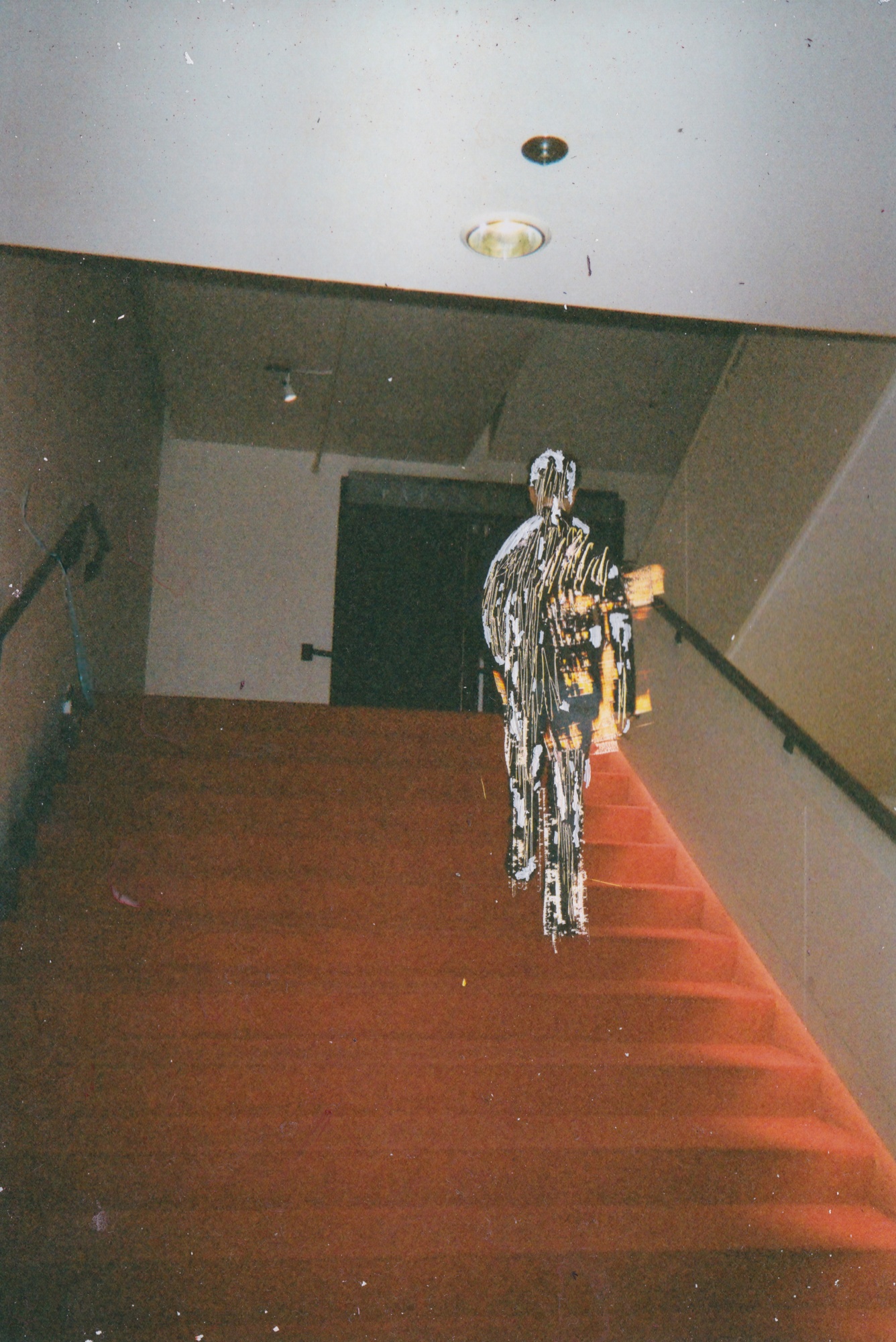
Untitled, Figure ascending a staircase, partially redrawn and obscured through a hand-drawn intervention on the photograph. Photograph and drawing by NAH 2026.
Since 2021, I have been teaching a course titled Embodied Theory in the second year of the Master in Dance at the Royal Conservatoire Antwerp. The study programme is strongly oriented towards dance research, and more specifically towards practice-based research. While this orientation opens many possibilities, it also confronts students with a fundamental challenge: how to understand research when knowledge is generated through embodied, artistic processes rather than through predefined academic models. In this context, students often experience theory as something external to their studio practice: something they draw on intuitively for inspiration, apply retrospectively to justify artistic choices, or approach as an institutional requirement, without yet perceiving their own practice as capable of producing or contributing to theory. As one Master’s student reflects:
I feel like I am flirting with theory but never allowed in because it often feels intimidating. I use it more as a source of inspiration than something I can critically work with in the studio. Sometimes it feels like theory cannot belong to me as a dancer. (MA student, 2023)
Working with theory within an embodied and practice-based research context, therefore, means engaging with a set of inherited assumptions. Among these are the idea that theory mainly belongs to the realm of cognition rather than embodied artistic practice, and the belief that artistic research primarily develops through individual self-expression. During the course, these assumptions are carefully historicized and questioned through lectures that trace their origins, how they persist, and why they shape how dance students understand research. These take the form of three-hour, teacher-led sessions that combine lectures with continuous debate and questions from students. We begin, for example, by unpacking what theory is and how it functions, before situating mind-body dualism historically, and later moving into questions of consciousness, the mind-body divide, and embodied cognition.
In addition, one session during the course is shaped by the students’ interests. Depending on the group, I either invite guest speakers or develop lectures in dialogue with the students’ research concerns. In recent years, these lectures included sessions on technofeminism, micellar networks, 4E cognition, and hauntology. Each topic is proposed in response to concrete questions raised by the students in relation to their artistic research.
Across the course, mornings are dedicated to lectures, while afternoons are devoted to testing these questions in practice, allowing critical analysis and embodied research to inform each other. In practical terms, students use a structured questionnaire that gradually deepens their engagement with theory before moving into experimentation. They begin by working with a text of their choice1 through a close analysis supported by a series of seventeen questions. This process guides them in identifying the text’s key constructs, principles, underlying logic, assumptions, and hypotheses, while also structuring a careful, step-by-step engagement with its language and relation to other references in the field. At this stage, the focus is not on interpretation or critique but on developing familiarity and precision. The aim is not to ‘apply’ the text, but to inhabit and dissect it for long enough that its language and structure become understandable and workable.
From there, the analysis intentionally becomes looser. Students are invited, again via the questionnaire, to deepen their engagement through associations that move beyond discursive meaning, working on a more sensory and imaginal level. They are asked, for example, to relate the text to specific colours, textures, images, or physical actions. This enables another mode of engagement, in which affects, artistic references, intuitions, and aesthetics are encouraged to surface, forming a growing network of relations around the text. This process often takes an arborescent form, in which ideas branch out rather than converge, and understanding develops through accumulation and associations. A student notes:
The questionnaire helped to extract many departure points for practice as it made the text closer to an experienced dimension […] it made me develop a more tangible relation to the text. (MA student, 2024)
Only when students are sufficiently immersed in this expanded field do they move into studio experimentation. At this stage, theory actively shapes compositional choices and students engage critically with their reading through creation.
The cycle concludes with a debrief, which serves as the basis for the course assignment. Students are asked to reflect on what took place during the experiment and to detail their processes and methods. These reflections function as a further articulation of the ongoing exchange between theory and embodied practice, often feeding back into the next cycle of work.
This impact is articulated clearly by a student from a previous cohort:
After the combination of the lectures and the questionnaire, integrating everything into the practical experiment of the afternoon opened a new world for me. I was struggling with understanding the concept of the lived body by Merleau-Ponty and completely changed my interpretation by bringing my reading with me to the floor. I realized that even more when writing the debrief. Reflecting helped me retrace my process and then led me to formulate a hypothesis which gave a new and needed direction for my Master’s research. (MA student, 2022)
Here, another student reflects on how the course helped them build a feedback loop between theory and practice:
The course helped me to create a more functioning feedback loop between pieces of a research inquiry: text/theory → practice → presentation → feedback → reflection and analysis of the relation between practice and theory → expanded understanding of the inquiry. (MA student, 2024)
Teaching Embodied Theory within a practice-based research programme does not mean teaching theory as a separate body of knowledge. It means cultivating the capacity to think with theory through practice and allowing embodied research to contribute back to theory-making. Instead of merely referencing theories, students should integrate theory critically into their practice, using it as a tool for inquiry and experimentation. This becomes evident, for instance, when students translate theoretical questions into embodied scores, test hypotheses through spatial and compositional choices, and reflect critically on these experiments during the debriefs.
At the core of my approach is an understanding of theory as a world-building force within creative practice. World-building is often framed as an inward process, closely tied to the artist’s imagination and subjectivity. While this inward movement can be generative, it becomes problematic when it obscures lineages and conditions, or when it reinforces the image of the autonomous artist-genius. Working with theory reintroduces exteriority. It situates practice within broader discursive, historical, and political contexts, emphasizing that artistic research is always relational. In this sense, theory does not limit imagination; it expands and complicates the worlds a practice can construct.
As a PhD researcher, my own research feeds back continuously into this loop of theory and embodied practice. As I work through questions across both realms, often simultaneously, I bring references, tools, and emerging insights into the classroom. At the same time, observing recurring interests and thematic clusters among new generations of students sharpens the bibliographical and conceptual toolbox I analyze and share. This ongoing exchange is guided by a preference for bottom-up thinking and non-linear sense-making. Knowledge is allowed to emerge gradually, through accumulation, association, and testing. Research unfolds as an ongoing negotiation between thinking and doing, inside and outside, self and world.
The classroom functions as one of the sites where my research continues, while my research practice, in turn, shapes the course’s structure and content. This integration takes full action at the level of method: the ways of working I develop as a researcher also organize how the course cycles between theoretical analysis, experiments, and reflection.
In a context where artistic research is increasingly pressured to demonstrate its value through products and outputs, teaching “embodied theory” offers an alternative orientation. Here, research is not added to education as expertise or knowledge transfer but shared as a practice that students actively inhabit. For Schools of Arts, fostering such practices is not about resolving the tension between theory and practice, but about sustaining the conditions in which their inseparability can be meaningfully explored.
+++
Anne-Lise Brevers
is a dancer, maker, and researcher whose work explores human presence and its destabilization through embodied and technological practices. She is currently completing a PhD at the Royal Conservatoire Antwerp and the University of Antwerp (ARIA). Anne-Lise supervises research projects and co-coordinates CORPoREAL, focusing on posthuman bodies, non-human relations, and future-oriented dance practices.
Noten
- Recent selections (2025–26) have included: Butler, Judith, editor. “The Lesbian Phallus and the Morphological Imaginary.” Bodies That Matter: On the Discursive Limits of Sex, New York, Routledge, 1993, pp. 57-91; Han, Byung-Chul. The Burnout Society. Stanford, CA, Stanford University Press, 2015; Russell, Legacy. Glitch Feminism: A Manifesto. London and New York, Verso, 2020; and Negarestani, Reza. “Frontiers of Manipulation.” #Accelerate: The Accelerationist Reader, edited by Robin Mackay and Armen Avanessian, Falmouth, Urbanomic, 2014, pp. 185-204. ↩
Meer in dit thema
Trompet leren spelen met Quesalid. Een studie over vaardigheid en transformatie
Kevin Toksöz Fairbairn
Nieuwe verhalen. Een visuele dialoog met het fotoarchief van Fritz Mayer van den Bergh
Charlotte Lybeer, Els Vanden Meersch, Inge Henneman, studenten
Meer uit dit dossier
Voorbij regels, voorbij grenzen
Jaana Erkkilä-Hill
The sympoiesis garden
Eline De Clercq
De kunstschool in transitie
Kevin Voets
Meer uit dit nummer
Mapping the Local. A collaborative pedagogical paradigm
Özgür Ilter, Allan Siegel
Conceptual, performative, personal: A curriculum
Yuki Okumura
Collective Signal: A swan song for the air raid siren
Angela de Weijer, Karin Bijsterveld