Dit artikel verscheen in FORUM+, pp. 36-41
Mapping the Local. A collaborative pedagogical paradigm
Özgür Ilter, Allan Siegel
Urban space offers fertile ground for pedagogical experimentation, where artistic practices and collective enquiry converge. In this article, we present Mapping the Local, a project-based seminar at the Hungarian University of Fine Arts that brings together local and visiting art students from across Europe in innovative transdisciplinary projects. Framing the seminar’s evolving practices of “method-making” as a valuable contribution to art education discourse, we describe student collaborations and international partnerships that address contested urban conditions through situated, practice-led interventions.
De stedelijke ruimte biedt een vruchtbare bodem voor pedagogische experimenten, waar artistieke praktijken en collectief onderzoek samenkomen. In dit artikel presenteren we ‘Mapping the Local’, een projectgericht seminarie aan de Hongaarse Universiteit voor Schone Kunsten dat lokale en gaststudenten uit heel Europa samenbrengt in innovatieve transdisciplinaire projecten. We beschouwen de ontwikkelende praktijken van ‘method-making’ binnen het seminarie als een waardevolle bijdrage aan het discours over kunstonderwijs. We schetsen de samenwerkingen tussen studenten en de internationale partnerschappen die omstreden stedelijke omstandigheden aanpakken door middel van contextgebonden, praktijkgerichte interventies.
As higher education faces growing demands for curricular standardization, art education can respond to this trend by re-imagining its pedagogical strategies. These reconfigurations enable reflexive practices, equipping students to confront societal challenges while generating creative vocabularies responsive to diverse contexts. The increasingly transnational and transdisciplinary composition of European art schools exposes the limitations of uniform pedagogical models, in which one-size-fits-all frameworks can suppress rather than unlock the collective potential of student cohorts.
Such models often presume culturally homogenous cohorts and stable disciplinary hierarchies, leaving less room for situated knowledges, dissent, and the negotiation of difference that contemporary urban conditions demand. In a moment driven by intensified mobility, uneven urban development, and shifting political climates across Europe, pedagogies that treat the city as a contested field of learning become especially pressing.
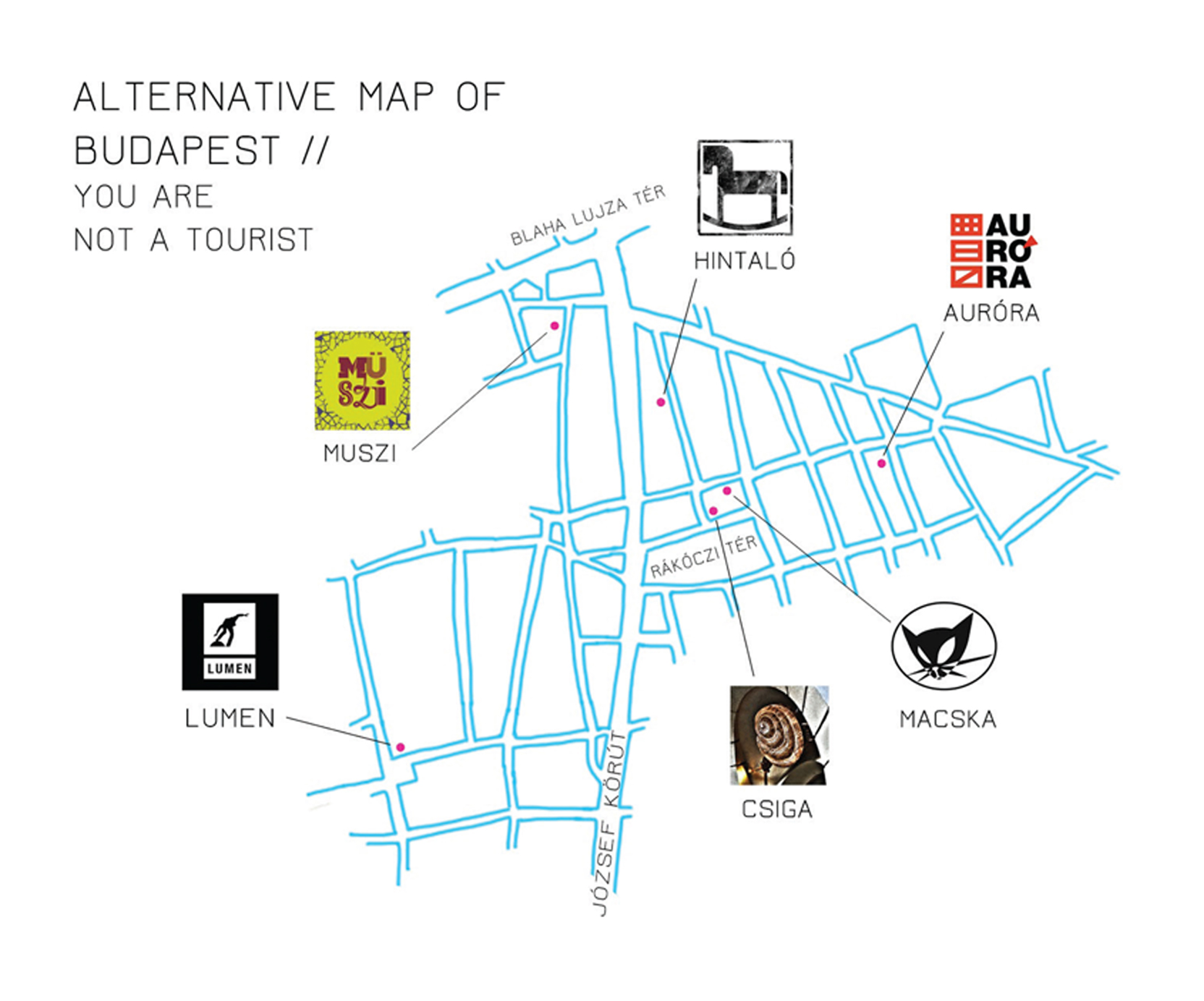
Anna Dohy, Anya-Stewart Maggs, Jessye Curtis, Luca Pintér, and Ricardo Amélio, You Are Not a Tourist [Alternative map of Budapest], 2015, alternative urban mapping. Photo courtesy of the artists.
Against this backdrop, the Mapping the Local (MTL) project-based seminar at the Hungarian University of Fine Arts (HUFA) initiated an internal dialogue on the constraints of inherited pedagogies.1 Too often, these rely on prefabricated templates that neutralize difference and leave cultural and disciplinary diversity unaddressed. The enthusiasm of visiting Erasmus students for collaboration with local peers underlined the urgency of rethinking such approaches, signalling the need for mixed cohorts to develop collective methodologies and practices. MTL was designed as an inversion of these logics, placing cross-disciplinary and intercultural collaboration at its centre.
Framing Budapest as a working laboratory, the seminar conducts two intensive five-day workshops supported by fortnightly tutorials. Walks and fieldwork open thematic directions, after which students and tutors collaboratively define research questions and form working groups. Tutorials sustain this process, culminating in closing presentations where outcomes are refined and presented through exhibitions, publications, or digital platforms. At its core, MTL advances “method-making” as a pedagogical principle, with groups co-devising and testing tactics within real urban spaces and revising them through feedback from the site, the public, and one another. In this sense, method-making entails the collective invention and iterative refinement of working tools as situational tactics that are developed in response to specific sites and encounters, rather than the application of a preselected participatory method.
MTL frames the city as a studio and laboratory, making it simultaneously a site of scrutiny, production, and encounter.
Although informed by artistic research practices, MTL positions itself adjacent to the field, not in direct alignment with it. This adjacency signals a pedagogical emphasis where the seminar adopts artistic research’s situated, iterative modes of enquiry but remains free from the expectations of producing research outputs that meet discipline-specific criteria. Following sociologist and philosopher Bruno Latour’s idea of enquiry as a networked Gedankenausstellung (thought exhibition), the seminar treats knowledge as something assembled and made legible through relations between sites, actors, institutions, materials, and narratives.2 Such knowledge is staged in tutorials and public presentations rather than authorized in advance. In turn, this emphasis reorients mobility in education from a logistical necessity to an epistemic asset. Doing so diversifies the ways investigation is initiated and carried forward, while opening up space for pedagogical critique.
Building on this, we will first outline MTL’s conceptual foundations and educational strategies, situating the seminar’s pedagogical orientation; later sections will move into detailed accounts of student group projects and international collaborations. The projects exemplify method-making as practice-in-action, articulating theory through site-specific experiments and public interventions, such as installations, performances, and participatory formats, emerging as propositions within urban space.
Urban social space as an arts education laboratory
Each semester, the seminar addresses distinct urban themes, for example, gentrification, social stratification, and post-industrial transformations. The thematic focus encourages immersive formats that bring theoretical reflection into contact with lived experience and confront the city’s spatial and political dimensions. Students often engage with local communities and social tensions, shifting from observation to interaction. Through shifts of this kind, artistic activity is drawn into social contexts that are not reducible to predetermined outcomes, cultivating dialogue and experimentation. In practice, community engagement ranges from informal encounters, such as conversations, interviews, on-street invitations, and situated listening, to more structured forms of participation. Given that co-creation is not always the primary aim within an intensive workshop format, the seminar treats this limitation as a pedagogical question rather than a blind spot.
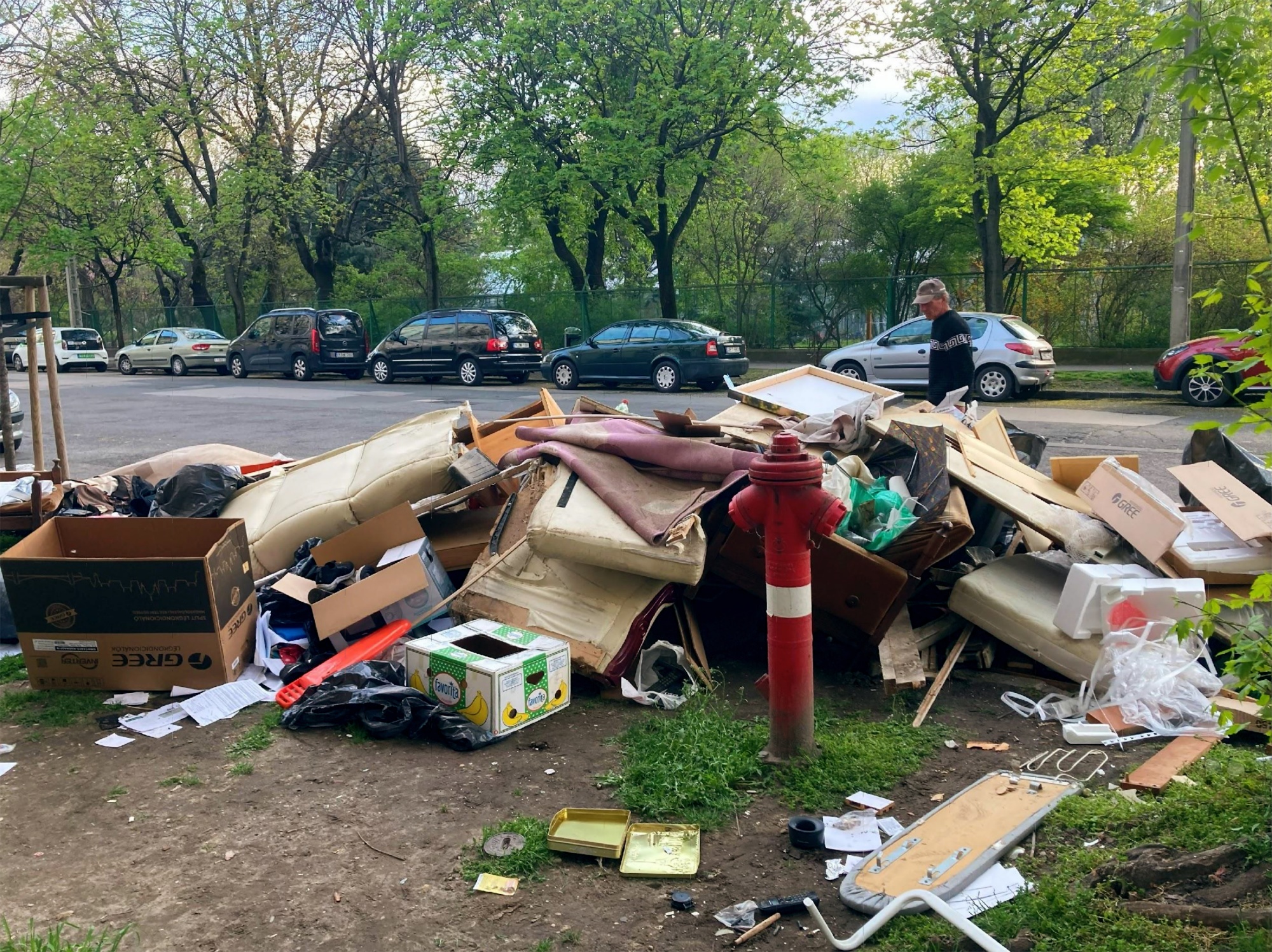
Alibhe Reilly Tuite, Sophia Rossetto, and Zsófia Marchhart, Collectors [Materials photographed in situ], 2023, urban waste inventory project. Photo courtesy of the artists.
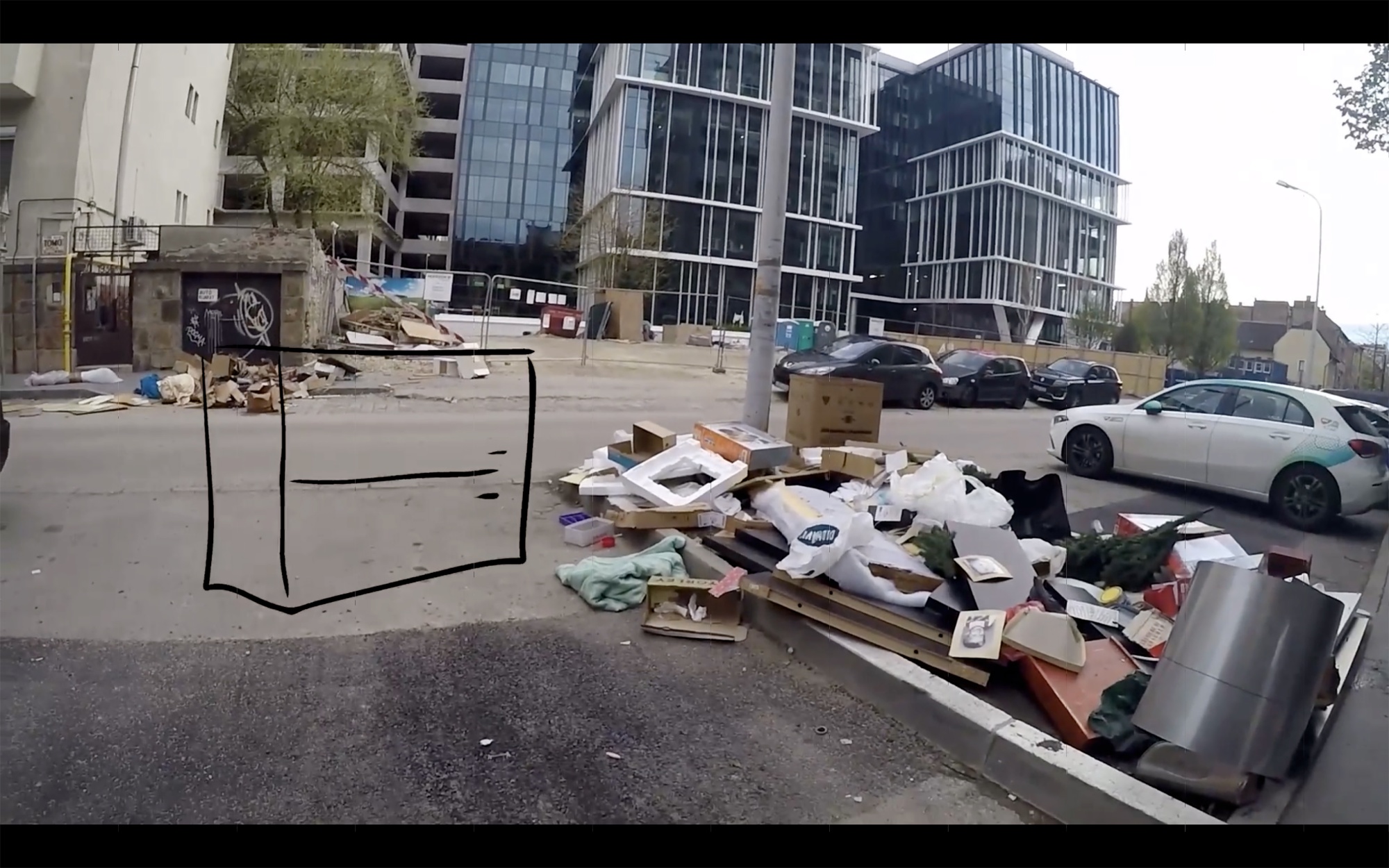
Alibhe Reilly Tuite, Sophia Rossetto, and Zsófia Marchhart, Collectors [Animated video collage], 2023, urban waste inventory project. Photo courtesy of the artists.
MTL frames the city as a studio and laboratory, making it simultaneously a site of scrutiny, production, and encounter. Students analyse overt and latent urban conditions, document and interpret their realizations, and develop collaborative interventions that render underlying structures perceptible. Through sensory and reflective engagement, these actions prepare the ground to unsettle habitual perception and expose entanglements between spatial form and socio-political undercurrents.
This methodological orientation is informed by “drifting.” It follows Situationist theorist Guy Debord’s concept of the dérive, understood as an unplanned, random journey through an urban landscape. It is also informed by Guy Debord’s related views on psychogeographical explorations, which observe how the built environment subconsciously shapes human feelings and behaviour within urban transformations. The approach also draws closely on cultural theorist Michel de Certeau’s emphasis on everyday tactics, referring to the informal, improvisational ways in which ordinary people move through and subvert imposed structures.3 But awareness alone does not yet amount to critique. Students are encouraged to devise spatial practices that interrogate imposed structures and dominant narratives. Marxist philosopher and sociologist Henri Lefebvre’s triadic model of space – perceived, conceived, lived – operates not simply as a conceptual apparatus, but as a framework inspiring practical implements that can be activated and tested through first-hand experience in fieldwork.4 Spatial dimensions are traced and translated into actions that probe the semiotic and cultural textures of specific urban spatialities.
In this way, conceptual understanding merges with practice, enabling political awareness through artistic means, where knowledge is produced in cycles of application, revision, and reflection. Educational theorist Donald Schön’s concepts of “knowing-in-action” and “reflection-in-action” resonate here, as the self-devised methods developed by the groups become both medium and message, in the sense that the ways in which groups think through and shape their approach collectively are grounded in tacit understanding and responsiveness to context.5
At its core, MTL advances “method-making” as a pedagogical principle, with groups co-devising and testing tactics within real urban spaces and revising them through feedback from the site, the public, and one another.
The multiplicity of methodologies is not an aesthetic gesture but a central pedagogical commitment that defies singular models of artistic agency. Creative outputs, understood in relation to their conditions of production and reception, are treated as cultural artefacts produced through dialogue, contingency, and context.6 Thus, making and reflecting converge across material and discursive registers.
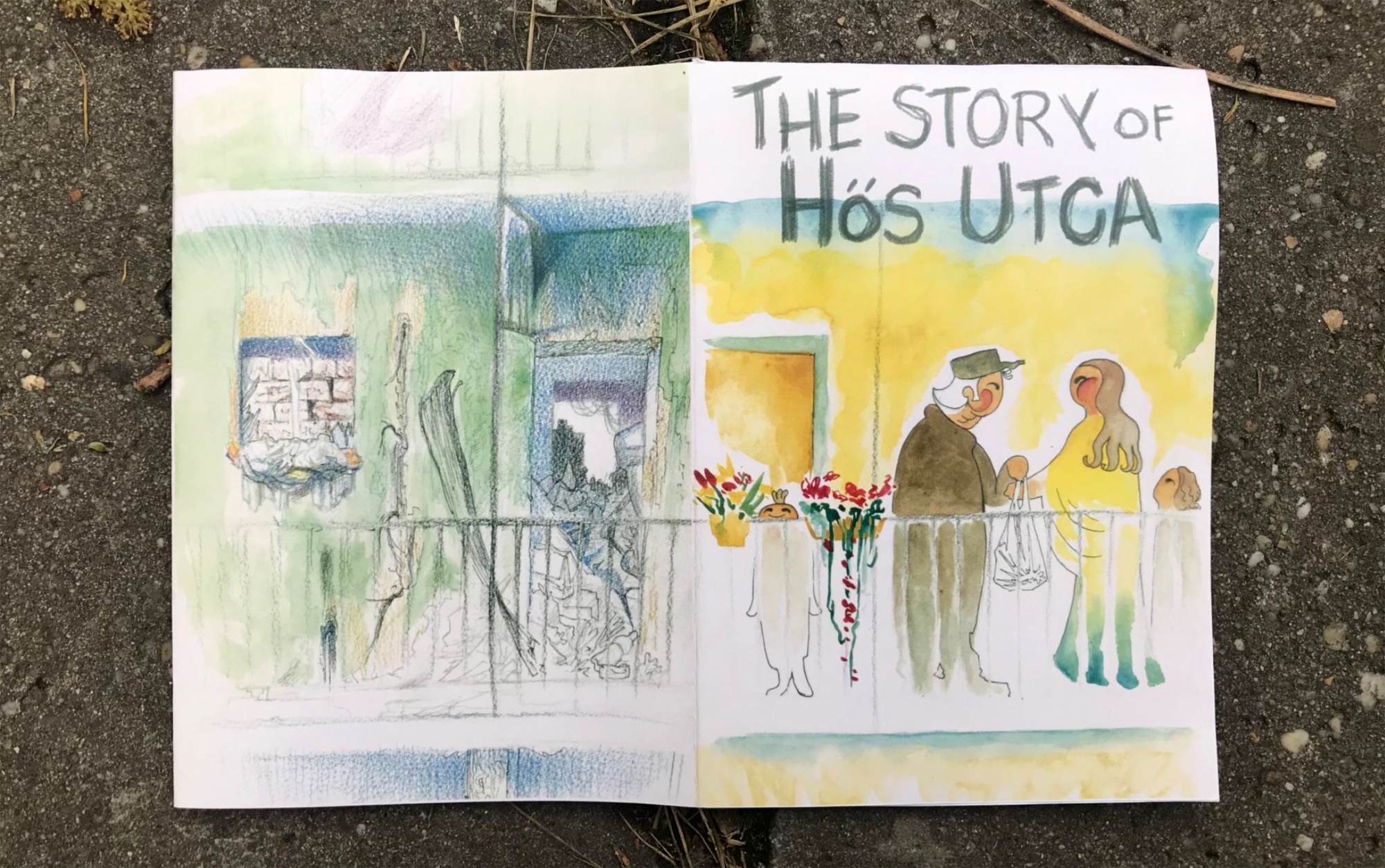
Beatrise Estere Kaminska, Monika Hlavatá, and Vince Támba, The Story of Hős Street [Printed zine], 2023, illustrated documentary zine. Photo courtesy of the artists.
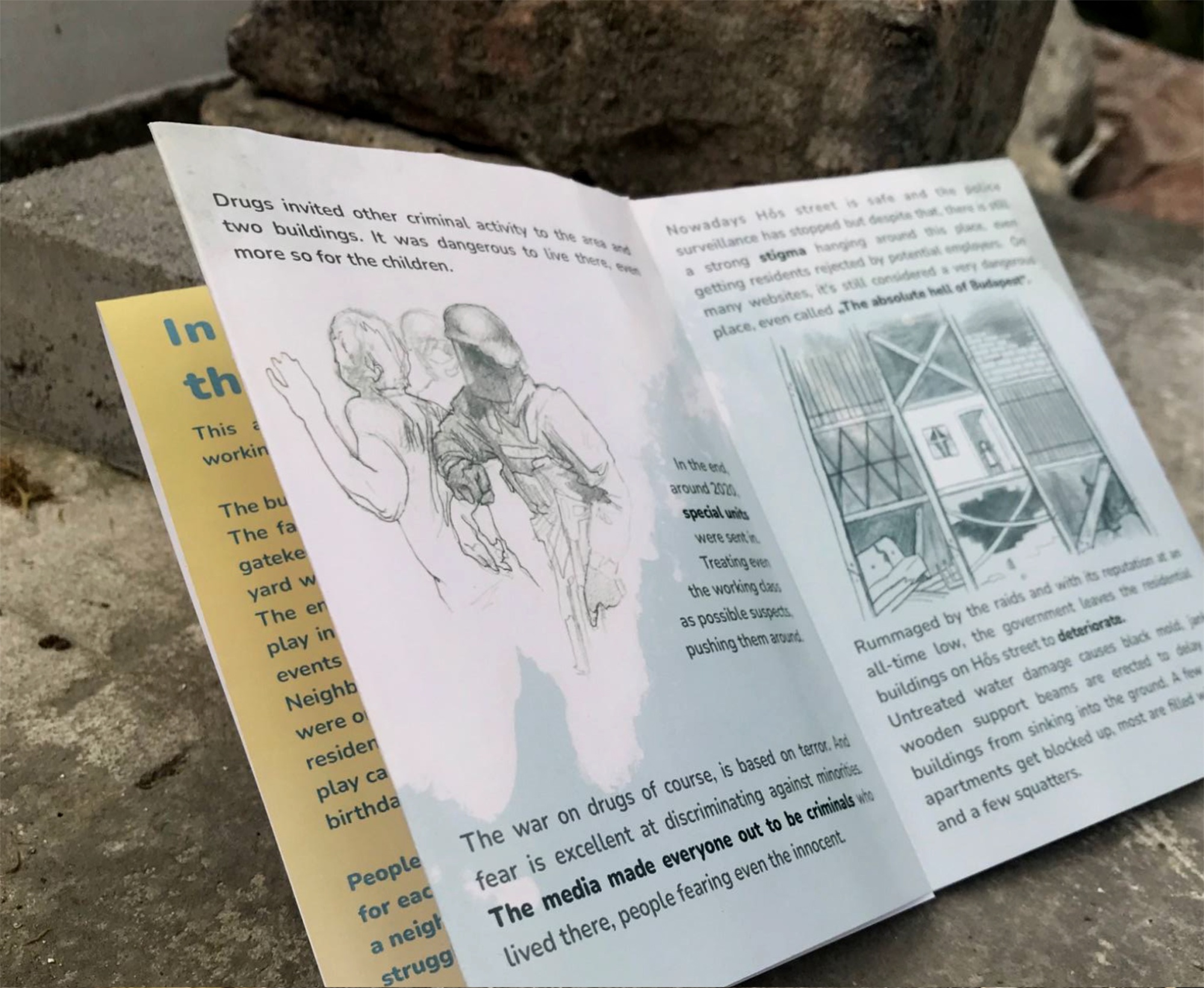
Beatrise Estere Kaminska, Monika Hlavatá, and Vince Támba, The Story of Hős Street [Printed zine spread], 2023, illustrated documentary zine. Photo courtesy of the artists.
Such commitments resonate with broader debates in contemporary art discourse. Art historian Miwon Kwon’s framing of site-oriented art as a social process and art critic and curator Nicolas Bourriaud’s emphasis on participatory meaning-making provide conceptual scaffolding for MTL’s focus on process over object.7 Art historian and critic Claire Bishop’s critique of simplistic binaries in participatory art – “such as active versus passive spectatorship, or good versus bad authorship” – further informs MTL’s treatment of collaboration as an open, generative field.8 Here, authorship is continually redistributed through negotiation and is integral to learning processes, where uncertainty is not a shortcoming but a productive pedagogical condition.
Generating transdisciplinary vocabularies
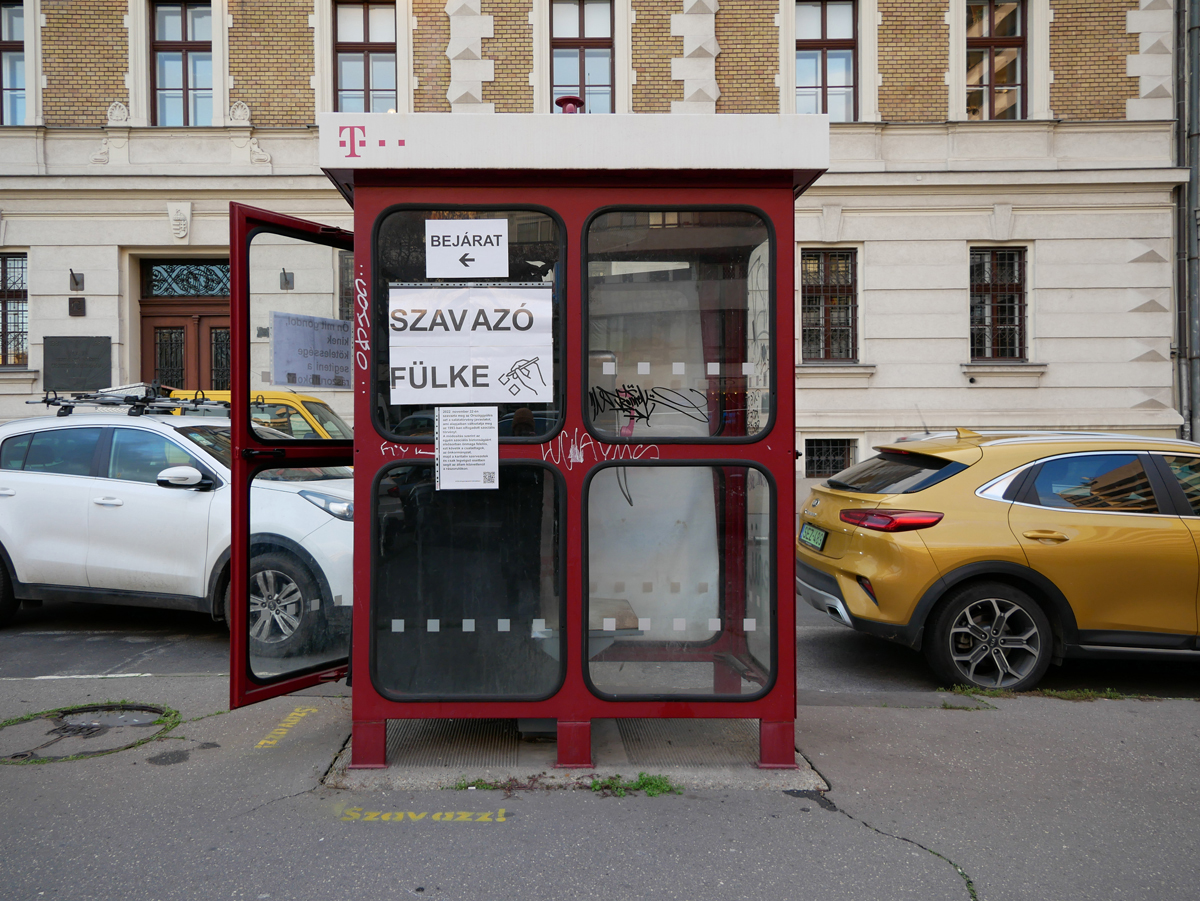
Evelin Sefér, June Irazabal Periz, Regina Sárvári, and Richard Stone, Voting Booth [Installation view], 2022, site-specific intervention in Budapest (repurposed phone booth, fabric, printed signage). Photo courtesy of the artists.
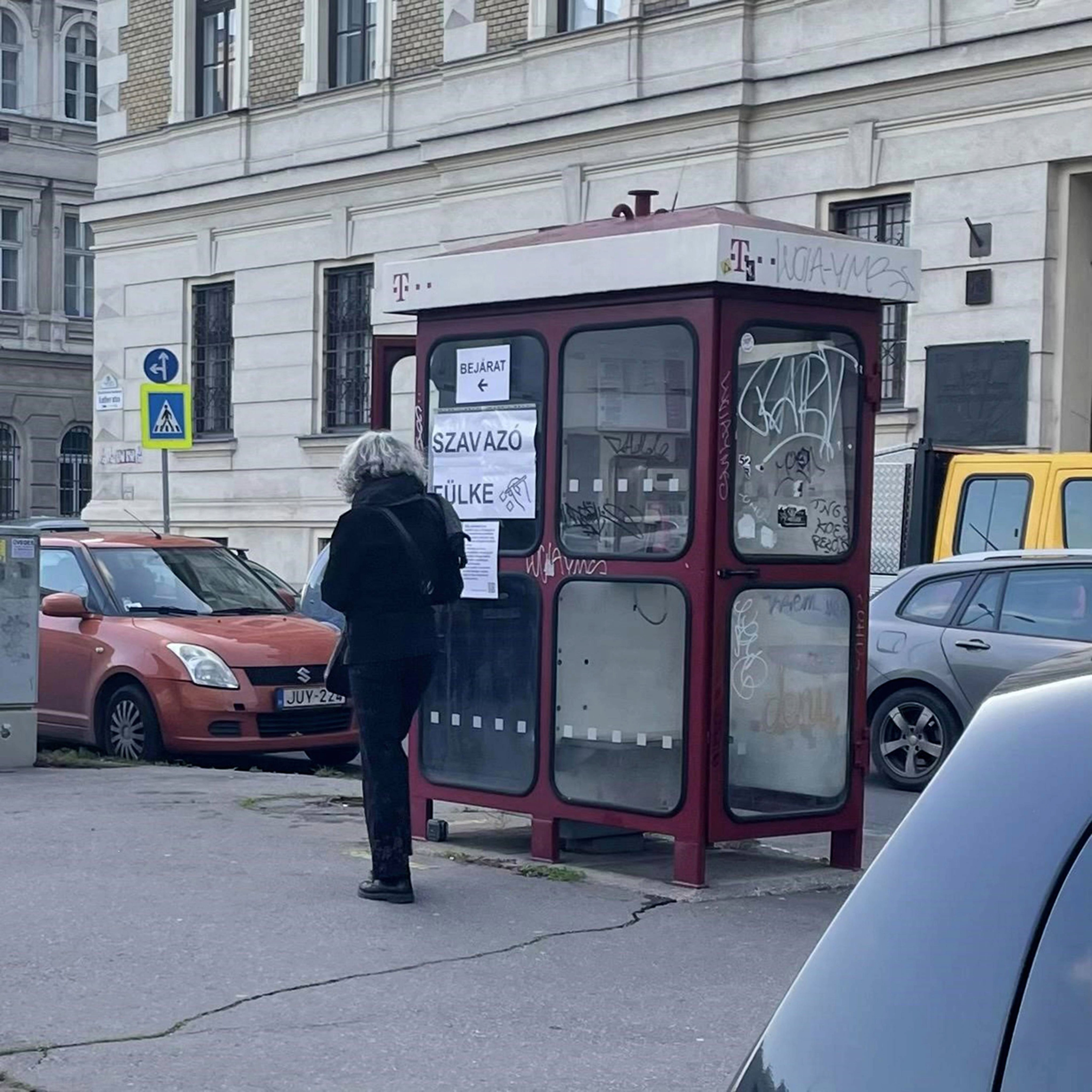
Evelin Sefér, June Irazabal Periz, Regina Sárvári, and Richard Stone, Voting Booth [Public interaction], 2022, site-specific intervention in Budapest. Photo courtesy of the artists.
From the outset, the seminar’s introduction identifies broad concerns, such as civic participation and cultural infrastructures, around which students autonomously form groups. These groups then evolve through peer negotiation, guided by walking debriefs, reader discussions, and site visits, formulating working tools from art, design, theory, and media. Each group deploys a provisional modus operandi developed in situ, adjusting through iterative research and public experimentation.
For instance, one group developed an audio-visual project during Budapest’s lomtalanítás (a yearly district-by-district curbside “bulk waste” collection event, when residents discard unwanted household items for disposal and reuse), logging discarded items across districts and compiling an inventory list with socio-economic readings.9 The final version took the form of an animated video collage alongside the list, with overlays that visualized differences and continuities across districts. In this way, the project mapped consumption patterns and made district-level social disparities legible. Another group conducted on-site conversations with local residents on Hős Street in District Ten, a neighbourhood awaiting a delayed demolition project. The group tackled the urban stigma attached to the area through an interview with a long-term homeowner, which informed an illustrated zine distributed around the city in collaboration with local shops to raise awareness.10 These projects exemplify how artistic devices can reveal overlooked dynamics and support collaborative explorations in urban settings.
In this context, transdisciplinarity forms another key pillar of MTL’s methodology. Contextualization is approached not as a top-down framework but as reciprocal exchange where students do not simply replicate existing structures but actively reshape them. Local and visiting students bring diverse cultural and creative perspectives that destabilize disciplinary silos. By working in mixed groups grounded in practice-led experimentation and embedded “local knowledge,”11 students are able to develop interdisciplinary practices. Group work prioritizes co-creation as collective problem-solving when it becomes necessary within the group’s approach, as a way of building adaptability, fluency, and contextual sensitivity for real-world conditions, skills vital to contemporary socially engaged practice in urban contexts.
MTL thus produces a constellation of practices responsive to emergent themes, sites, and group dynamics. It operates as a living curriculum, with students co-constructing practice-based trajectories, wherein method and pedagogy converge, affirming that practice and learning are inseparable.
Communities of collaborative practice
A key strength of the MTL framework lies in its support for diverse student cohorts across varied sites of engagement. Each project demonstrates how participants develop cross-disciplinary vocabularies and form collaborative learning communities capable of generating expanded knowledge.
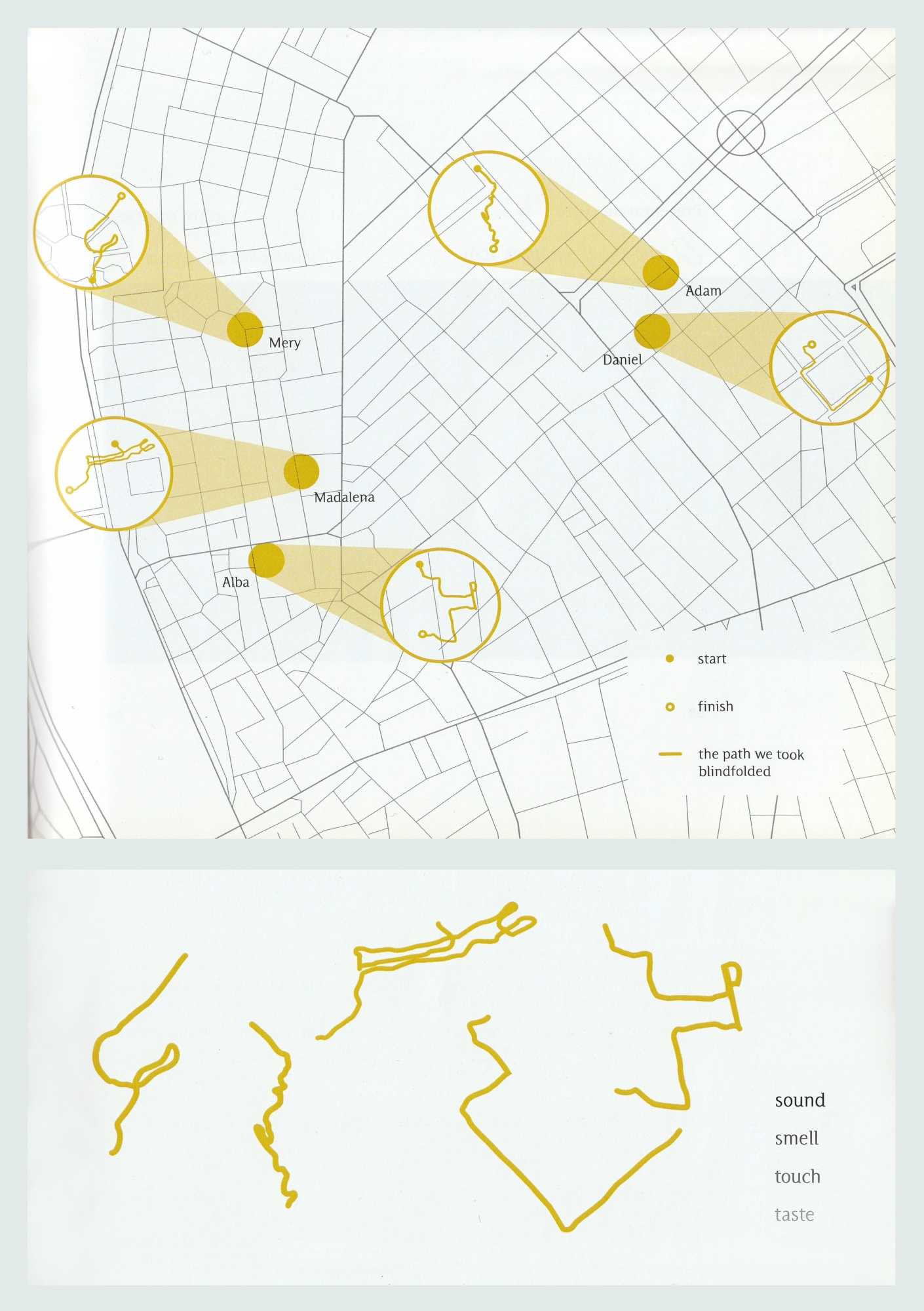
Alba Reche, Ádám Tóth, Daniel Echevarrías, Madalena Pequito, and Mery Gobec, Dark Dog Experience [Digital graphic mapping], 2017, blindfolded site-specific walks. Photo courtesy of the artists.
These outputs take varied forms, including site-specific installations, public actions, social media campaigns, printed matter, video, and sound works. Many address urgent concerns such as housing and urban infrastructure, civic disengagement, and intercultural tensions, and the “right to the city,” while helping students discern broader socio-cultural patterns through comparative site reading and public encounters. The following three cases illustrate how MTL also operates as a portable research tool, in the sense that its method-making apparatus can travel across sites and still produce situated enquiries. It highlights distinct modes of engagement ranging from staged participation to embodied observation and dialogic mapping.
The first case, Voting Booth (2022), was developed by Evelin Sefér and Regina Sárvári (HUFA), June Irazabal Periz (University of the Basque Country, Bilbao), and Richard Stone (Dun Laoghaire Institute of Art, Design and Technology, Dublin). In response to welfare reforms in Hungary, the group repurposed disused phone booths as symbolic voting stations, inviting passers-by to answer: “Who has the biggest responsibility to help the needy?” Inside, no voting mechanism existed, only a notice: “Your government has already decided, and you have no input into their decision.” Participants then received slips reading: “Your opinion matters! Thank you for your vote!” Here, the public’s role was framed not through co-creation but through participatory intervention wherein citizens were engaged as active respondents within a staged scenario. This performative contradiction brought into relief how minimalist, context-sensitive interventions can function as situated critique, making visible the contingency of participatory structures in everyday life as well as the changing realities of urban space.
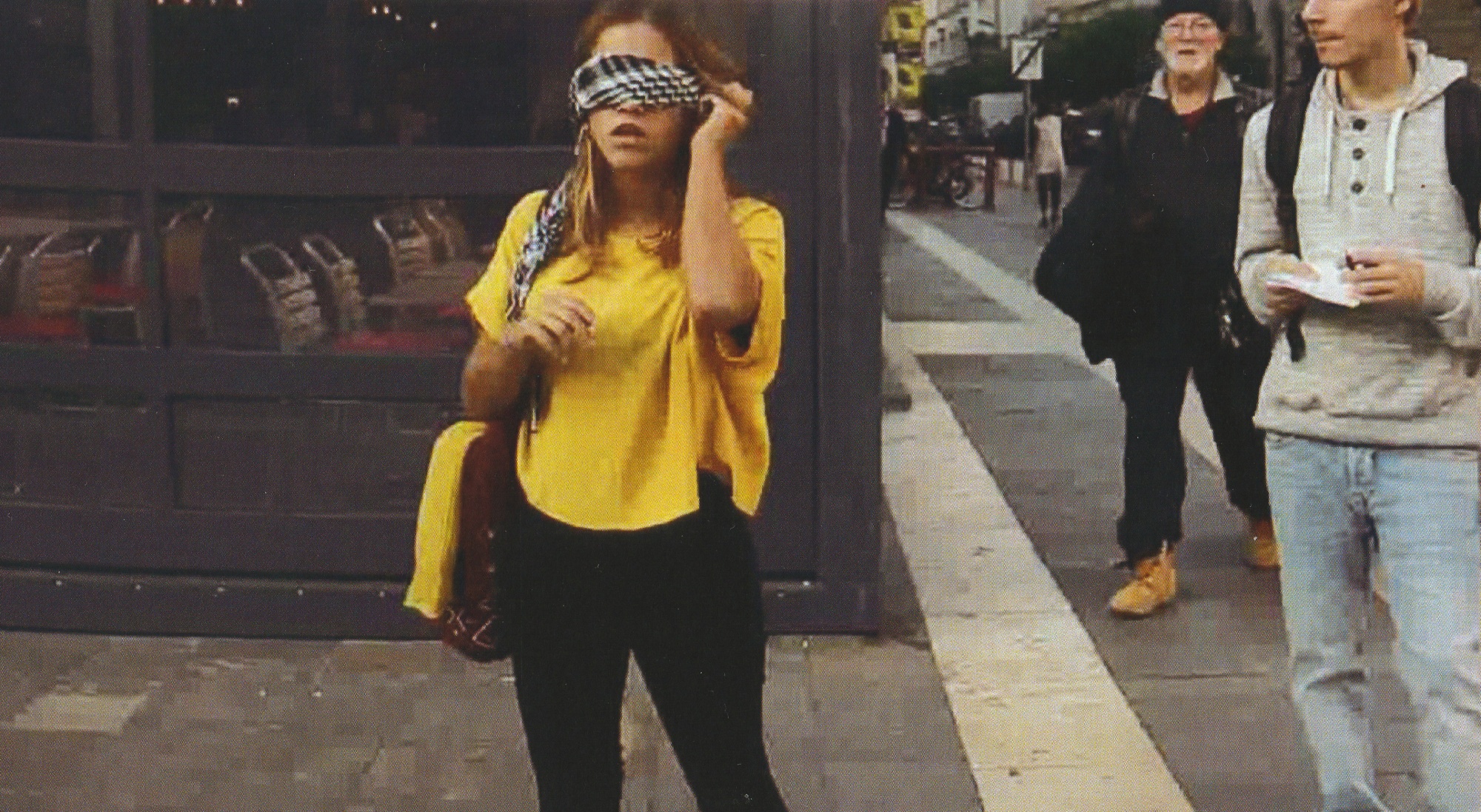
Alba Reche, Ádám Tóth, Daniel Echevarrías, Madalena Pequito, and Mery Gobec, Dark Dog Experience [Site-specific sensory performance], 2017, blindfolded site-specific walks. Photo courtesy of the artists.
The second case, Dark Dog Experience (2017), involved Ádám Tóth (HUFA), Alba Reche and Daniel Echevarrías (University of San Carlos), Mery Gobec (School of Arts Nova Gorica), and Madalena Pequito (University of Lisbon). They investigated the intersection of sensory perception, intuition, and memory. Inspired by the metaphor of a blind guide dog, they staged blindfolded walks in locations such as Szabadság and Hunyadi Squares and Király Street, Budapest, documenting their emotional and bodily reactions to sound, smell, and touch. These “wishpaths” – routes guided by instinct rather than sight – emphasized how non-visual senses inform spatial orientation and, in turn, questioned the dominance of vision in urban design, which often marginalizes alternative forms of experience. Their installation extended this logic, inviting blindfolded visitors to navigate among tactile objects on plinths and trace their movements on paper-covered floors. The project brought forward latent sensory geographies of the city and challenged visual-centric modes of spatial engagement. The process is more fully examined in the publication Drifting through Cityscapes.12
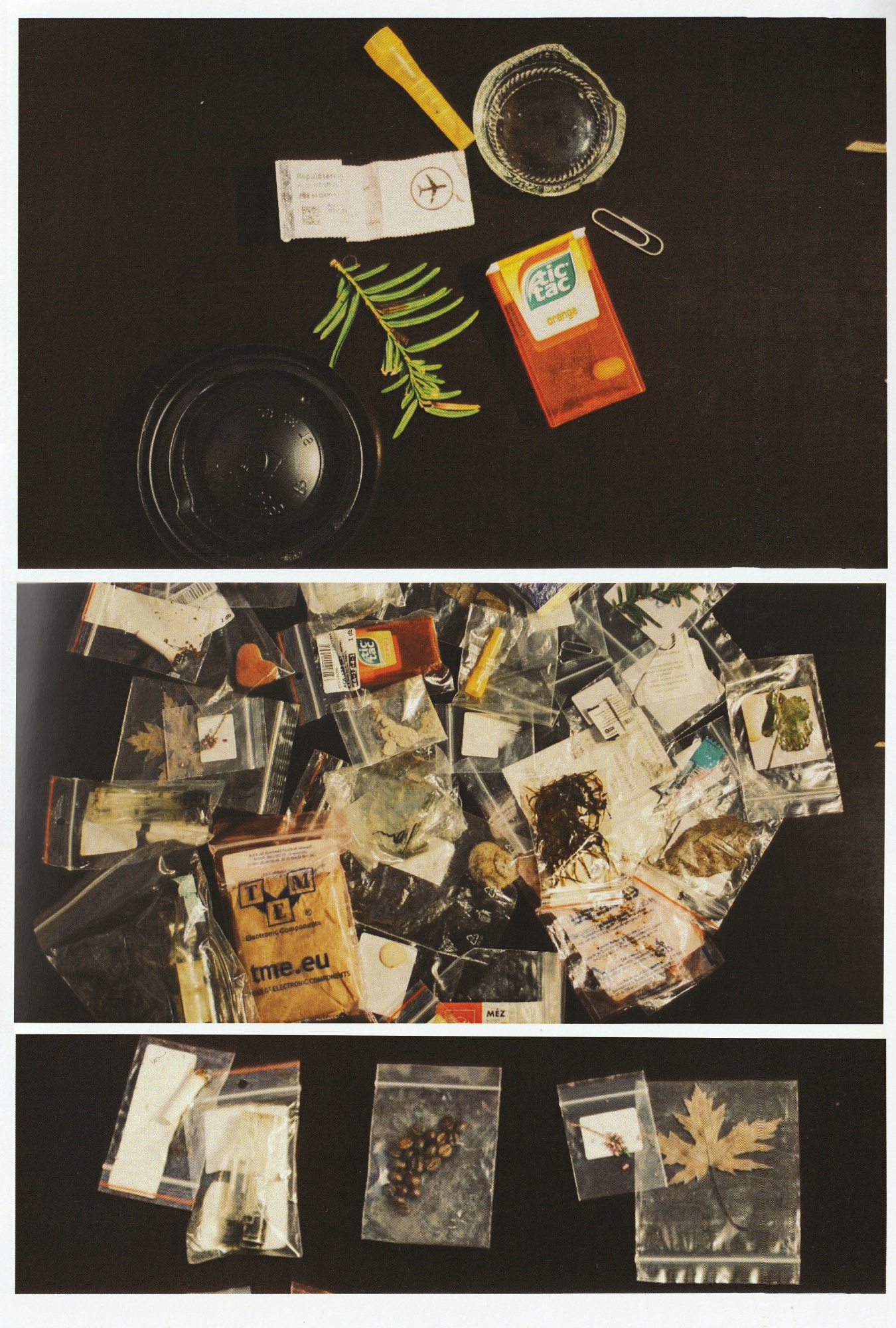
Alba Reche, Ádám Tóth, Daniel Echevarrías, Madalena Pequito, and Mery Gobec, Dark Dog Experience [Assemblage of collected materials], 2017, blindfolded site-specific walks. Photo courtesy of the artists.
The third case, You Are Not a Tourist (2015), arose from the experiences of a Hungarian-British-Portuguese group – Jessye Curtis (Chelsea College of Art and Design), Anya Stewart-Maggs (Bristol School of Art), Ricardo Amélio (Lisbon School of Fine Arts), and Anna Dohy and Luca Pintér (HUFA) – who, after relocating to Budapest, struggled to find non-commercial, community-based venues, particularly in District Eight. They developed an alternative map for Erasmus students and newcomers, featuring local cafés, cultural spaces, and grassroots organizations often left out of mainstream tourist networks, thereby re-scripting a district framed as peripheral and reframing it as a site of belonging, informal know-how, and cultural hybridity. This project approached co-creation through dialogue, as the map’s content was not invented by the students but excavated through conversations with venue owners and residents, effectively turning local knowledge into a shared resource. Selected for their independence from corporate chains and rootedness in local social life, the venues included Lumen, Csiga, Macska, Auróra, Hintaló Iszoda, and Művelődési Szint. Combining field visits, interviews, and narrative mapping, the group produced flyers, a hand-drawn map, and a virtual information kiosk. The project culminated in an exhibition (Barcsay Hall, HUFA) and the publication Spaces of Uncertainty III.13
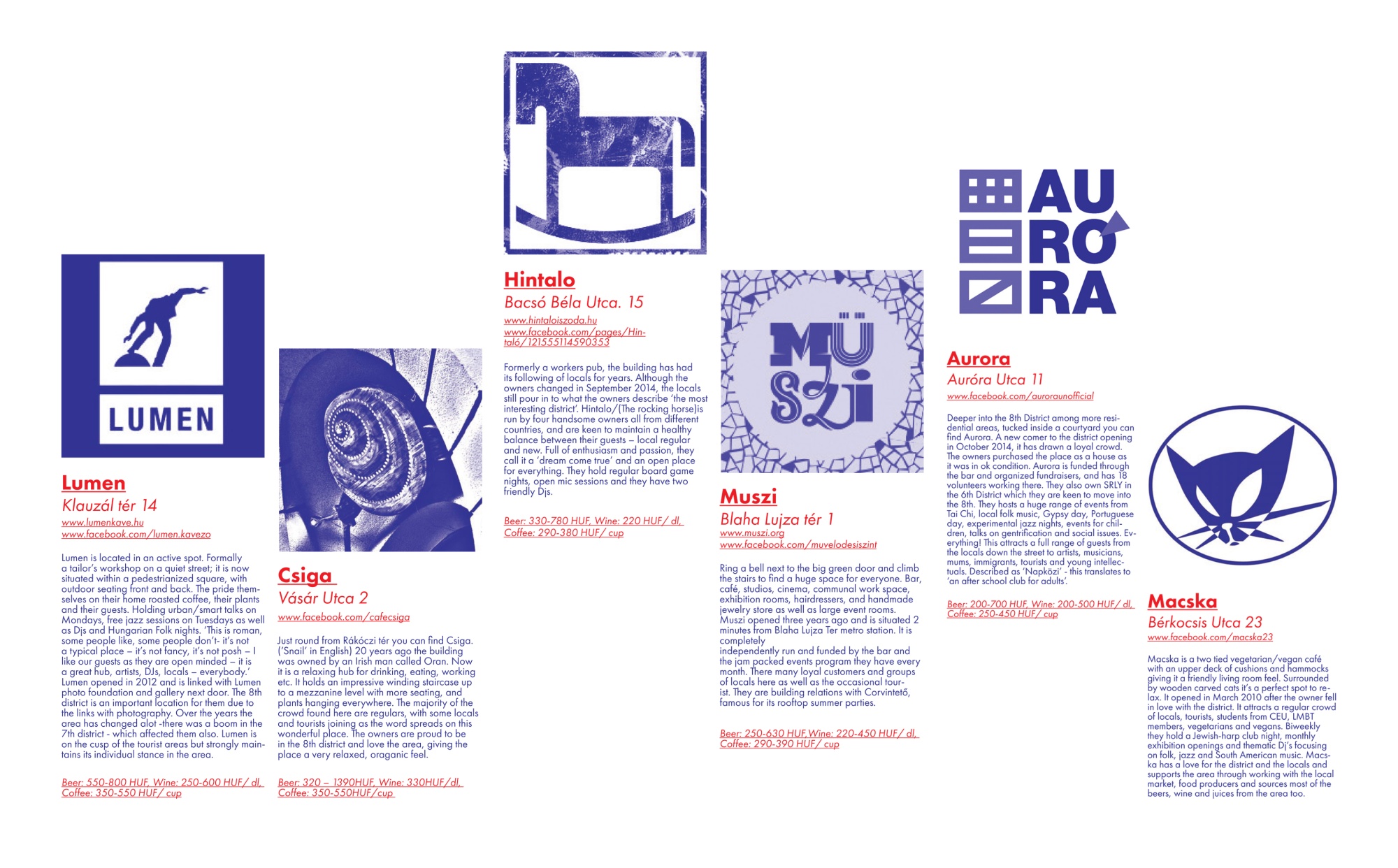
Anna Dohy, Anya-Stewart Maggs, Jessye Curtis, Luca Pintér, and Ricardo Amélio, You Are Not a Tourist [Chosen venues and descriptions], 2015, alternative urban mapping. Photo courtesy of the artists.
While MTL is rooted in Budapest, it does not remain locally confined. Collaborations with art departments elsewhere in Europe, supported by networks such as the Central European Exchange Program for University Studies,14 and Advancing Digitally Renewed Interactions in Art Teaching,15 have broadened research processes across cultural contexts. In each locale, student groups addressed issues tied to spatialities: post-socialist urban redevelopment in Belgrade, border dynamics and regional identity in Nova Gorica, public dissonance in Prague, and times of polycrisis in Bratislava.16 Considering symbols of social inequalities and conflicting narratives in cities, these site-specific investigations emphasize that place-based exploration drives method-making and keeps MTL responsive to context.
In addition to each cohort’s artistic outputs, rotating sites and teams shared research processes while faculty shifted between guiding and co-researching roles. This fluid adaptability made possible new vantage points that articulated viable methodologies and enabled comparative analysis across diverging and converging spatialities. The resulting works generated joint scholarly publications that reinforce the seminar’s collective art-education ethos and a culture of learning grounded in public space and cross-cultural dialogue.17
Knowledge-making-in-action
Taken together, the projects and collaborations demonstrate that MTL’s approach is not institution-bound, since it can readily adapt across diverse sites and contexts, while giving practical form to its conceptual framework as an intellectual and social negotiation that interrogates structures through creative activity. In this context, learning arises through a process of co-authorship. Because artistic research is not predefined in MTL’s frame, it evolves organically through methodological mutability, wherein processes and realizations are not supplementary but constitute its very substance.18
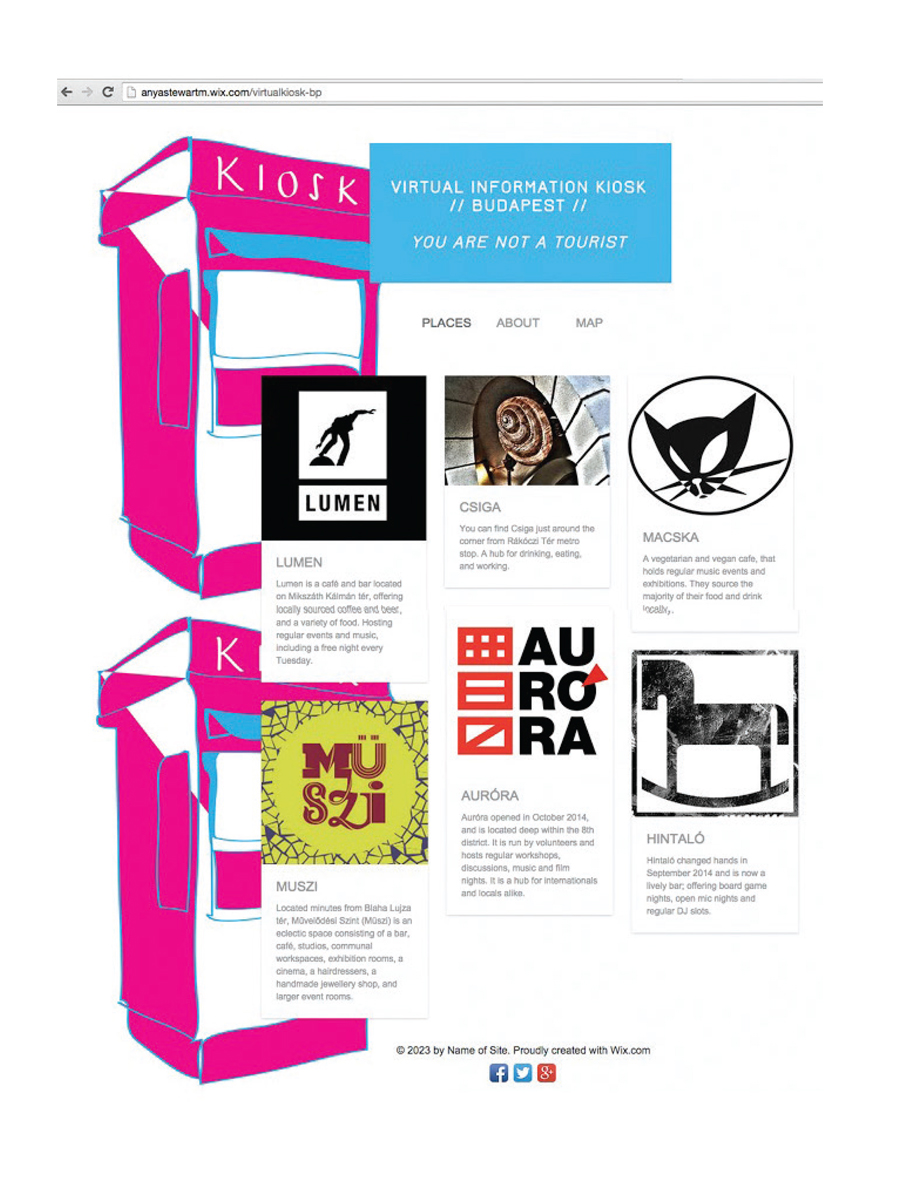
Anna Dohy, Anya-Stewart Maggs, Jessye Curtis, Luca Pintér, and Ricardo Amélio, You Are Not a Tourist [Virtual information kiosk], 2015, alternative urban mapping. Photo courtesy of the artists.
Here, research proceeds “into,” “for,” and “through” art, generating learning arcs that are theory-informed and practice-led, continually extended and revised via public interaction and iterative feedback.19 The seminar integrates divergent disciplinary logics without allowing one to dominate, privileging emerging forms of learning in tandem with puzzling, contested, and context-specific phenomena.20 This decentralized approach cultivates a problem-solving ethos where ownership shifts with each experiment but remains collective. In this sense, “method” becomes a primary and distinctive scholarly contribution.
Learning outcomes are evaluated through a combination of process-based criteria including ongoing tutorials and debriefs, peer critique within groups, and final public presentations. Students also produce reflective documentation in the form of field notes, mapping, and photo or video logs. Assessment prioritizes the clarity of the group’s enquiry alongside ethical and contextual responsiveness to the site and its publics. Additionally, assessment considers the group’s capacity to iterate methods in response to feedback and to articulate what was learned collectively and individually through the work’s making and reception.
MTL, therefore, enacts “modes of knowledge production” that prioritize context-defined methodologies stimulated by multidisciplinary practices. It advances a living epistemology of “knowing-in-action” by becoming a situated form of research in which knowledge remains in motion, continually reformed through collaborative engagement with the intricacies of urban life. Consequently, the seminar positions method-making as a critical contribution to art education by giving expression to a dynamic and adaptable pedagogical paradigm.
+++
Özgür Ilter
is a visual artist, designer, and researcher at the Hungarian University of Fine Arts, where she is pursuing a practice-based doctorate. Her work probes shifts in identity within spatial dialectics through image-making and mixed-media construction.
Allan Siegel
is a filmmaker, visual artist, writer, and teacher who holds a doctorate in curatorial studies from the University of Reading. He was a founding member of the film collective Newsreel (1968) and later co-director of Third World Newsreel. He has taught at the School of the Art Institute of Chicago and in the Intermedia Department at the Hungarian University of Fine Arts.
Noten
- Founded in 2011 in the Intermedia Department by artist Szabolcs KissPál and cultural researcher Zoltán Kékesi, MTL has since run as a recurring seminar embedded in the department’s curriculum. For further information and the full seminar archive, see Mapping the Local, mke.hu/mapping_the_local/index.php. Accessed 26 Apr. 2026. ↩
- These concepts originate in the development of Actor-Network-Theory (ANT) and Latour’s curatorial frameworks. See Latour, Bruno. Reassembling the Social: An Introduction to Actor-Network-Theory. Oxford University Press, 2005, pp. 219-20; Latour, Bruno. “From Realpolitik to Dingpolitik or How to Make Things Public.” Making Things Public: Atmospheres of Democracy, edited by Bruno Latour and Peter Weibel. MIT Press, 2005, p. 31. ↩
- In Debord’s precise theoretical framing, the dérive is “a technique of rapid passage through varied ambiances” where individuals “drop their relations, their work and leisure activities (…) and let themselves be drawn by the attractions of the terrain and the encounters they find there.” He outlines psychogeography as the “study of the precise laws and specific effects of the geographical environment (…) on the emotions and behavior of individuals.” See Debord, Guy. “Theory of the Dérive.” Situationist International Anthology, edited and translated by Ken Knabb. Bureau of Public Secrets, 2006, p. 62 (for a broader conceptual understanding, see pp. 62-66); and Debord, Guy. “Introduction to a Critique of Urban Geography.” Situationist International Anthology, edited and translated by Ken Knabb. Bureau of Public Secrets, 2006, p. 8. For de Certeau, a tactic refers to “a calculated action determined by the absence of a proper locus,” one that must “play on and with a terrain imposed on it and organized by the law of a foreign power.” See de Certeau, Michel. The Practice of Everyday Life, translated by Steven Rendall. University of California Press, 2002, p. 37. ↩
- Lefebvre, Henri. The Production of Space, translated by Donald Nicholson-Smith. Blackwell, 1991, pp. 33, 40. ↩
- Schön, Donald A. The Reflective Practitioner: How Professionals Think in Action. Basic Books, 1983, pp. 50, 60-61. ↩
- Sullivan, Graeme. Art Practice as Research: Inquiry in the Visual Arts. Sage, 2005, pp. 78-80. ↩
- Kwon, Miwon. One Place After Another: Site-Specific Art and Locational Identity. MIT Press, 2004, pp. 3, 26; Bourriaud, Nicolas. Relational Aesthetics, translated by Simon Pleasance and Fronza Woods. Les Presses du réel, 2002, pp. 25, 38. ↩
- Bishop, Claire. Artificial Hells: Participatory Art and the Politics of Spectatorship. Verso, 2012, p. 8. ↩
- This group project, titled Collectors, was developed within MTL in Spring 2023 by Alibhe Reilly Tuite (MTU Crawford College of Art and Design), Sophia Rossetto (Rome University of Fine Arts), and Zsófia Marchhart (Hungarian University of Fine Arts). Further documentation is available via the seminar archive Mapping the Local: mke.hu/res/collectors_mtl_gr_3_presentation.pdf. Accessed 26 Apr. 2026. ↩
- This group project, titled The Story of Hős utca, was developed within MTL in Spring 2023 by Monika Hlavatá (Academy of Fine Arts and Design Bratislava), Beatrise Estere Kaminska (Art Academy of Latvia), and Vince Támba (Hungarian University of Fine Arts). Further documentation is available via mke.hu/res/group2_mapping_the_local.pdf. Accessed 26 Apr. 2026. ↩
- Quoted in Dunin-Woyseth, Halina. “Some Notes on Mode 1 and Mode 2: Adversaries or Dialogue Partners?” The Routledge Companion to Research in the Arts, ed. by Michael Biggs and Henrik Karlsson, Routledge, 2010, p. 73. ↩
- KissPál, Szabolcs, et al. Drifting through Cityscapes, edited by Peter Purg, Hungarian University of Fine Arts / University of Nova Gorica / University of Arts, Belgrade, 2018, joom.ag/cmld. Accessed 27 Apr. 2026. ↩
- Siegel, Allan and Eszter Lázár, editors. Spaces of Uncertainty III. Hungarian University of Fine Arts, 2015, joom.ag/Vmld. Accessed 27 Apr. 2026. ↩
- Central European Exchange Program for University Studies (CEEPUS) is a multilateral academic exchange programme among fifteen Danube-region countries supporting student and teacher mobility through university networks. CEEPUS, www.ceepus.info. Accessed 27 Apr. 2026. ↩
- Advancing Digitally Renewed Interactions in Art Teaching (ADRIART.CE) is a CEEPUS Central European derivative network of the Erasmus Multilateral LLP ADRIART project, which promotes interdisciplinary collaboration across media arts and cultural theory through joint teaching, mobility, and site-specific enquiry in the Media Arts and Practices programme. ADRIART.CE, au.ung.si/en/portfolio-item/adriart-ceepus/. Accessed 27 Apr. 2026. ↩
- This three-session collaboration between HUFA, the Academy of Fine Arts and Design Bratislava, and the Academy of Fine Arts Prague addressed the themes “Public in Times of Polycrisis,” “How Artistic Formats Can (Re)produce the Lost Public?” and “Public Dissonance,” and was supported by the International Visegrad Fund through the V4 Gen Mini-Grant programme. See “Our University Participates in V4 GEN Mini-Grant Project.” Hungarian University of Fine Arts, mke.hu/news/index.php?mid=NHzjPlRltwje2kPyzGddxb. Accessed 27 Apr. 2026. ↩
- For further MTL student projects, see KissPál, Szabolcs, et al., editors. Crossing the Paths. Hungarian University of Fine Arts, 2017, joom.ag/smld. Accessed 27 Apr. 2026. ↩
- Borgdorff, Henk. The Conflict of the Faculties: Perspectives on Artistic Research and Academia. Leiden University Press, 2012, p. 24. ↩
- Frayling, Christopher. “Research in Art and Design.” Royal College of Art Research Papers, vol. 1, no. 1, Apr. 1993, pp. 4-5. ↩
- Schön, p. 50. ↩
Meer in dit thema

The state of collective creativity within the site and upon arrival. Artists’ perspectives on the Liminal Lab project
Marija Griniuk
Nurturing musician-educators’ reflective practice through a Blended Intensive Programme on practitioner research
Mathias Moors, Adri de Vugt, Thomas De Baets
Meer uit dit dossier
Educatief onderzoek in de kunsten: een praktijkgebonden en nomadisch perspectief
Joost Vanmaele, An De bisschop
Meer uit dit nummer
Nurturing musician-educators’ reflective practice through a Blended Intensive Programme on practitioner research
Mathias Moors, Adri de Vugt, Thomas De Baets
Collective Signal: A swan song for the air raid siren
Angela de Weijer, Karin Bijsterveld
Embodied Theory
Anne-Lise Brevers