Dit artikel verscheen in FORUM+, pp. 6-7
Nurturing musician-educators’ reflective practice through a Blended Intensive Programme on practitioner research
Mathias Moors, Adri de Vugt, Thomas De Baets
This article presents a case illustrating how the nexus between research and education takes shape within a music education curriculum: the Blended Intensive Programme (BIP) on practitioner research in music education, building on an existing partnership between LUCA School of Arts (Leuven) and the Royal Conservatoire (The Hague). We introduce the partnership and its research paradigm, outline the content and structure of the BIP, and share students’ experiences and considerations for future editions.
Aan de hand van een case illustreren we hoe de verbinding tussen onderzoek en onderwijs vorm krijgt binnen het curriculum muziekeducatie. Het Blended Intensive Programme (BIP) rond praktijkonderzoek in muziekeducatie bouwt verder op een bestaande samenwerking tussen LUCA School of Arts (Leuven) en het Koninklijk Conservatorium (Den Haag). We lichten de samenwerking en het onderzoeksparadigma toe, schetsen de inhoud en structuur van de BIP, en delen ervaringen van studenten en overwegingen voor toekomstige edities.
‘It takes two to tango …’: Practitioner research in music education
The Bologna Process, launched in 1999 within European higher education, led to two notable developments with which music education Bachelor’s and Master’s programmes in Flanders and the Netherlands had to engage.
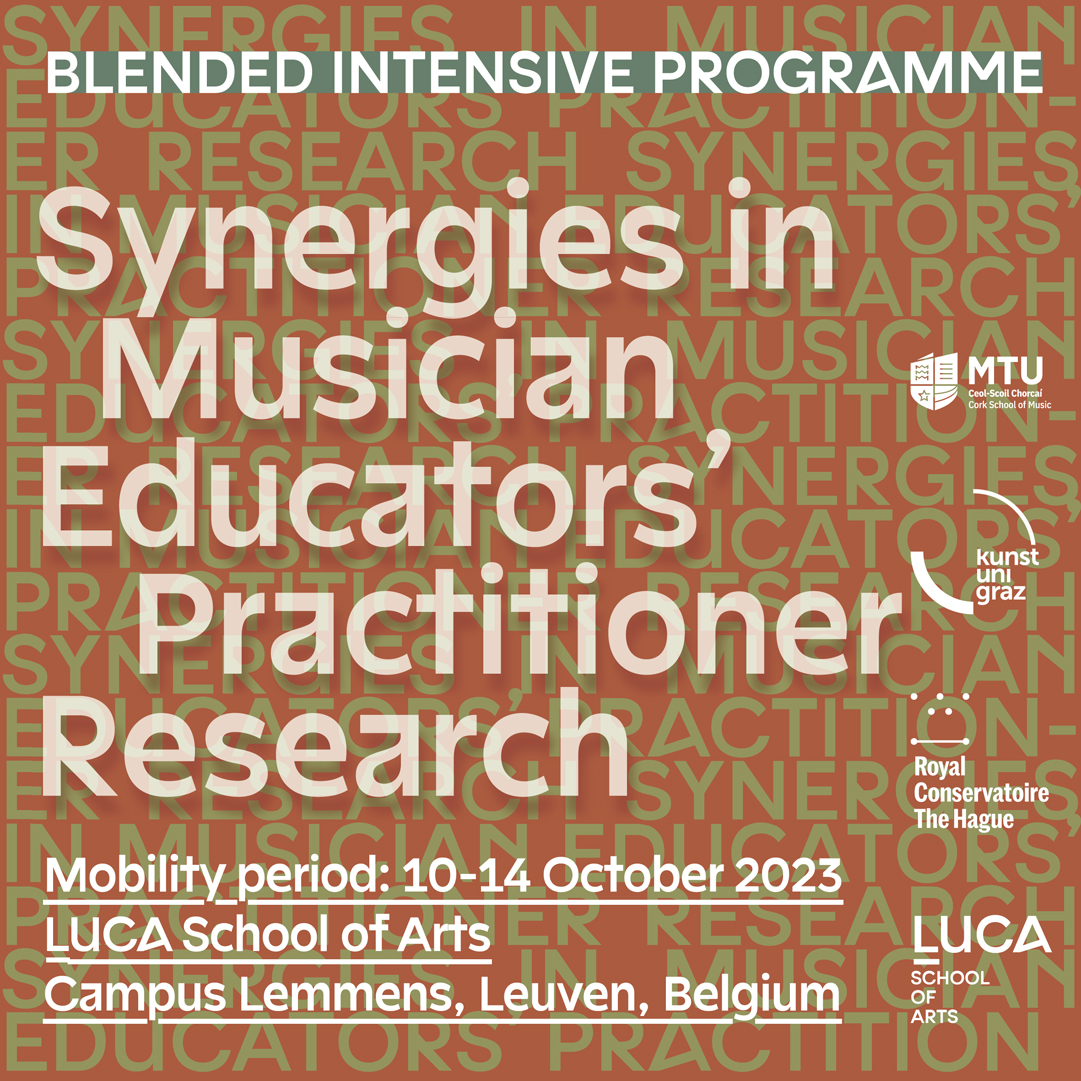
LUCA, Social media campaign of the BIP 2023 in Leuven, titled ‘Synergies in Musician Educators’ Practitioner Research’, 2023. Designed by Stefaan Vermeulen.
Firstly, there was increased attention to research within music curricula, resulting in the emergence of a distinct paradigm of artistic research. This type of research is conducted by artists themselves and takes their personal position and experiential world as a gateway to new knowledge. In essence, it concerns a form of practitioner research carried out by “reflective practitioners”.1 Master’s programmes in music education at EQF level 7,2 such as those in The Hague (Royal Conservatoire) and Leuven (LUCA School of Arts), which existed prior to the formal introduction of educational Master’s programmes in Flanders, aligned themselves with this paradigm early. This led to an artistic, fundamentally practice-oriented approach to music education research. That choice also resonated with practice-based traditions in pedagogy, such as “educational action research”, enabling these programmes to position themselves in a productive middle ground between pedagogical and artistic research.3
Secondly, the further development of a ‘European Higher Education Area’ strengthened the emphasis on international mobility for students and staff. Building on a shared interest in practitioner research, a multi-day exchange was established to bring together Master’s students from The Hague and Leuven. The first “Joint Seminar on Practitioner Research in Music Education” took place in The Hague in 2014 and has since been organized annually, becoming an important catalyst for the development of the practitioner research paradigm. A highlight of this collaboration was the 2017 publication Ticket to Ride.4
Practitioner research was thus adopted not only as a response to changing European policy contexts, but also because of its substantive value: it contributes to high-quality music education, supports teachers’ job satisfaction, bridges the research-practice gap, and plays a role in advocacy for music education.5 Elsewhere, we have further explored the artistic dimension of music teachers’ professionalism in relation to artistic research.6
‘… But it takes a community to create change’: An evolving partnership
Referred to as trick-or-treats, these sessions offer a buffet of research snippets, allowing participants to consider which ‘tricks’ may become genuine ‘treats’ for their own projects.
The introduction of Blended Intensive Programmes (BIPs) within Erasmus+ provided structural funding opportunities for the joint seminar.7 Defined as “short-term physical mobility abroad combined with a compulsory virtual component,”8 BIPs allowed the seminar to expand beyond its previously self-supported format. As BIPs require involvement of at least three higher education institutions, Kunstuniversität Graz (Austria) and MTU Cork School of Music (Ireland) joined the collaboration, resulting in the first BIP edition in 2022.
This expansion led to a more formalized structure, with clearly articulated learning outcomes, formal reporting, and an integrated ‘blended’ component, extending the exchange trajectory. The programme aimed to increase students’ ability to share and develop their research projects, enhance research and communication skills, engage in peer feedback, and foster collaborative research competences. Through international exchange, students were also encouraged to engage with diverse perspectives and critically reflect on their own values, beliefs, and practices.
‘Do the Hokey Pokey’: Structure and learning activities
To achieve the intended learning outcomes within the BIP format, we designed a trajectory consisting of one introductory online session, an in-person intensive week (hosted annually at one of the partner campuses), and four follow-up online sessions. The trajectory typically runs from October to March and involves around twenty Master’s students. During the intensive week, students engage in an in-depth exchange of ideas and experiences related to their research project, culminating in the design and presentation of a poster.
Presenting a poster to peers while receiving immediate feedback supports most learning outcomes. The poster serves as a snapshot of students’ research-in-progress, whether they are still orienting themselves or already collecting data. Explaining rationales, methodological plans, and emerging struggles to peers from other institutions proves valuable and effective. The poster format facilitates making each step explicit. In the predecessor of the BIP, the joint seminar, students prepared posters in advance to initiate reflection and dialogue. Within the BIP, poster presentations were moved to the final day of the intensive week, allowing the design process to nourish reflection throughout the exchange.
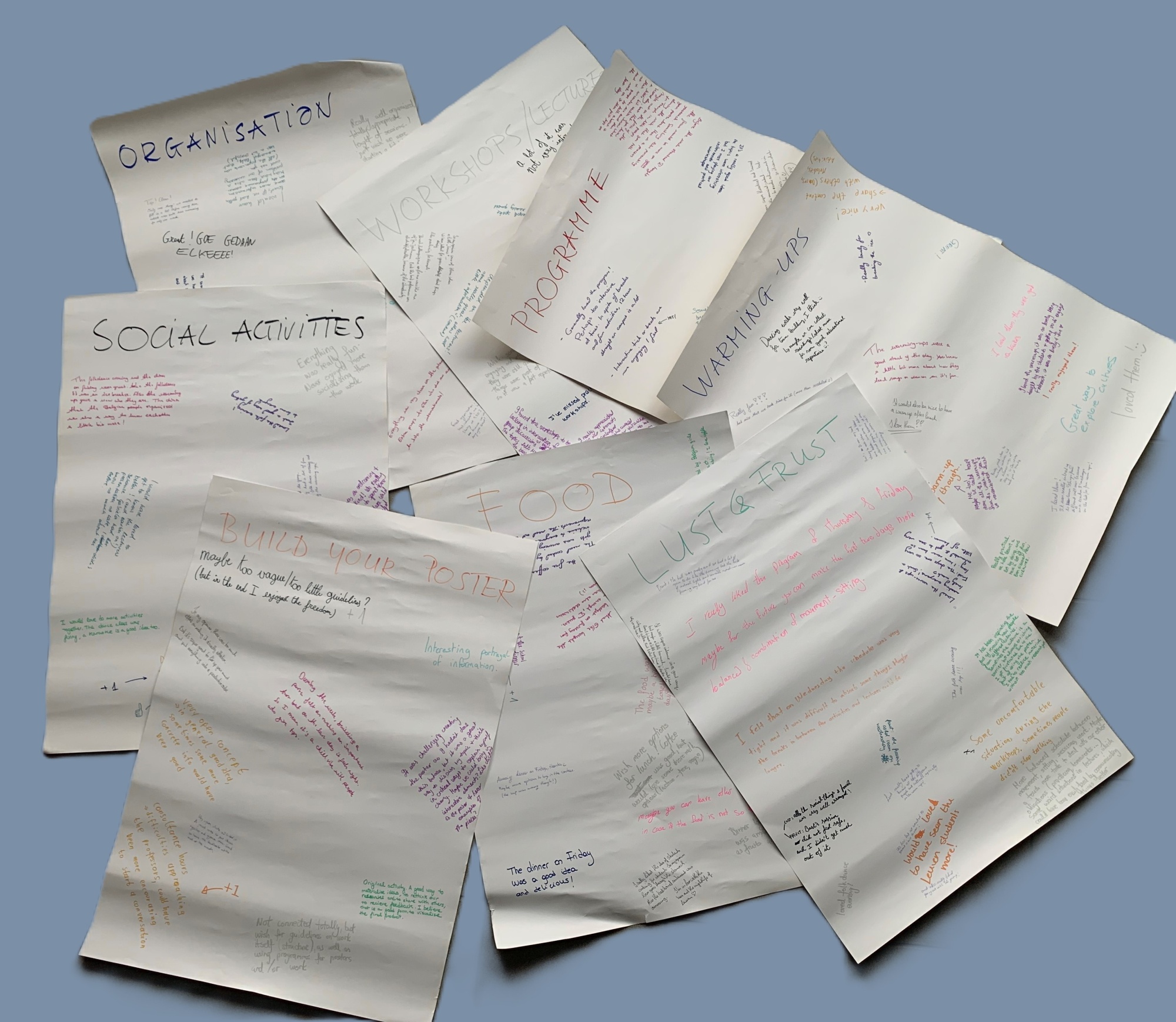
LUCA, Posters featuring participants’ feedback on a range of topics at the conclusion of the BIP 2023 intensive week in Leuven, 2023. Photo by Thomas De Baets.
To prepare students for this presentation, a wide range of activities is embedded in the intensive week. These include music and music education workshops, research methodology input, peer feedback moments, and one-on-one supervisory sessions. Each BIP edition features interactive talks and workshops led by collaborating lecturers and guests, often addressing the complex relationships between students’ roles as educators, musicians, and researchers. Another recurring theme concerns the ontology and enactment of artistic-musical acts, including practising an instrument and teaching improvisation.
Research-methodological input is provided through a series of fifteen-minute sessions distributed across the week, each introducing a technique commonly used in music education research, such as Video-Stimulated Recall, Critical-Incident technique, diary studies, and learner reports. Referred to as trick-or-treats, these sessions offer a buffet of research snippets, allowing participants to consider which ‘tricks’ may become genuine ‘treats’ for their own projects.
Over time, we have witnessed exceptional collaborations emerging from intercultural exchanges of local musical practices, as well as from the recognition of shared European values.
The intensive week also includes various extracurricular activities. Each morning begins with a musical warm-up led by a different group of students, fostering embodied encounters with diverse musical cultures. Participants value these moments for both their artistic vibrancy and strong sense of community. Similarly, the first evening features a welcome dinner prepared by students of the home institution: an informal yet cherished way of connecting and cultivating cultural awareness.
After the intensive week, four online sessions allow students to continue working in smaller, self-selected groups based on shared interests, resulting in each group exploring entirely different topics. In a final plenary meeting, groups present their progress and outcomes. Over time, we have witnessed exceptional collaborations emerging from intercultural exchanges of local musical practices, as well as from the recognition of shared European values. These synergies often lead to innovative perspectives that would not have surfaced within a single institutional context.
Students highly value the diverse opportunities for exchange and particularly appreciate the chance to present research-in-progress to an international audience and to position themselves as reflective musician-educators who articulate their ideas in English as a second language.
‘Save the last dance’: Lessons learned for future editions
In 2025, the BIP on practitioner research in music education was organized across all four partner institutions. We are continuing the programme and may expand the partnership, as these short mobility experiences have shown significant impact on students. Compared with longer mobility programmes, short-term initiatives are less complex to organize and more inclusive for students who cannot commit to an extended exchange.
Future editions raise four considerations: (1) As differing institutional interpretations may dilute practitioner research, continued investment in a shared understanding remains essential; (2) As the BIP integration into curricula varies considerably, partner institutions could adopt a more consistent approach; (3) Methods for collecting and analysing non-verbal musical research data (both processes and products) should be explored more intensively; (4) Although group diversity enriches the exchange, we still struggle to design activities that make all students feel included and engaged.
Overall, we value the blended format of the programme, as the hybrid structure strengthens student ownership. We are aware that other BIPs experience difficulties in implementing the online component, as confirmed by the European Association of Conservatoires, which has identified “digital integration” with “online components to complement, not duplicate, in-person activities” as a unique challenge for BIPs in higher music education.9
Acknowledgements
From the perspective of LUCA School of Arts and the Royal Conservatoire in The Hague, we would like to extend our gratitude to our BIP partners who have helped shape the BIP editions in respectively The Hague, Leuven, Graz, and Cork: Gabriela Mayer from MTU Cork School of Music, and Jan Jachmann and Lukas Kleemair from Kunstuniversität Graz. We would also like to thank our international officers for their marvellous support.
+++
Mathias Moors
is a PhD Candidate at LUCA School of Arts, KU Leuven, in the Music Education expertise team.
Adri de Vugt
is Senior Lecturer in Music Education and Programme Leader of the Master’s programme The Musician Educator at the Royal Conservatoire in The Hague.
Thomas De Baets
is Associate Professor of Music Education at LUCA School of Arts, KU Leuven, where he leads the Music Education expertise team.
Noten
- Schön, Donald. The Reflective Practitioner: How Professionals Think in Action. Basic Books, 1983. ↩
- Europass. “The European Qualifications Framework.” Europass, europass.europa.eu/en/description-eight-eqf-levels. Accessed 3 Dec. 2025. ↩
- A similar exploration can be found in the practice-based, nomadic perspective at KASK & Conservatory Ghent, as described in Vanmaele, Joost, and An De bisschop. “Educatief onderzoek in de kunsten: een praktijkgebonden en nomadisch perspectief.” FORUM+, vol. 31, no. 1, pp. 12-23, doi.org/10.5117/forum2024.1.003.vanm. ↩
- De Vugt, Adri, Tine Castelein, and Thomas De Baets, editors. Ticket to Ride: Praktijkonderzoek in muziekeducatie. Garant, 2017. ↩
- De Baets, Thomas. “The Promise of Practitioner Research in Music Education: a Continental European Perspective.” TOPICS for Music Education Praxis, forthcoming. ↩
- De Baets, Thomas, et al. “De virtuoze muziekdocent als artistiek onderzoeker”. Cultuur+Educatie, vol. 22, no. 65, 2024, pp. 18-31. ↩
- Co-funded by the European Union. The European Union support for the production of this publication does not constitute endorsement of the contents, which reflect the views only of the authors, and the European Union cannot be held responsible for any use which may be made of the information contained therein. ↩
- Erasmus+ Programme Guide 2025, European Commission, 2025, p. 48. ↩
- AEC – European Association of Conservatoires. “Guidelines for Implementing Blended Intensive Programs (BIP) in Conservatoires.” AEC, 2024, p. 8, cms.aec-music.eu/wp-content/uploads/2024/12/BIP-2024-Dublin-Report-.pdf. Accessed 1 Aug. 2026. ↩
Meer in dit thema
Meer uit dit dossier
De academische carrière van de rupsband. Middelen voor voortbeweging – Betekenis van vooruitgang
Bert Willems
FAST45 - Futures arts school trends 2045
Koenraad Hinnekint
Meer uit dit nummer

From the mountain I see the mountain. Shifting landscape perception through filmmaking, encounters, and indigenous archives
Julián García Long
Conceptual, performative, personal: A curriculum
Yuki Okumura