Dit artikel verscheen in FORUM+ vol. 33 nr. 1, pp. 14-19
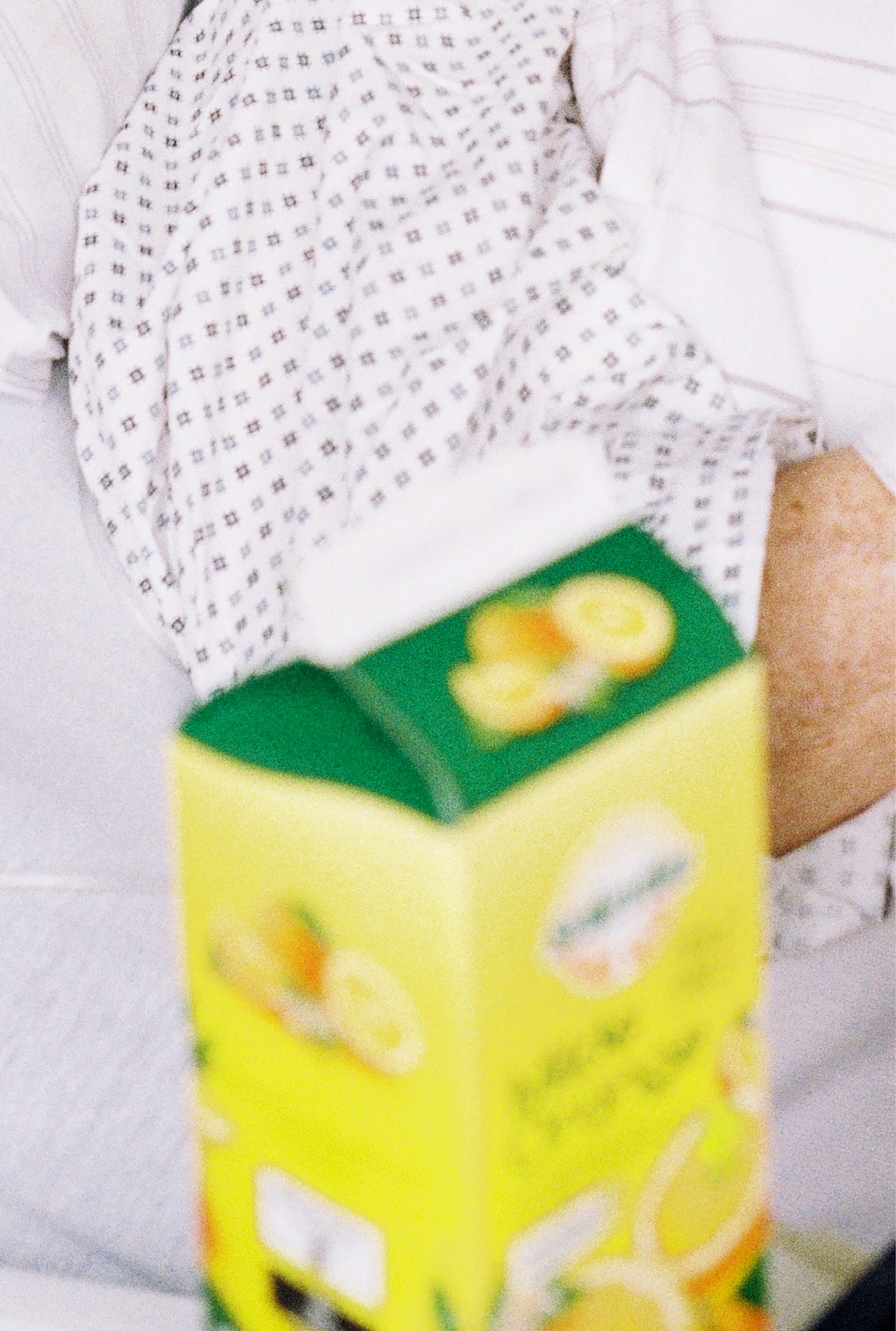
Anaïs Chabeur, Orange treat, 2024, scanned analogue photograph.
I am an artist and researcher working with film, in situ installations, performative objects and workshops. I create sensorial encounters that cultivate a quality of presence, situations in which intimacy with materiality, time, and finitude can unfold. Care is central in my work, shaping spaces of exchange between the intimate and the collective.
The text presented here was written in the context of Visions for Crossing, a two-year artistic research project developed at the Royal Academy of Fine Arts Antwerp. The project focuses on the “laying out” of the corpse, namely the acts of washing, grooming, and dressing the dead. I am drawn to the liminality of these gestures, which mark a transition between life-care and death-care and reveal death as a threshold process rather than something that happens in an instant. The research explores how tactile intimacy with the dead body might transform a relationship with grief and death.
Written with immediacy, this text documents my experience of assisting an independent funeral director. It focuses on the embodied process of preparing a body for farewell, moving between technical gestures and ordinary moments outside the morgue. Through detailed sensory observations, the text oscillates between clinical description and poetic reflection, questioning notions of neatness, intimacy, dignity, and the assumptions embedded in culturally standardized practices of death-care.
This research emerges from a longer engagement with death and dying. Since 2021, I have been a trained palliative care volunteer, accompanying terminally ill patients and their relatives. Across my practice “being in the room” functions as a methodology: a commitment to presence, slowness, and receptivity, wishing to sense through my own body what is at stake. I aim, as the feminist philosopher Nina Lykke puts it, “to approach death as a carnal, visceral and very material event and grief as a difficult and serious bodywork.”1
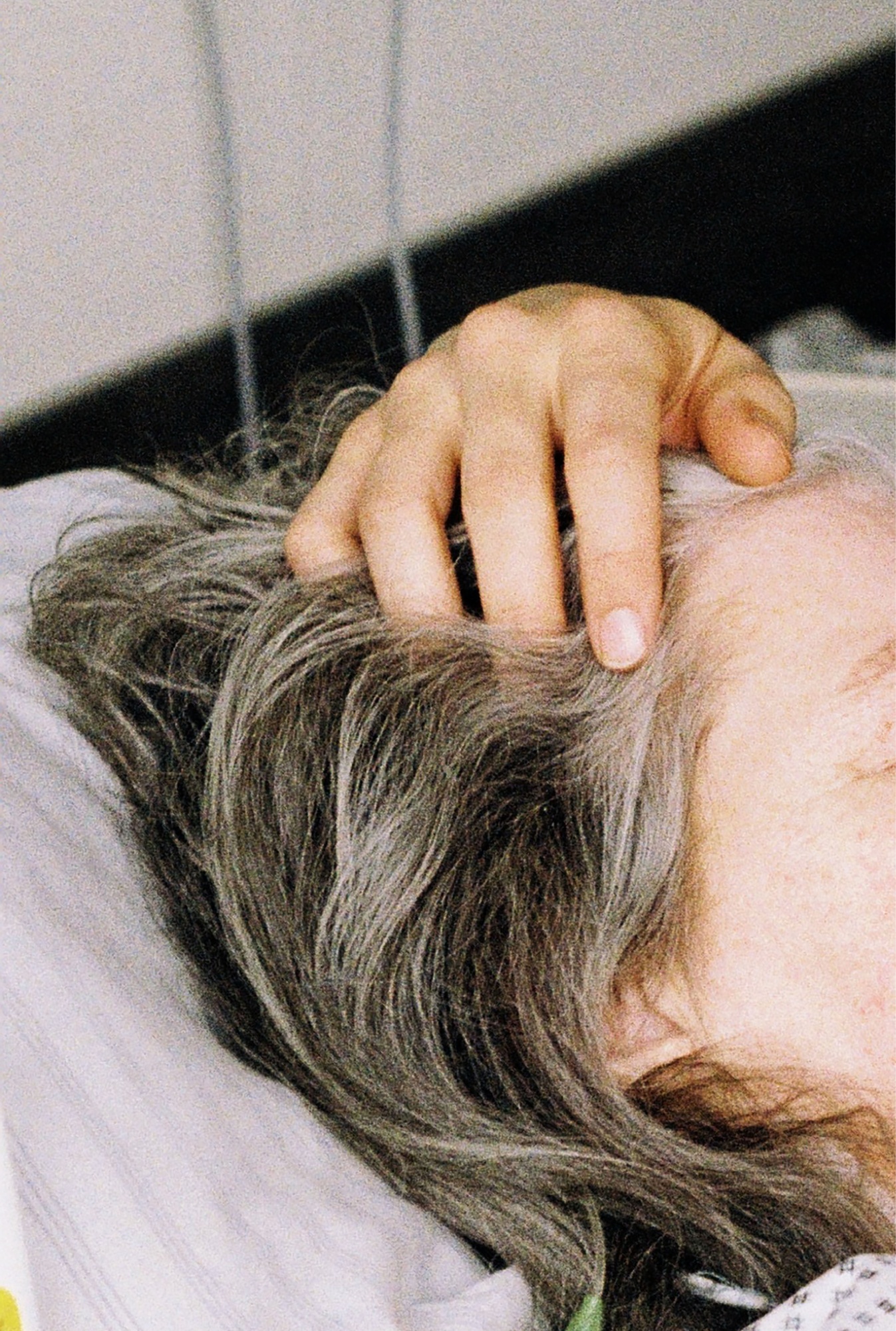
Anaïs Chabeur, Son's hand, 2024, scanned analogue photograph.
Private clinic, Brussels, April 2025
I get in Cléo’s car. She asked me to meet outside the hospital. It’s always a labyrinth to reach morgues and this one is particularly well tucked away. We go down the ramp to the third underground floor. Outside it’s hot like in July. I’m wearing open shoes. I told myself it was a bad idea, what if something – the body – leaks? But with this surge of good weather I ignore the thought. In the end, I will just bump my toe against the wheel of a metallic mortuary table, making Cléo laugh.
She is a funeral director who has agreed to let me assist as she cares for the dead. Together, we prepare them to spend a last moment with their relatives. John’s is the fourth mortuary care I have taken part in.
Cléo gets annoyed at the large hearse parked in the middle of the three dedicated mortuary spots, leaving her a narrow corridor to squeeze the car through. Cléo would like the dead to be on the ground floor, near the entrance, perhaps under another name than ‘mortuary’. We step in and my next breath is filled with a distinct hospital smell.
The staff elevator informs us:
+3 maternity
+2 general care, chapel
+1 general care
0 lobby, emergency
-1 radiology
-2 intensive care
-3 pharmacy, mortuary
Cléo opens the door to the walk-in fridge and the first thing we see is a tiny wooden coffin laid on a large table. It looks minuscule. A dreadful elevator ride between +3 and -3. Four white sheets are pulled over adult-size corpses. Cléo wheels John out.
I’m writing in the sun. In front of me, a man in his seventies is eating a mango flavoured ice cream. His yellow polo shirt matches the color of the treat he licks with a calm and focused air. I ask myself what he will look like on his mortuary table. What would we have to straighten up about him, because, without his vital energy radiating even beyond his body, all the ‘unruly’ details would jump to our attention. Details that are harder to perceive now, while he relishes the polo-coloured sorbet.
John is already dressed for his funeral, but there are stains on his shirt and jacket. The nurses seem to have tried to clean something up without much success. The timeline is blurry for me: Cléo speaks of vomit. Can that happen after death?
We brush it away and I feel satisfied. I notice John’s socks were hastily put on. Luckily Cléo seems as bothered as me, and before I have the chance to mention it she removes his shoes to carefully realign the fabric with the heels. “Doesn’t cost more,” she says.
I take care of his nails, going slowly under them with the flat and rounded tip of a metallic instrument. It reminds me of caring for Rose, my partner’s mother. Cleaning her nails at the hospital gave me something to do in the room. A small accessible way to care for her and forget about all that could not be repaired. Cléo tells me I can wipe the instrument on the sanitary sheet laid over John’s chest to protect his clothes. She tries to be mindful of waste in her practice, but the sheet has done its time and we’ll dispose of it afterwards. Unconsciously, I draw a dotted pattern on it with John’s fingernail dirt: it doesn’t feel right to wipe on the same spot. I am pleased at the sight of the organized smudges – even if slightly grossed-out.
His moustache curls up toward his nostrils. Cléo hands me scissors and I start cutting some hair. Quickly, I’m alerted by my urge to keep on pruning. To make it ‘neat’. Snip snip. But I stop myself and think: what is not ‘neat’ about this? Why the need to straighten up these wild hairs? What if I make him look less like himself? Cléo said he was a rather well-kept man but I imagine his family gathered around his body, starting to laugh at the idea of a post-mortem tickle. What if I cut away the thing that could lighten up this difficult moment? What if, by cutting away the hair, I cut away the laughter?
John is smiling a little, he has a slightly joyous expression. I can’t help but invent things about his life, his personality. I close my eyes and tense my jaw at the crackling sounds John’s cartilage makes as Cléo places cotton in his nasal cavities. We have three on each side, that’s a lot of cotton.
I move toward the shadow to continue writing. The queue for the ice cream shop goes further around the block now. The man with the mango sorbet left, to be replaced by a woman and her two boys.
John’s hands are of a light yellow colour. His skin is soft. Actually, I have no idea. I touch him with gloves. Cléo shows me how to relax his fingers. After death rigor mortis sets in, it’s basically a lactic acid build up, just like when we play sport and get cramps. After a while it is possible to regain some flexibility. “Gently pull toward you, with enough force that it moves but never forcing beyond a certain point of resistance. You know what I mean?” I reply, “Yes, I know.” I think I know. I sense it as I take John’s hand and gently pull his fingers one by one. I feel his cold arm against my belly, through my shirt and gown. This intimate contact gives me pause.
The thumb is the hardest. I have an odd perception of movement, from his finger, something else shifts, in the arm, in the chest. In my head I thank John for letting me open up his hands.
Cléo talks to me as if I am an apprentice, her intern. She would like to show me different cases. About the cartilage sounds she says, “maybe you’ll get used to it, maybe not”. I like the idea of being her apprentice.
When it’s time for the make-up, I realize I find the dead “deader” with foundation. Cléo does it very lightly, far from the cakey effect I heard about from old-school funerals. But still, I don’t want to hide the red marks, the marbling, the little orange spot that Cléo calls parcheminé, like parchment paper. That happens when the cells have been pressed and lost their water. Instead of regaining their shape, the skin is tanned. A little leather on John’s face.
I stretch after a long time arching over my notebook. At this moment a woman walks by, her back folded ninety degrees. I watch her slowly pulling a grocery cart and wonder how many more times I will be able to straighten up my spine.
Cléo pricks a curved needle through the John’s chin. She’s happy because the beard will hide the mark well – although I’ve seen her do it on a hairless chin and it seemed invisible. The thread, going through his palate and nose, will close John’s mouth. Before she brushed his teeth, the real ones and the false ones. I couldn’t believe how dirty they left it – who “they” are, I don’t know. If forcing the mouth to be closed by piercing through the skin can seem barbaric and unnecessary in a world where we don’t have a sacred purpose to do so, not cleaning someone’s denture while they are alive seems just as wrong and careless. I move from judgement to empathy, reminding myself of the nuances: sometimes, cleanliness can be form of violence too.
A father sits on the edge of a planter, pushing the lavender that bows against his back. He places his daughter next to him, she disappears behind the green shrub not yet in bloom. He is eating a violet ice cream. I recognize all the flavours because I studied them carefully while choosing mine. Eating sugar, writing about the experience. That is my routine to digest the sessions with Cléo.
The morgue worker comes to see us. Cléo asks him for a pillow. John’s head has been precariously placed on a towel; she doesn’t like it. He proposes to take a pillow from someone else in the walk-in fridge. Cléo says “no, that person won’t have a pillow then”. She folds a viewing cover, a textile used to present the dead to their relatives, and sneaks it under the sheet, propping up John’s well-combed hair. The morgue worker says he always puts a whole viewing set on the table, he finds it more ‘clean’ than the white hospital sheet. How odd, I think, what could be cleaner than a white hospital sheet? The cover is grey and pleated, with a synthetic textured fabric that tries to imitate velvet. One part goes under the head and shoulders and the other part covers the legs and belly. Cléo tells me the family is rather traditional. We try. She interlaces John’s fingers over the fabric – he was religious. We place the necklace with an orange stone that was in his body bag over his hands and John is ready to go back into the fridge.
The morgue worker used to be a cop. He is newly retired and works there three days a month, he doesn’t know much about how things work. He is surprised Cléo is so young and her own boss. I can hear pride and slight annoyance in her voice as she talks to him. Walking out, she mentions how in Flanders you don’t need to have a diploma to become an undertaker. Cléo says “and if you rely on the morguist to give you the info, it might not go well”. Cléo says she will have three other funerals this week: “the rule of series”. Usually, she does four per month.
The queue for the ice cream shop doesn’t get any shorter. I hear people exclaim “it’s a 30-minute wait, let’s do it!” I leave them to it and cycle home.
Things I didn’t write about:
How she cleaned inside his eyes and placed plastic shells under the eyelids.
How she told me there are negative signs of life and positive signs of death – glassy eyes for instance.
How I cleaned inside John’s nose with a long metallic tweezer and a ball of cotton, with the clumsy gestures of a first-timer.
How the blood inside his nose and possible vomit on his jacket made me realize I imagined a peaceful death for John but maybe that was not the case at all.
How I can’t remember what Cléo was doing when I was busy with my own task.
How we creamed his face, each massaging a cheek before she shaved him.
How I plucked hairs on top of his nose and how it took me a while to understand the request.
How she washed his hair and I washed his eyebrows.
How she showed me the “green spot” which is the first place of decomposition in the human body – lower right side of the belly.
How she showed me how to tuck in the seam of the jacket’s sleeve so you don’t see it.
How it took us two hours and a half.
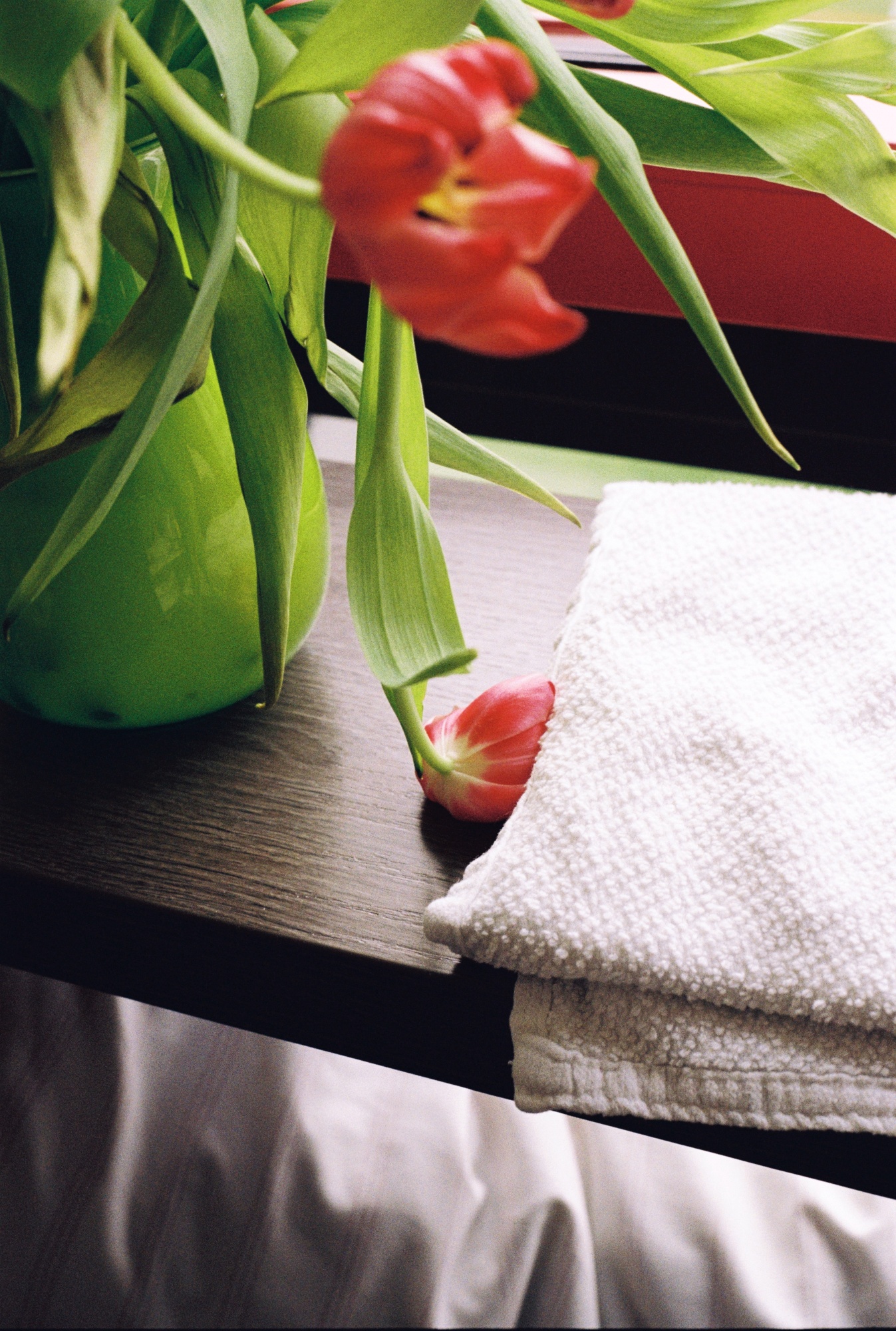
Anaïs Chabeur, Tulips in Rose’s room, 2024, scanned analogue photograph.
Acknowledgements
I should like to express my gratitude to Cléo Duponcheel (Croque Madame) for allowing me to be in the room. And to the Dead I had the chance to be touched by.
The photographs were taken in Rose's hospital room. In loving memory of her fierce refusals and surrender.
+++
Anaïs Chabeur (she/her)
graduated from La Cambre in 2016 and was a HISK laureate in 2018. She had solo shows at V2Vingt, Botanique, Atelier Arthur Rogiers (Brussels). Group shows at Krupa Art Foundation (Wrocław, PL), KZN museum (Pietermaritzburg, ZA) Brussels Generation, S.M.A.K. (Ghent), De Singel (Antwerp), Wiels (Brussels), CIAP (Hasselt). She was a laureate of the SOFAM grant in 2024 and the Science, Transdisciplinarity, Artistic Research in Transition grant in 2025.
Noten
- Lykke, Nina. Vibrant Death: A Posthuman Phenomenology of Mourning. London, Bloomsbury Publishing, 2021. ISBN 9781350149731. ↩
Meer in dit thema
Achter de façade. Een exploratie van de verschillende betekenislagen in een orgelperformance
Francesca Ajossa, Kurt Bertels
Meer uit dit nummer
The state of collective creativity within the site and upon arrival. Artists’ perspectives on the Liminal Lab project
Marija Griniuk
Double or nothing. A duet on mothering and artistic research
Mariske Broeckmeyer, Eva Moulaert
Meer in deze rubriek

Creativiteit en samenwerking in modeopleidingen. Talen, talenten en methodes binnen samenwerkend leren
Andrea Cammarosano
City in Reverse. Verven op plastiek
Karen Vermeren
Precipitaten*
Robbert&Frank Frank&Robbert